Tanya Tanna (pictured centre), 56, from South Ruislip, had the operation in January.
A team of surgeons from Hillingdon Hospital in West London, and the Royal Free Hospital (RFH) in Hampstead, performed the operation.
They took a blood vessel from Tanya’s abdomen and used it, and surrounding tissue, to build a new breast.
Ordinarily, in this type of reconstruction, known as DIEP flap surgery, surgeons are required to make a 12cm incision in a patient’s abdominal wall to harvest the blood vessels for a ‘flap’ of tissue, which is used to reconstruct the breast after a mastectomy. In this case, the team used keyhole surgery, which meant only a 2cm incision was needed. The minimally invasive TEP DIEP surgery means instead of requiring up to five days to recover, patients can return home within two to three days.
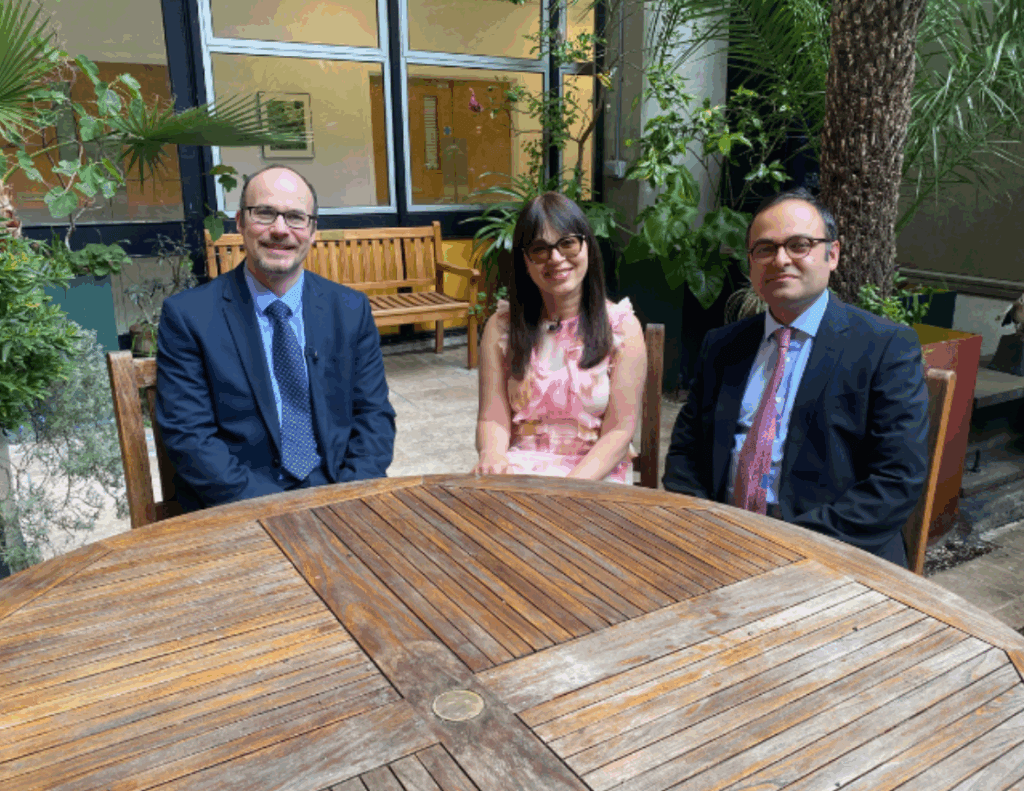
The idea for this innovative approach came about through collaboration between Dariush Nikkhah, a consultant plastic surgeon at the RFH, (pictured above right) and Alistair Slesser, a consultant colorectal surgeon at Hillingdon (pictured above left).
The team now wants to refine the process before performing the surgery using a robotic surgical system. They are hailing it as a significant leap forward in minimally invasive microscopic breast reconstruction.
The Hillingdon surgeons freed the blood vessel from the tissue. The RFH team – Mr Nikkhah, Prof Afshin Mosahebi-Mohammadi, Stephen Hamilton and Shadi Ghali – then used it to build a breast with a good blood supply.
Tanya had a mastectomy in 2020 following a breast cancer diagnosis, but the pandemic and the backlog of other patients meant she faced a long wait for reconstructive surgery.



Mr Slesser said: “I am proud to have performed this surgery with my team. This is a huge step for Hillingdon Hospital.”
Mr Nikkhah said: “The Royal Free Hospital is now one of the few centres in the world which can offer this type of minimal access surgery, which could reduce problems such as hernias and bulges and shorten inpatient stays. It’s more difficult to perform, but it makes the recovery better for our patients. We will aim to progress to perform the operation robotically in the future.”
Mr Slesser added: “I am immensely grateful to my colorectal colleagues at Hillingdon who have helped me over the years develop the skills required for such a complex procedure. This was about teamwork, and I am glad that, with the plastic surgeons, we will be able to continue to innovate and provide this type of surgery at Hillingdon in the future for our breast cancer patients.”
A day after the operation at the RFH to reconstruct her breast, Tanya was on her feet and able to walk around the ward without discomfort, something her nurses told her they had never seen before.
Tanya said: “I thought it was normal, but they were looking at me like it was some kind of miracle!”
She added: “Mr Nikkhah and the team want to reduce the suffering of women who have already gone through so much. This new operation has the ability to give us our independence back much sooner and that’s a huge boost for mental and physical wellbeing.
“I decided I wanted to do this for all the women who will come after me. For more than four years my feminine energy was dimmed and now I can look at myself and feel ‘Yes, I am whole again!’
“I feel so privileged to be able to share my story and tell the world about these incredibly talented surgeons.”