‘The Arrogant Ape’: A takedown of the human supremacy complex

Untitled (1200 x 628 px) (Facebook Post)

In the grand story of evolution, the crowning human distinction is our big brain. But our large heads have been slow to recognize a less admirable trait of Homo sapiens — self-centeredness.

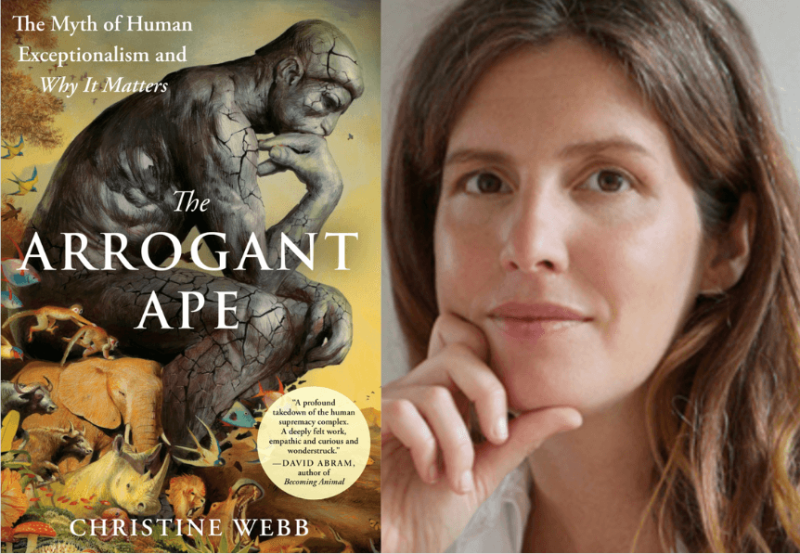
The human presumption of superiority and entitlement to exploit the natural world is deeply rooted in our religious, cultural, and scientific traditions — and now we are witnessing the consequences, said Christine Webb, a former Harvard lecturer and author of “The Arrogant Ape: The Myth of Human Exceptionalism and Why It Matters.”

Follow the latest news and policy debates on sustainable agriculture, biomedicine, and other ‘disruptive’ innovations. Subscribe to our newsletter.

The central thesis of her book is that anthropocentrism — or what Webb calls the “human superiority complex” — has pushed our planet to environmental crises such as mass extinctions, rising sea levels, forest fires, and more.

“I’ve come to think of the arrogant ape not as a species, or a culture, or even an individual, but as a tragic protagonist in a Greek drama, blinded by their own hubris,” said Webb. “This unfortunate and dangerous way of viewing our world is a brainwashing of such major proportions that many people remain entirely unaware of it.”


This is an excerpt. Read the original post here

{{ reviewsTotal }}{{ options.labels.singularReviewCountLabel }}
{{ reviewsTotal }}{{ options.labels.pluralReviewCountLabel }}
{{ options.labels.newReviewButton }}
{{ userData.canReview.message }}

Related Articles

Infographic: Global regulatory and health research agencies on whether glyphosate causes cancer

Infographic: Global regulatory and health research agencies on whether glyphosate causes cancer

Does glyphosate—the world's most heavily-used herbicide—pose serious harm to humans? Is it carcinogenic? Those issues are of both legal and ...

Most Popular

Screenshot 2025-07-30 at 10.48
Can gene editing eliminate Down syndrome? Scientists have done it in lab-grown cells
ChatGPT Image May 26, 2026, 08_42_17 AM (1)
Viewpoint: Greenpeace and poison: How environmental advocacy groups rely on compliant (and often ignorant) journalists to spread disinformation and spark litigation
ChatGPT Image May 26, 2026, 08_21_36 AM
Limiting gender affirming interventions: Trump administration targets Texas even though it already bans youth access
Screenshot-2026-05-28-at-1.36.28-PM
Viewpoint: Can mRNA research survive the Trump administration?
Screenshot-2026-06-03-at-1.24.46-PM
Challenging anti-GMO disinformation: Why genetically-tweaked crops offer bushels of benefits
ChatGPT-Image-Jun-2-2026-03_04_17-PM
Viewpoint: Why the hyper-promoted doping ‘enhanced games’ pseudo Olympics flopped
ChatGPT-Image-May-26-2026-07_51_21-AM-2
Viewpoint: There are more than 1,000 chemicals in a cup of coffee—including many substances that can cause cancer. Why isn’t it banned?
Picture1
Sounds we can’t hear — the hidden planetary signals behind science, fear, and misinformation
ChatGPT-Image-Jun-3-2026-12_33_40-PM-2-1
Viewpoint—The end of ‘ivory tower science’: What does that even mean, and what comes next
ChatGPT-Image-Jun-2-2026-11_39_58-AM
Viewpoint: Who is RFK, Jr.’s newly-appointed CDC senior counselor, Sara Brenner — Vaccine skeptic and self-proclaimed “MAHA mom”

ChatGPT-Image-Mar-10-2026-01_39_01-PM
Viewpoint—“Miracle molecule” debunked: Why acemannan supplements don’t work
ChatGPT-Image-Jun-4-2026-01_27_58-PM
Viewpoint—N.A.D.+: Why Gwenyth Paltrow’s heralded anti-aging supplement doesn’t work
Screenshot-2026-04-14-at-11.11.06-AM
‘Turbo cancer’ or mRNA cancer cure? Strategies to counter misinformation
glp menu logo outlined

Get news on human & agricultural genetics and biotechnology delivered to your inbox.