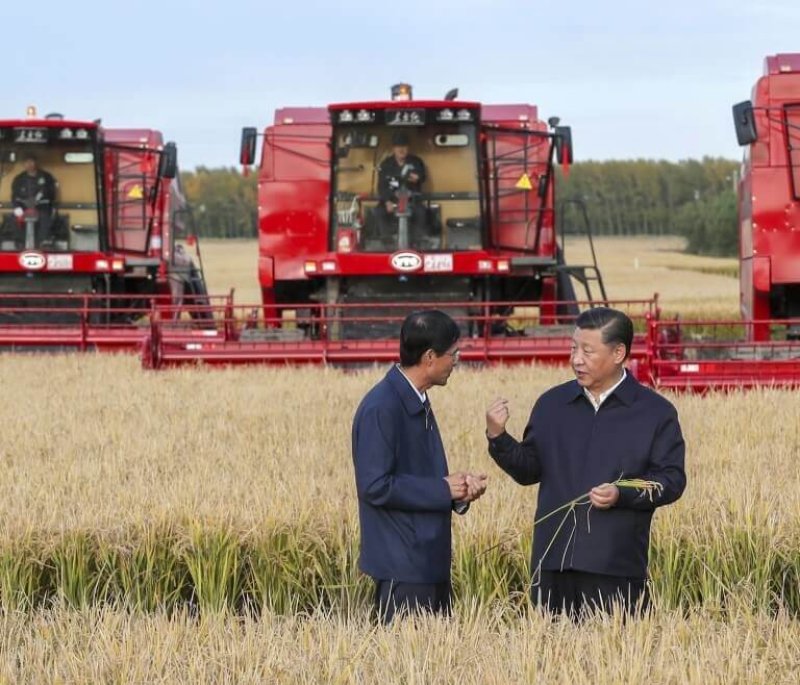
As China doubles down rejecting U.S. exports of soybeans, food security takes central focus in next 5-year agricultural plan 

Credit: Xinhua
Credit: Xinhua

For decades, one of the most common mantras from China’s leadership has been to “firmly hold the rice bowls of the Chinese people in our own hands” — a principle that continues to shape the Communist Party’s five-year plans.

In the current blueprint, the 14th five-year plan (2021-2025), policymakers have prioritised food security, alongside energy and finance, as one of three areas to enhance national economic security.

China has stabilised and elevated grain production to record levels over the past five years through heavy investments in agricultural technology and fierce protection of farmland, according to official figures.

Mis- and disinformation are distorting science and public policy. Subscribe to our Daily and Weekly Digests for incisive coverage of ‘disruptive’ innovations in AI, agricultural biotechnology, food, chemicals, nuclear energy, vaccines, and other disruptive innovations.

China’s animal feed industry remains heavily dependent on imported soybeans but has yet to make any bulk orders from this season’s U.S. crop. Washington, meanwhile, faces mounting pressure from American farmers to quickly strike a trade deal that would resume normal sales.
Chinese agricultural scientists have already developed several promising varieties of higher-protein corn to replace soybeans in animal feed as part of Beijing’s efforts to reduce its reliance on imports, according to the president of the Huazhong Agricultural University.


This is an excerpt. Read the original post here

Related Articles

Infographic: Global regulatory and health research agencies on whether glyphosate causes cancer

Infographic: Global regulatory and health research agencies on whether glyphosate causes cancer

Does glyphosate—the world's most heavily-used herbicide—pose serious harm to humans? Is it carcinogenic? Those issues are of both legal and ...

Most Popular

ChatGPT-Image-Sep-17-2026-12_28_43-PM
Vitamin D, omega-3 fish oil and glucosamine supplements could cause brain damage 
ChatGPT-Image-Mar-10-2026-01_39_01-PM
Viewpoint—“Miracle molecule” debunked: Why acemannan supplements don’t work
Screenshot-2026-09-10-at-12.20.19-PM
'Jet fuel didn't melt the steel': 9/11 conspiracy theories debunked
ChatGPT-Image-Sep-17-2026-10_17_15-AM
Viewpoint: Why are the less intelligent more likely to be conservative—and smarter people more socially liberal?
Screenshot-2026-09-16-at-12.07.47-PM
The heated debate over trans athletes in the WNBA
Screenshot-2026-08-12-at-11.31.46-AM
AI is helping develop new vaccines
ChatGPT-Image-Sep-9-2026-02_48_24-PM
Viewpoint: Trump-RFK Jr. report on “Gender Ideology & Left-wing Ideology’ targets LGBTQ community—and science
Screenshot-2026-09-11-at-2.26.23-PM
Newly approved GMO chestnut trees planted across from the White House are stirring debate
ChatGPT-Image-Sep-15-2026-12_15_00-PM
Viewpoint: Women, depression and empathy: Explaining the gender gap in views about child-murderer Lindsay Clancy
ChatGPT-Image-Sep-15-2026-11_36_23-AM
Doomsday cult? Why we should be suspicious of end-of-the-world claims
Screenshot-2026-09-17-at-10.24.54-AM
Viewpoint: Dubious environmental fears: Why the AI buildout is critical to America’s ecological future
Screenshot 2026-09-11 at 12.39
Child-monitoring apps: When the cure is worse than the harm—and how the technology could be tweaked
glp menu logo outlined

Get news on human & agricultural genetics and biotechnology delivered to your inbox.