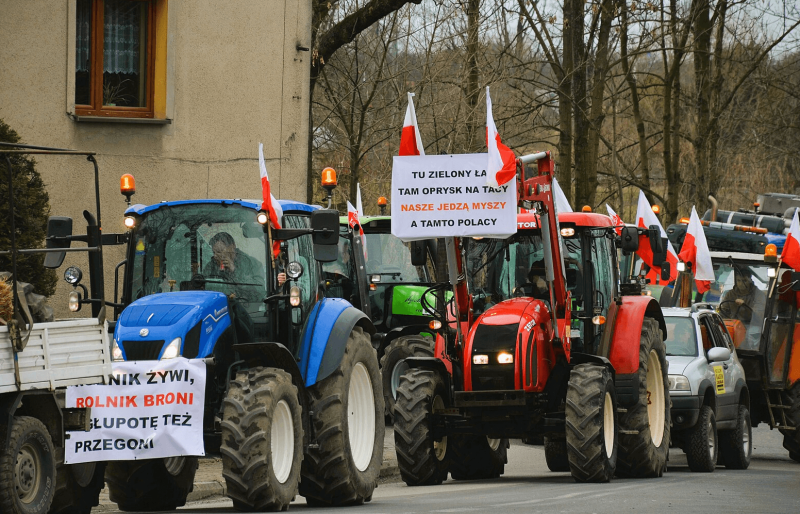
Viewpoint: European farmers protest the nightmare of the Green Deal and other science-rejectionist EU agricultural regulations

Credit: Creative Commons

Over the past two years, farmers throughout Europe have mobilized on a scale that should dominate news headlines.

European farmers are not protesting against environmental responsibility. Many already apply methods of balance preservation, reduced inputs, limited grazing, cover cropping, and soil-enhancing methods. What they reject are regulations detached from reality.

Under policies guided by the European Union and initiatives such as the European Green Deal, farmers face rules that arbitrarily impose nitrogen limits per hectare, treat synthetic nitrogen and organic nitrogen as the same, require land to be removed from production regardless of local context, and demand extensive reporting on arable land and compliance that small and medium-sized farms cannot sustain.

This is no longer about practices. There are regenerative agriculture farmers, without chemicals, with integrated livestock, biologically active soil, whose crops are still regulated to death.

Follow the latest news and policy debates on sustainable agriculture, biomedicine, and other ‘disruptive’ innovations. Subscribe to our newsletter.

When agriculture becomes impossible, land changes hands. Small and medium-sized farms close first. Family land is sold. Concentration accelerates. Institutional capital enters. Farmers become tenants, or disappear entirely. European farmers understand this. That is why they are angry.


This is an excerpt. Read the original post here

{{ reviewsTotal }}{{ options.labels.singularReviewCountLabel }}
{{ reviewsTotal }}{{ options.labels.pluralReviewCountLabel }}
{{ options.labels.newReviewButton }}
{{ userData.canReview.message }}

Related Articles

Infographic: Global regulatory and health research agencies on whether glyphosate causes cancer

Infographic: Global regulatory and health research agencies on whether glyphosate causes cancer

Does glyphosate—the world's most heavily-used herbicide—pose serious harm to humans? Is it carcinogenic? Those issues are of both legal and ...

Most Popular

ChatGPT-Image-May-7-2026-12_16_37-PM-2
Viewpoint: Are cancer rates ‘skyrocketing’ as RFK, Jr. and MAHA claim? The evidence says mostly the opposite
Screenshot-2026-04-13-at-1.39.26-PM
Viewpoint: ‘Safer for children?’ Stonyfield yogurt under fire for deceptive organic marketing
Screenshot-2026-04-22-at-10.46.29-AM
Viewpoint: How to counter science disinformation? Science journalist offers 12 practical tips
Picture1-14
When superbugs threaten vulnerable children: Can AI help solve antibiotic resistance?
Screenshot-2026-04-23-at-11.00.36-AM
Regulators' dilemma: Thalidomide, Metformin, and the cost of getting drug approvals wrong
Picture1-1
Cooling the planet with balloons: Could a geoengineering gamble slow global warming?
bigstock opioids on chalkboard with rol
GLP podcast: 'Safe injection sites': enabling drug addiction or saving lives?
ChatGPT-Image-May-12-2026-08_39_41-PM
GLP podcast: Big Pharma, Big Ag, Big Food—health harming industries or life-saving innovators?

Sorry. No data so far.

glp menu logo outlined

Get news on human & agricultural genetics and biotechnology delivered to your inbox.