
Everything around us seems to be changing at breakneck speed. Twenty years ago, smartphones were niche products. Twenty years before that, computers were clunky behemoths. Forty years before that, far more Americans traveled by train than by plane. Forty years before that, cars were just starting to supplant horses.
Over the past couple millennia, a mere blip of Earth’s history, humans have manifestly reshaped the planet – from the physical to the biological. The ground, the oceans, the air, the flora, the fauna – nothing is as it was. And yet, despite this radical transformation, it can seem like we ourselves haven’t changed much at all…
But that’s an illusion.
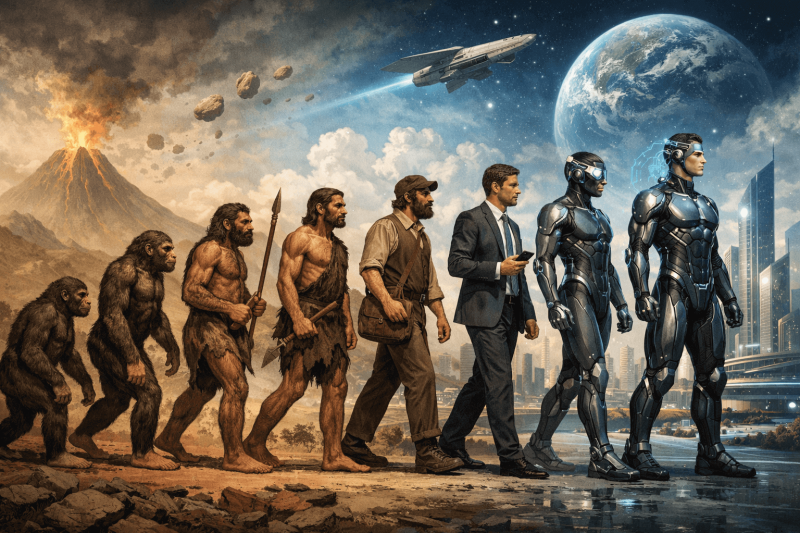
“Humans are still evolving,” Dr. Scott Solomon, an Associate Teaching Professor at Rice University specializing in ecology, evolutionary biology, and scientific communication, wrote in his forthcoming book Becoming Martian: How Living in Space Will Change Our Bodies and Minds.
Sure, over the last 10,000 or so years, our physical alterations have been relatively muted compared to the changes seen in society and on our planet. Essentially, we’ve shrunk a bit, and our jaws have weakened. But even a little change is still change, and it begs a question: “In the far-flung future, what will happen to us, evolutionarily speaking?”
It’s a question that Solomon considered in his 2016 book, Future Humans: Inside the Science of Our Continuing Evolution. He surmised that our ultimate evolutionary fate could follow one of three basic trajectories.
The first is a standstill – our species will remain roughly as it currently is. But Solomon thinks this is unlikely.
“So far, in the 3.7-billion-year history of life on Earth this has not happened to a single species… All species change, some faster than others, but there is no species alive today that has not undergone changes throughout its existence.”
Our second possible fate is extinction. Though the chances of this may seem remote to our brains biased to optimism, the odds are far higher than any of us would like to admit. Extinction, after all, is the norm on Earth – 99 percent of all the species that have ever lived ultimately died out.


“There are an uncomfortably high number of plausible ways this could happen,” Solomon wrote, “including another giant asteroid impact, a super-volcano eruption, nuclear war, catastrophic climate change, the spread of a devastating pandemic, or our sun exploding in a supernova.”
The third possible fate for humanity, which Solomon explored in depth in Becoming Martian, is that at least part of humanity will evolve into a different species. A decade ago, Solomon deemed this path improbable. Humans today are so interconnected that no population could be siloed enough to speciate.
But now, he thinks the chances have risen considerably. Why? Because the world’s richest men are plowing their hefty fortunes into making humans interplanetary. What once seemed science fiction is growing closer to reality with the launch of every large rocket. If a group of humans could colonize another world – Mars, for example – and cease to breed with Earthlings altogether, it may take only ten generations before they grow genetically distinct enough to no longer be considered humans, but rather Martians.
“If we do manage to spread out and survive on planets scattered across our solar system and others, we should expect to evolve, adapt, and speciate everywhere we go,” Solomon wrote.
Like the cornucopia of different creatures inhabiting Charles Darwin’s beloved Galapagos Islands, humans dwelling on different bodies within the solar system could similarly evolve “endless forms most beautiful and most wonderful.”
A version of this article was originally posted at RealClearScience and has been reposted here with permission. Any reposting should credit the original author and provide links to both the GLP and the original article. Find RealClearScience on X @RCScience