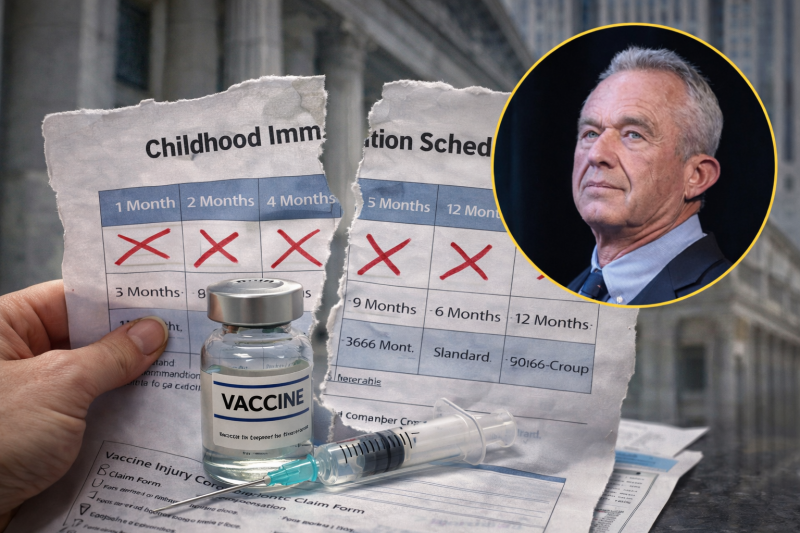
For nearly four decades, Americans who believe they have been harmed by a vaccine have had access to a little-known no-fault legal process called the Vaccine Injury Compensation Program (VICP) — often referred to simply as the vaccine court.
Health and Human Services Secretary Robert F. Kennedy, Jr. — a longtime critic of the system — has vowed to “revolutionize” or “fix” it, calling the program “biased,” unfair, and punitive toward claimants. But transforming it wholesale would be far more complex — and potentially far more damaging to public health — than he seems to appreciate. Perhaps that is precisely the point — opening the door to the kind of spurious vaccine-causes-injury suits and large settlements that were once his stock-in-trade as a tort lawyer.
A four-decade-old solution to a public-health crisis
The vaccine court was created by Congress in 1986 amid a crisis in the nation’s vaccine supply. At the time, lawsuits over side effects from the older whooping cough vaccine, known as whole-cell pertussis, had driven several manufacturers out of the market, threatening shortages and risking the resurgence of deadly diseases.
To stabilize the situation, Congress passed the National Childhood Vaccine Injury Act, which shielded vaccine makers from most lawsuits and established a specific process within the U.S. Court of Federal Claims to handle vaccine injury claims. Instead of suing manufacturers directly, petitioners could bring cases before court-appointed adjudicators known as Special Masters.
The law also created a dedicated trust fund, financed by a 75-cent excise tax on every vaccine dose sold — to pay both compensation and attorneys’ fees. Some injuries with well-established causal links, such as certain allergic reactions or shoulder injuries from injection, qualify for automatic compensation. Others, where the science is disputed, are decided on the basis of written submissions or go through evidentiary hearings involving physicians, attorneys, and medical experts.
This system has long been praised as an ingenious compromise — a humane and science-based way to deliver justice for the small number of people genuinely harmed by vaccines, while maintaining confidence in the nation’s immunization program.
A system in need of modernization. But by Kennedy?
Still, much about the vaccine court reflects 1980s realities, not 21st-century ones. The number of Special Masters remains capped at eight, even as the caseload has surged with the inclusion of new vaccines. The $250,000 cap on damages for pain and suffering — set nearly forty years ago — has never been adjusted for inflation. And the three-year statute of limitations has proved too short for many petitioners who fail to file in time.
The program’s scope also remains uneven and at times arbitrary. Originally limited to childhood vaccines, it was only recently expanded to include shots given during pregnancy. Adult vaccines, such as shingles, are still excluded. Claims related to COVID-19 vaccines are routed through a separate emergency countermeasures system that has been widely criticized as opaque and inefficient.
Many experts across party lines support modest, bipartisan reforms to address these issues. Kennedy himself has mentioned several of these ideas.
What remains unclear is what Kennedy actually intends to do. His decades-long record on vaccines has been rife with dishonesty, deception, and disinformation. His broad promise to “revolutionize” the vaccine court could mean anything from modest modernization to total dismantling.
The first path — pursuing incremental, congressionally approved reforms — would be the least disruptive and most achievable. But Kennedy’s rhetoric sometimes suggests more radical ambitions. Some of his statements imply a desire to overturn past vaccine-court rulings or even reopen long-settled questions about vaccines and autism.
Kennedy’s involvement in this system is uniquely perilous because he is not merely a critic of bureaucratic inefficiency. He is not a reformer trying to strengthen public-health infrastructure. Rather, he has spent years portraying regulators, scientists, and the courts as guardians of a corrupt alliance shielding manufacturers from accountability, while recycling discredited claims about autism and chronic illness, blurring the line between policy skepticism and medical disinformation. Now he is trying to reshape the very machinery meant to preserve confidence in vaccines, possibly giving pseudoscience the sheen of official reform.
Autism precedent
From 2002 to 2010, the vaccine court oversaw one of its largest and most complex legal proceedings: the Omnibus Autism Proceedings, which examined whether vaccines could cause autism. After eight years, 50 expert reports, 939 medical articles, and testimony from 28 scientific experts, the court concluded decisively that autism is not a vaccine injury.
These findings were and remain consistent with the global scientific consensus. Yet Kennedy has continued to challenge them, asserting, without evidence (as is his habit), that the Special Masters “prioritize the solvency” of the system over justice for claimants.


He has no direct authority to remove or replace the Special Masters, who are appointed for four-year terms by judges serving 15-year terms on the Court of Federal Claims. But he could, in theory, try to revise the official list of recognized vaccine injuries to include autism or other conditions — a complex administrative process requiring public comment, scientific justification, and credible evidence. Doing so without credible evidence would trigger legal challenges and near-universal opposition from medical and public-health organizations.
Kennedy’s setback in the courts
Kennedy has also been trying to undermine the vaccine court indirectly by ousting all 17 members of the Advisory Committee on Immunization Practices (ACIP), the federal advisory panel whose recommendations help to determine which vaccines are routinely recommended and widely covered. Because those recommendations shape the broader legal and policy framework around vaccination, control of ACIP offers a back-door route to weakening the system.
But that route has been blocked, at least for the moment. Just last week, ruling on a lawsuit brought by the American Academy of Pediatrics and other medical groups against the Department of Health and Human Services, a federal judge rejected Kennedy’s recent overhaul of the nation’s childhood vaccine schedule and stayed his handpicked appointments to the ACIP. The panel had already made a number of widely condemned changes, including lowering the number of routine (“universal”) vaccinations recommended, such as the newborn hepatitis B vaccination, and targeted thimerosal-containing flu shots. They also recommended some vaccines only to people “at high risk” and moved some vaccines to “shared clinical decision-making,” a euphemism for “maybe you don’t need it.”
Reports suggested that rather than appeal the decision, Kennedy had decided to try to circumvent it by dissolving the panel altogether — and then simply appointing a new one — a move that would almost certainly have triggered another extended court fight. After immediate blowback, ACIP vice chair (and ardent anti-vaxxer) Dr. Robert Malone walked it back, claiming there had been a “miscommunication.” Kennedy remained silent.
Will Congress stumble into undoing compensation for vaccine injuries
What happens next is anyone’s guess, but Kennedy’s recent actions reveal the scale of his ambition, and there are other ways he could achieve his goals: He could still seek to weaken liability protections for manufacturers and reopen the door to disruptive civil litigation. Congress will be key. Kennedy is supporting legislation to recreate precisely the scenario Congress sought to avoid in 1986, when it created the vaccine court as a no-fault alternative to civil litigation after lawsuits against manufacturers destabilized vaccine development and supply.
If the Trump administration throws its support behind Kennedy’s plan, it could turn vaccine-injury claims into high-stakes jury trials, requiring plaintiffs to meet stricter standards of evidence and to face formidable corporate defendants. Such a shift could vastly increase litigation, destabilize vaccine manufacturing, raise prices, discourage innovation, and undermine public trust.
Stakes for public health
The greatest danger is institutional. As a Cabinet-level official, Kennedy has been able to elevate ideas that once occupied the fringe by wrapping them in the authority of the federal government. That shift has already eroded trust in vaccines, and it could encourage litigation built on junk science and fray the social contract that keeps herd immunity intact. Kennedy himself poses a threat larger than any single misguided reform effort: He embodies the fusion of populist grievance, anti-vaccine activism, and conspiracy-minded public health politics — a volatile mix capable of unraveling decades of progress in a single news cycle.
The VICP is an ingenious hybrid of science, law, and social policy that has compensated thousands of people while helping to stabilize both the vaccine market and public confidence in immunization. Reform is needed — more Special Masters, higher caps on compensation, broader coverage, and simpler filing rules — but radical, unjustifiable changes could undo decades of stability and progress.
As Kennedy proceeds with his radical agenda, he will face resistance not only from pharmaceutical companies but also from physicians, patient advocates, and public-health professionals who understand how much is at stake.
Reforming the vaccine court requires careful evolution, not revolution. If Kennedy and his allies succeed in tearing it down rather than improving it, the result would likely be a return to the chaotic, liability crisis of the 1980s, when waves of lawsuits drove manufacturers from the market, threatened vaccine supply, and helped prompt Congress to create the vaccine court in the first place.
Henry I. Miller, a physician and molecular biologist, is the Glenn Swogger Distinguished Scholar at the Science Literacy Project. A former research virologist, he was the founding director of the FDA’s Office of Biotechnology. Find Henry on his website: henrymillermd.org