
Some 10,109 doctoral-trained experts in science and related fields left their jobs last year as President Donald Trump dramatically shrank the overall federal workforce. That exodus was only 3% of the 335,192 federal workers who exited last year but represents 14% of the total number of Ph.D.s in science, technology, engineering, and math (STEM) or health fields employed at the end of 2024 as then-President Joe Biden prepared to leave office.
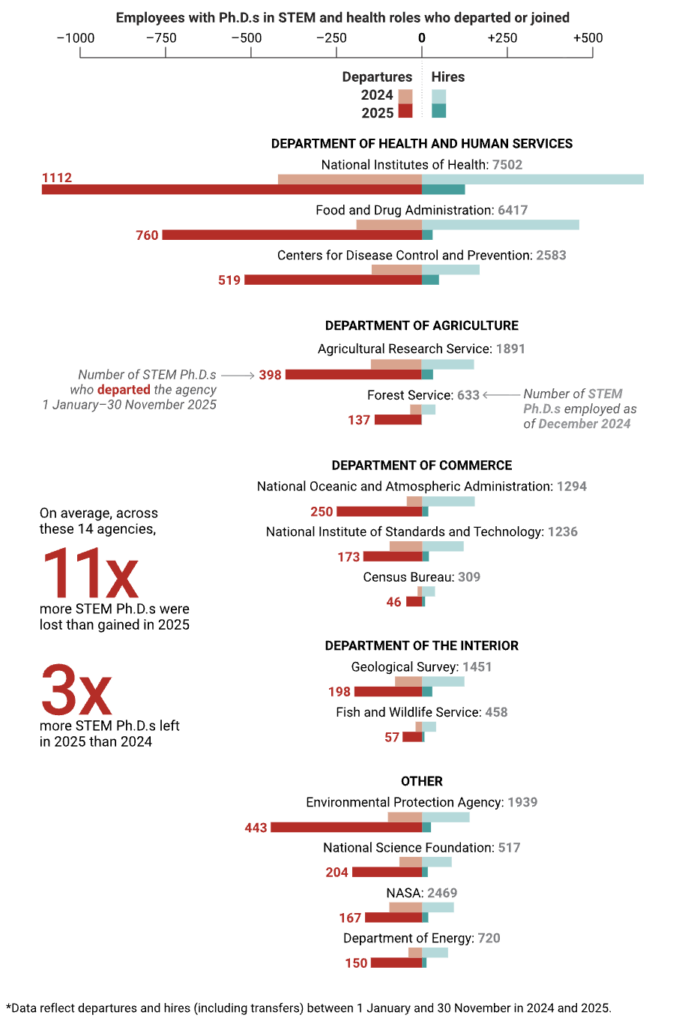
The numbers come from employment data posted earlier this month by the White House Office of Personnel Management (OPM). At 14 research agencies Science examined in detail, departures outnumbered new hires last year by a ratio of 11 to one, resulting in a net loss of 4224 STEM Ph.D.s. The graphs that follow show the impact is particularly striking at such scientist-rich agencies as the National Science Foundation (NSF). But across the government, these departing Ph.D.s took with them a wealth of subject matter expertise and knowledge about how the agencies operate.

Losses surged in 2025
Every one of the 14 agencies that Science analyzed lost far more STEM Ph.D.s in 2025 than in 2024, before Trump took office. The National Institutes of Health tops the list with more than 1100 departures, compared with 421 in 2024. On average, the 14 agencies lost roughly three times more of these experts in 2025 than in 2024, with the highest percent increase in departures at the National Oceanic and Atmospheric Administration, the Environmental Protection Agency (EPA), and the U.S. Forest Service (USFS). At the same time, the number of STEM Ph.D.s hired at every agency was dramatically lower last year than in 2024.
Where the losses were greatest
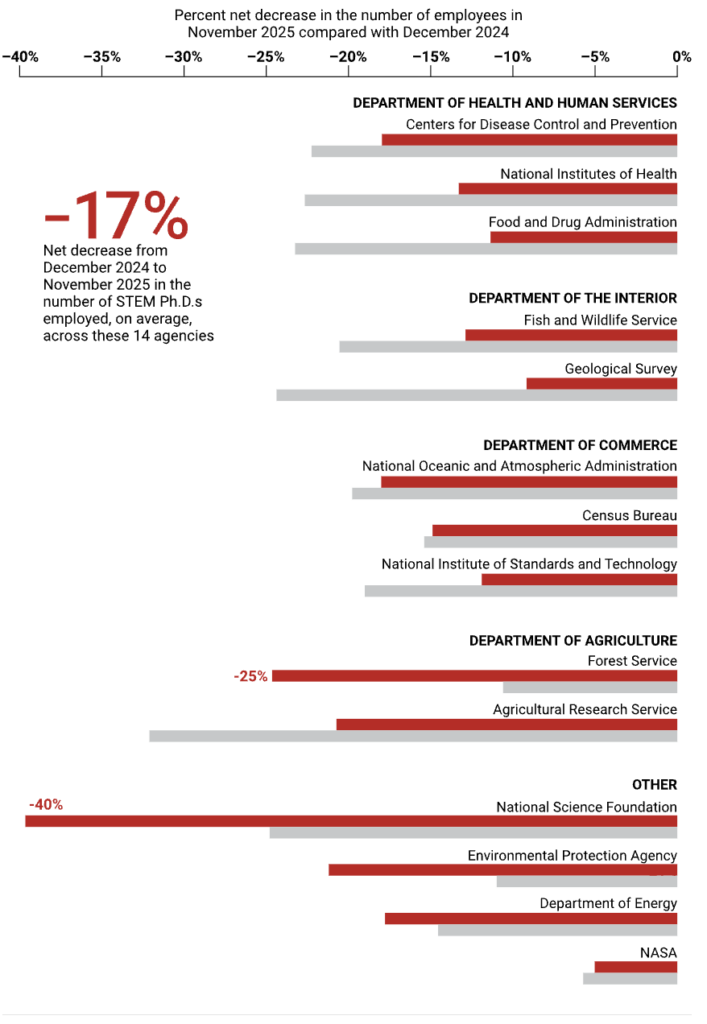
Although the payroll for both STEM Ph.D.s (red bars) and other employees (gray bars) shrank across the agencies that Science examined, research roles at four were hit particularly hard. NSF, EPA, the Department of Energy, and USFS all lost a greater percentage of that highly trained workforce than other workers. At NSF, the net reduction of 205 STEM Ph.D.s between 1 January and 30 November constituted 40% of its total pre-Trump Ph.D. workforce of 517, by far the largest percentage at any agency. STEM Ph.D.s also make up a larger percentage of the total workforce at NSF than at any other agency—some 30% in the waning days of the Biden administration. The losses reduced that percentage to 26% by 30 November 2025.
Why they left
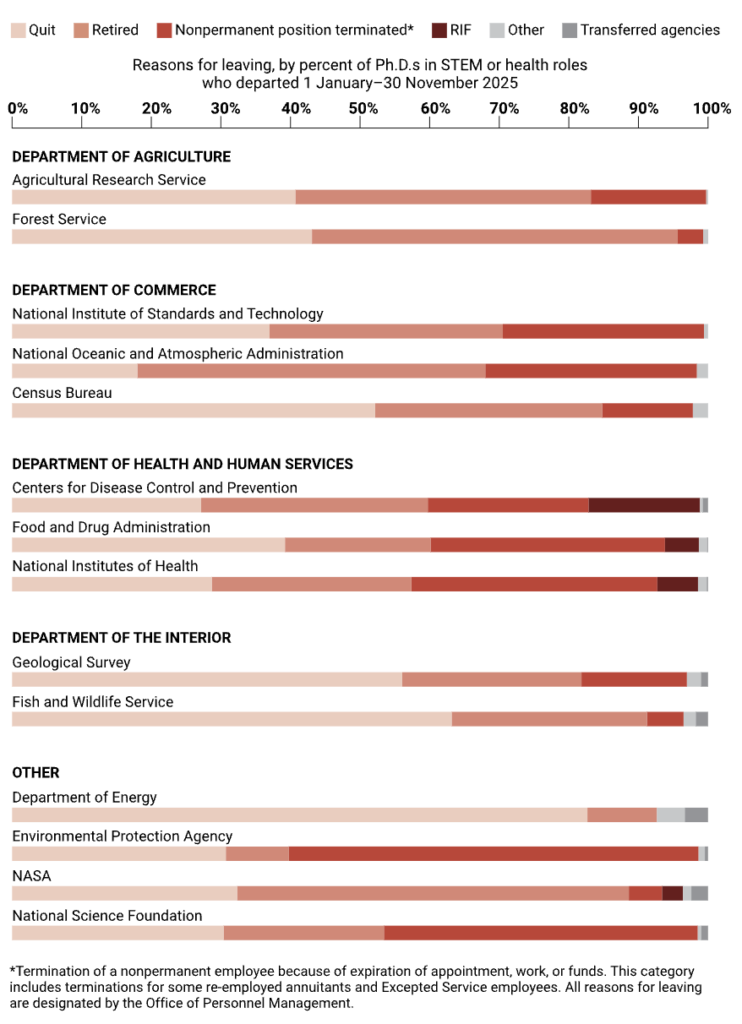
Science’s analysis found that reductions in force, or RIFs, accounted for relatively few departures in 2025. Only at the Centers for Disease Control and Prevention, where 16% of the 519 STEM Ph.D.s who left last year got pink RIF slips, did the percentage exceed 6%, and some agencies reported no STEM Ph.D. RIFs in 2025.



At most agencies, the most common reasons for departures were retirements and quitting. Although OPM classifies many of these as voluntary, outside forces including the fear of being fired, the lure of buyout offers, or a profound disagreement with Trump policies, likely influenced many decisions to leave.
Many Ph.D.s departed because their position was terminated. At NSF, 45% of the 204 STEM Ph.D.s who left last year were rotators—academics on leave from their university to work for a few years at the agency. Last year, NSF eliminated three-quarters of those positions.
A version of this article was originally posted at Science and is reposted here. Any reposting should credit both the GLP and original article. Find Science on X @ScienceMagazine.