The famous Orange Bowl may still host an annual New Year’s Day football game after 91 years in celebration of one of Florida’s most vital industries — but the appellation has become largely symbolic.
In May, Florida citrus growers are usually squeezing out the last late orange and grapefruit harvest of the year. It used to be a time that marks the celebration of another successful bounty. This year, as in recent years, it’s more like a wake. Instead of counting fruit, farmers are fretting over how many seasons they can survive their losing battle with citrus-greening disease as regulators ponder whether to approve the only solution that can save the once-booming industry from near-total collapse.
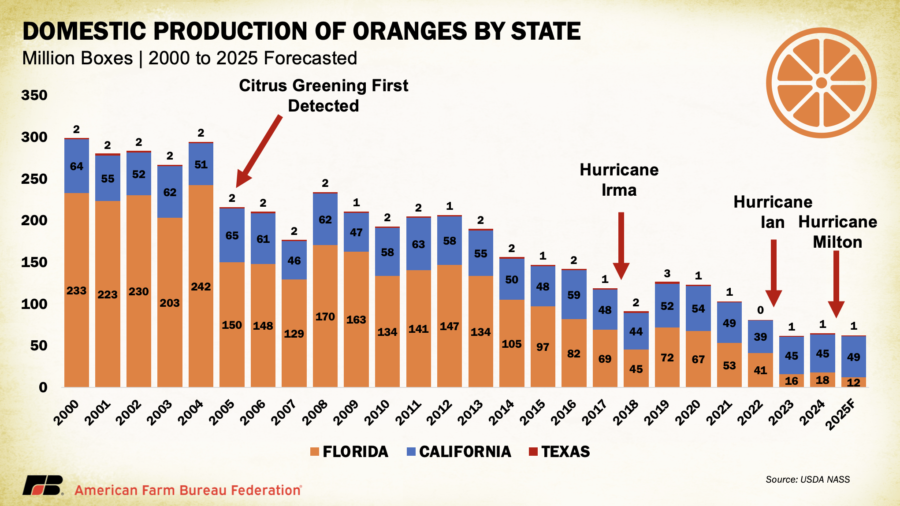
The numbers are brutal. At the 1997–98 peak, Florida groves produced about 244 million 90-pound boxes of oranges. USDA’s April 2026 forecast put Florida production at 12.2 million, with final Valencia fruit yield down 46 percent. Florida’s citrus industry is fighting for its life. And losing, as is evident from these charts:

Citrus greening crisis
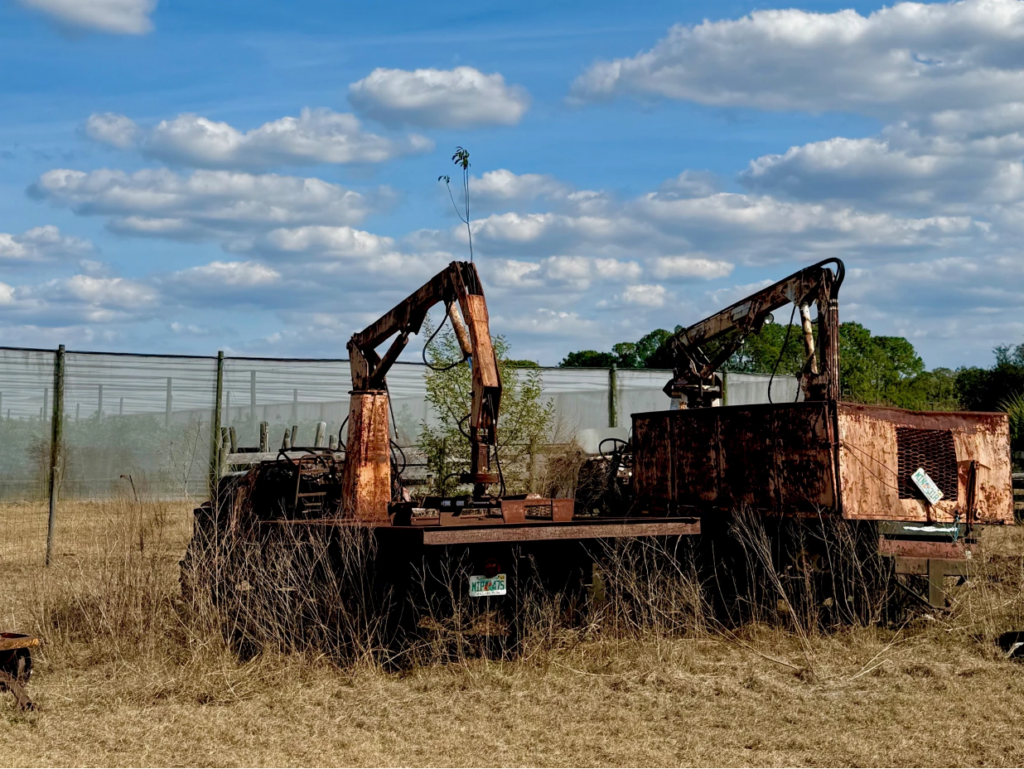
The crisis is most visible in places like Vo-LaSalle Farms in Volusia County, where two converted 1970s school buses—once used as fruit-loader trucks—no longer lift crates of citrus. Steve Crump, a fourth-generation grower, has shifted away from semi-load wholesale sales toward direct retail, screenhouses, and whatever tools can buy his trees a little more time. Some of those tools help. None addresses the disease.

“ When we were done, I parked the fruit loader trucks, and I thought, ‘I don’t think I’ll ever need these again,’” said Crump. “Right now, they’re still sitting where I parked them five years ago. And there’s a tree growing between them.”
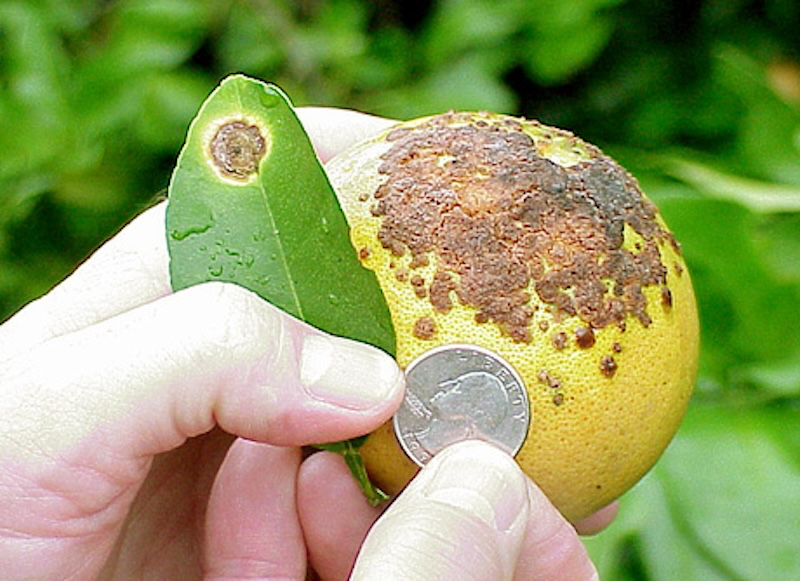
Huanglongbing — known popularly as HLB or citrus greening — has been devastating the industry for decades. HLB is spread by the Asian citrus psyllid, a tiny sap-sucking insect also called jumping plant lice. It attacks the tree’s vascular system, leaving fruit small, bitter, misshapen, green, and prone to dropping before harvest, eventually killing the plant. Hurricanes, freezes, and development have exacerbated the damage, but greening is the underlying reason for the catastrophe.
Traditional measures — pesticides, removal of infected trees, even protective screenhouses — have proven insufficient at scale. Growers can inject antibiotics, pull infected trees, cover orchards under screenhouses, or replant, but those are only stopgaps. There is no cure. For many growers, the only realistic path forward is to plant trees that can tolerate or resist the disease — citrus trees that can tolerate or resist HLB.
CRISPR rescue plan
This is a story of devastation and economic urgency, but also, if the cards fall the right way, of hope and scientific ingenuity. Growers have endured hurricanes, shrinking acreage, and the slow death of millions of trees, but there are shoots of hope, a science-based rescue plan.
“What we need is a tree that’s resistant or tolerant to this disease, and I thought we would have it during my career.” Said Crump. “But that was 15 years ago, and I thought by now we’d already have it. So now I’m just trying to hold on, maybe for 10 more years until there is a tree that’s resistant,” he said.
A solution is as obvious as it is complicated. The state is planting more than 300,000 citrus trees developed using CRISPR gene-editing technology through its Citrus Research and Field Trial Foundation program. Researchers will monitor whether trees that look promising in test groves can perform under commercial pressures — heat, storms, psyllids, poor soils, labor costs, and thin margins.
Another possible breakthrough is moving through the pipeline. Soilcea, a Florida biotech company, has developed CarriCea T1, a CRISPR-edited Carrizo rootstock aimed at HLB resistance. The company says growers have placed orders totaling more than 300,000 units and that 200,000 trees are already in nursery production, while it works with the USDA and EPA on regulatory clearance.
Florida citrus déjà vu?
Florida has been here before. Scientists have had a promising solution for years. More than a decade ago, Southern Gardens Citrus, a U.S. Sugar–linked Florida citrus company, backed a rescue strategy using a different biotechnology, transgenic “genetically modified organisms,” or GMOs. The government reviewed the proposal as a genetically engineered biological control agent, and the EPA later treated the technology as safe. Then it ran up against headwinds — not from science but politically. Environmental activists launched a public fear campaign — “Frankenstein” GMO oranges. “Bite some before it bites you!” was their antagonistic slogan.

Even though the evidence for safety and good nutrition is unassailable, public outcry and a regulatory maze slowed deployment. Some of that anti-technology hysteria has faded, and the Florida citrus industry now has a second chance. With CRISPR, gene-edited citrus appears poised to excise that stigma and the procedural burdens attached to transgenic crops.




That promising workaround should not obscure the larger issue. The earlier GMO tools were not reckless; they were promising, carefully reviewed technologies caught in a regulatory culture that judged the process more harshly than the product and its potential risk. From a scientific standpoint, what matters is not how a genetic change is made, but what new characteristics that change confers. A plant with a precisely targeted mutation produced by CRISPR may be functionally identical to one produced by older techniques of biotechnology — or even by conventional breeding. The method tells us little about the risk. That recognition has helped to lighten regulations in the U.S., Canada, and an increasing number of other countries.
Regulatory inconsistency
That principle is hardly radical. FDA’s 2024 guidance for foods from genome-edited plants says its voluntary engagement process is based on the “objective characteristics” of the food, especially those related to food safety. EPA has also exempted certain “plant-incorporated protectants” created through biotechnology when they pose no greater risk than traits available through conventional breeding.
However, the courts have, in some cases, moved agricultural innovation backward. A federal court vacated regulatory reforms and restored the pre-2020 regulatory framework. That means that regulators are again operating under older rules even as citrus researchers try to deploy next-generation tools against a disease that has already erased most of the crop.
The regulatory problem is not simply delay. It is incoherence. A CRISPR-edited citrus tree that modifies a susceptibility gene may move through one pathway. A transgenic rootstock engineered for the same practical purpose — HLB resistance — may face a longer, more burdensome, and more uncertain process. Yet the safety question is not whether a researcher used CRISPR, older recombinant DNA methods, or years of conventional breeding. The question is whether the resulting plant poses a new risk to health, agriculture, or the environment.
The National Academies reached a similar conclusion in their review of genetically engineered crops, finding no substantiated evidence of a difference in human-health risk between currently commercialized GE (transgenic) crops and conventionally bred crops. That does not eliminate the need for evaluation, however. It argues for evaluation based on traits, exposure, and evidence rather than breeding method.
Consequences of delay, optimism about a rescue
For annual crops, regulatory delay is expensive. For citrus, it can be an existential threat. A tree planted today may need years before it bears substantial fruit. Every lost season affects nursery decisions, grove financing, processing capacity, and whether younger growers see a future in the business.
That future is already fragile. The University of Florida estimated that the citrus industry supported about 32,500 jobs and nearly $6.9 billion in output during the 2020–21 season. Those numbers reflect the status quo ante before the latest collapse in production. Each shuttered grove means lost workers, lost packing capacity, lost processing infrastructure, and lost knowledge — the practical know-how that cannot readily be recreated after growers leave.
Critics will argue that faster approval means weaker oversight. That is a false dichotomy. A science-based system can scrutinize traits that raise real questions while clearing low-risk innovations without years of procedural delay. It can require data where data are needed, provide transparency where public confidence matters, and speed where the evidence supports it.
The citrus crisis is now a live test of whether U.S. biotechnology regulation and innovation can keep pace with an agricultural emergency. On May 15, USDA opened a request for information asking for public input on how genetically modified organisms should be reviewed under the Plant Protection Act. Comments are due June 15.
One of the core questions is whether regulation should continue to distinguish sharply between conventional, genetically modified organisms, and gene-edited crops — or continue the evolution toward a more risk-based approach. That does not mean every gene-edited plant deserves a free pass. It means the relevant question should be what changed in the plant, how the plant behaves, and whether the trait creates a plausible risk.
By next May, some of the CRISPR-edited trees now being planted may be settling into commercial groves. They will not rescue the industry overnight. No single technology will. But disease-resistant or disease-tolerant citrus is the only plausible path back to scale, and to reviving the industry. Screenhouses, antibiotics, and emergency regulatory tweaks can buy time, but better trees can change the future.
Henry I. Miller, a physician and molecular biologist, is the Glenn Swogger Distinguished Scholar at the Science Literacy Project. He was the founding director of the FDA’s Office of Biotechnology. Find Henry on his website: henrymillermd.org