Black Death: Was the plague actually good for the environment?

zoom
Chemical fences: some substances in our everyday life may hamper penetration into the protective coat of the egg cell.

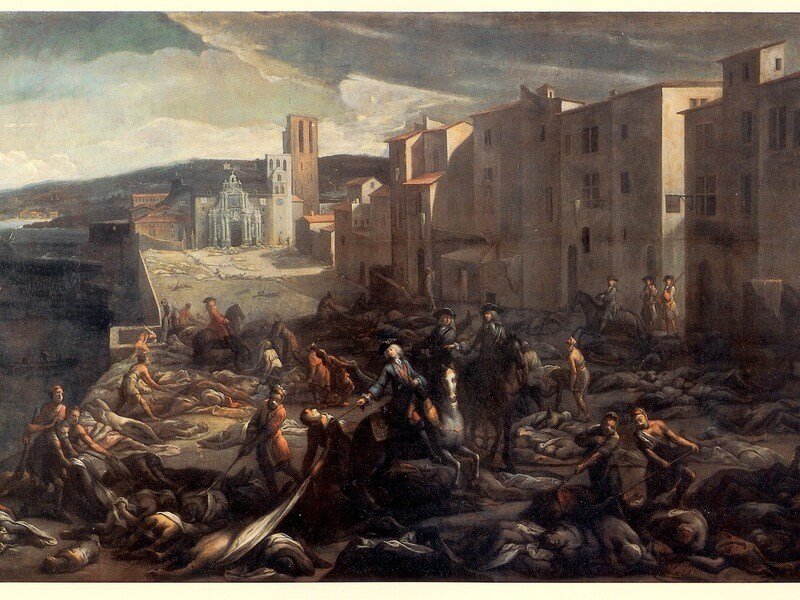
From 1347 to 1351, a nightmare disease ravaged Europe, afflicting victims with putrid black boils, fevers, vomiting, and in short order, death. Daily life ground to a halt as the Black Death spread along medieval trade routes, claiming an estimated 20 million lives with ruthless efficiency. Now, a team of researchers is asserting that the plague had an unexpected impact: clearing the air of a toxic pollutant for the first time in over a thousand years.

Lead pollution is typically considered a hallmark of industrial society, but a growing body of research suggests human activity has been fouling the air with harmful heavy metals for millennia. Results of a new ice core analysis, published last week in the journal GeoHealth, support the idea that in Western Europe at least, mining and smelting activity has tainted the air with lead for at least 2,000 years. In fact, the only sliver of time during which the scientists’ instruments sniffed lead-free air was from 1349 to 1353, when folks were presumably too busy dying in droves to work the mines.

Reconstructing the past is a messy business, and the debate over how much our ancestors sullied the air—and the extent to which catastrophic events like the Black Death cleared it—is likely to rage on for years. But if one thing’s clear, it’s that we need to stop thinking of the pre-industrial past as a pollution-free era. Humans have always impacted their environment, and we’re just starting to come to terms with the consequences.

The GLP aggregated and excerpted this blog/article to reflect the diversity of news, opinion, and analysis. Read full, original post: The Black Death May Have Had a Surprising Effect on the Environment


{{ reviewsTotal }}{{ options.labels.singularReviewCountLabel }}
{{ reviewsTotal }}{{ options.labels.pluralReviewCountLabel }}
{{ options.labels.newReviewButton }}
{{ userData.canReview.message }}

Related Articles

Infographic: Global regulatory and health research agencies on whether glyphosate causes cancer

Infographic: Global regulatory and health research agencies on whether glyphosate causes cancer

Does glyphosate—the world's most heavily-used herbicide—pose serious harm to humans? Is it carcinogenic? Those issues are of both legal and ...

Most Popular

Screenshot-PM-24
Viewpoint: The herbicide glyphosate isn’t perfect. Banning it would be far worse.
d-b
Blocked arteries, kidney stones, nausea, constipation, fatigue: Long list of health problems caused by too much vitamin D 
circular-bioeconomy-should-focus-on-sustainable-wellbeing
GLP podcast: What's wrong with 'doomsday' environmentalism? It's false.
Screenshot-2026-04-27-at-12.22.38-PM
Running ‘wild’: Last year, RFK, Jr. was given a green light to ‘reform’ chemical policies. Glyphosate illustrates how Trump now has him on a tight leash, and MAHA is furious
Screenshot 2026-02-25 at 11.20
Why the herbicide glyphosate is key to sustainable agriculture
bayer-supremecourt-lt
EPA concludes glyphosate is not carcinogenic. Missouri courts say Monsanto failed to warn it might be. SCOTUS weighs in.
ChatGPT-Image-Apr-22-2026-11_06_18-AM
Wellness influencer nonsense: No, nicotine does not boost cognition and productivity, but it can damage your health 
glp menu logo outlined

Get news on human & agricultural genetics and biotechnology delivered to your inbox.