Does the US grow too much GMO corn and soy, most used for livestock?

cattle

[Editor’s Note: Jayson Lusk is a food and agricultural economist and head of the Agricultural Economics Department at Purdue University.]

I saw some recent discussion on Twitter of this post by Emily Cassidy in which she discusses her 2013 paper….

She writes:

…Over two-thirds of the calories grown in the U.S. are fed to livestock. And for every eight calories of corn and soybean fed to livestock, only one of those calories ends up on our plates.

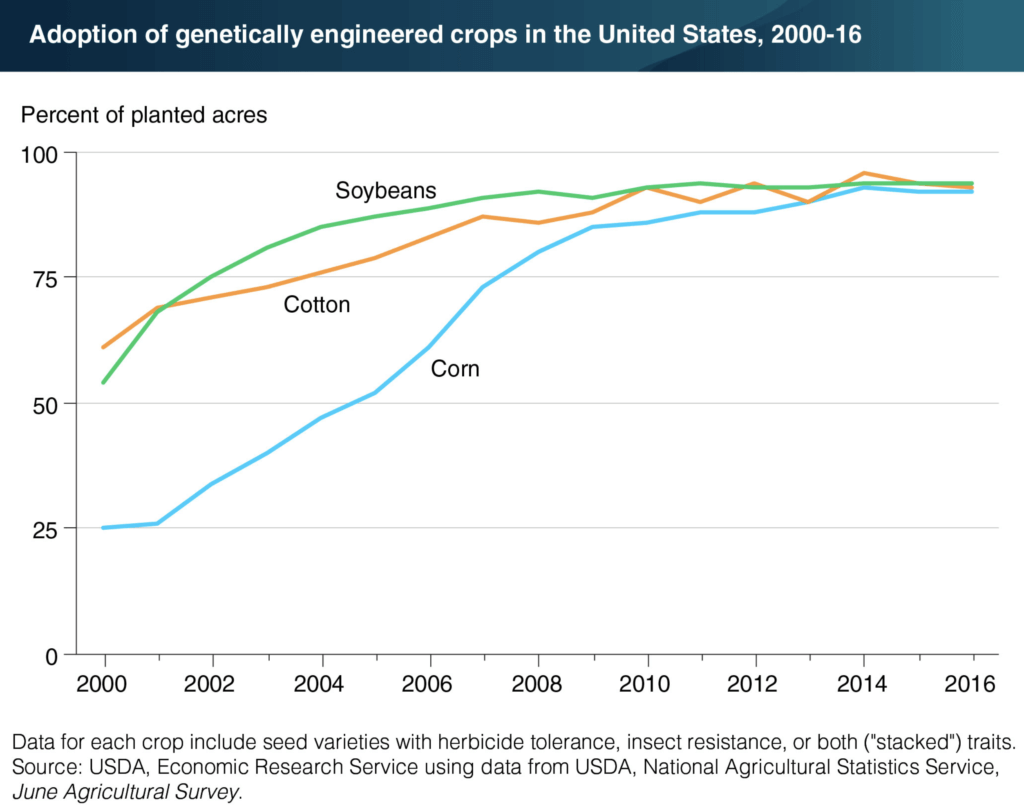
[Editor’s note: approximately 95% of all corn and soybeans grown in the US is genetically engineered.]Screen Shot at PM
Beyond “preferences”, why do we grow so much corn, soy, and wheat in the U.S.?  A primary answer is that these plants are incredibly efficient at converting solar energy and soil nutrients into calories…. Moreover, these calories are packaged in a form (seeds) that are highly storeable and easily transportable….

[One way to view livestock] is that they are good at converting one form of energy that is highly storeable/transportable but untasty (field corn, soy, sorghum) to another form (eggs, meat, dairy) that we like to eat. Rarely do these sorts of research papers include the the calories (or energy) used in food processing.
…

I’m not going to say it’s perfectly rational for the U.S. to devote the majority of it’s cropland to corn/soy/wheat, but I think this discussion suggests it’s not irrational either.  

download

The GLP aggregated and excerpted this article to reflect the diversity of news, opinion, and analysis. Read full, original post: Redefining Agricultural Yields


Related Articles

Infographic: Global regulatory and health research agencies on whether glyphosate causes cancer

Infographic: Global regulatory and health research agencies on whether glyphosate causes cancer

Does glyphosate—the world's most heavily-used herbicide—pose serious harm to humans? Is it carcinogenic? Those issues are of both legal and ...

Most Popular

Screenshot-2026-11-17-at-12.18.09-PM
Challenging glyphosate fear-mongering: Statewide Nebraska study finds no link between weedkiller use and non-Hodgkin lymphoma
Screenshot-2026-11-16-at-2.37.32-PM
30 years of GMO farming: Is the boom in glyphosate and glufosinate use harming the environment? Data show they’re the most sustainable choice
Soybean Harvest in Cupped Hands
30 years of GMO farming: Defying cynics, we’ve had larger harvests, lower costs, and $385 billion in added global farmer income
ChatGPT-Image-Mar-10-2026-01_39_01-PM
Viewpoint—“Miracle molecule” debunked: Why acemannan supplements don’t work
Stormlit Portrait Over Golden Mountains
Searching for life where no one thought to look: A renowned astrophysicist’s seemingly quixotic quest to explore Venus’s clouds
Screenshot-2026-11-19-at-7.54.57-PM
European General Court sides with scientists, dismisses activist claims that glyphosate is toxically dangerous
Screenshot-2026-11-13-at-10.02.02-AM
Viewpoint: Why it’s such a big deal that under Trump-RFK Jr., the U.S. has lost its ‘measles-free’ status  
Screenshot-2026-11-09-at-3.01.19-PM
Are Texas data centers killing calves? Debunking viral AI claims
Prescription Capsules Scattered on Twenty-Dollar Bills
Facts & Fallacies podcast: America's health care system is broken. A doctor explains how to fix it, Part 2
glp menu logo outlined

Get news on human & agricultural genetics and biotechnology delivered to your inbox.