Could printable lungs solve transplant shortage?

lung transplant
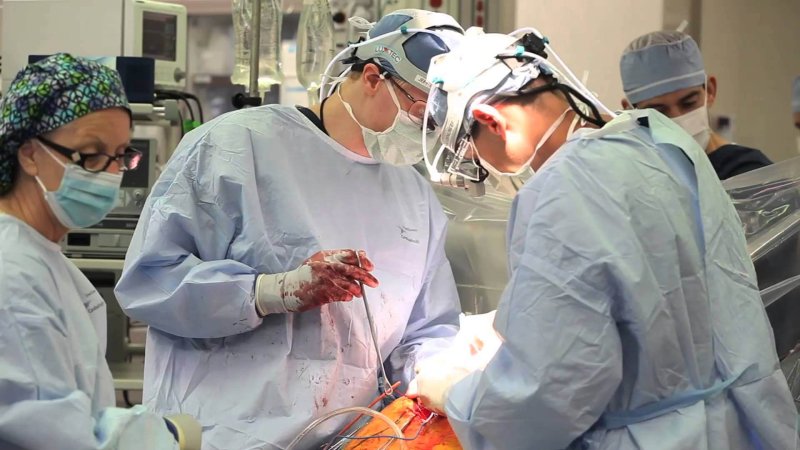
Lung transplant. Image credit: Sarah Pack/Medical University of South Carolina
[Recently] I had the chance to hold a replica of the upper part of a human airway—the windpipe plus the first two bronchi. It had been made from collagen, the biological cement that holds our bodies together. It was slippery and hollow, with the consistency of undercooked pasta.

The structure had emerged from a refrigerator-size 3-D printer in Manchester, New Hampshire, at an outpost of United Therapeutics.

One day, the company says, it plans to use a printer like this one to manufacture human lungs in “unlimited quantities” and overcome the severe shortage of donor organs.

A lung made from collagen won’t help anyone: it’s to a real lung what a rubber chicken is to an actual hen. So United is also developing ways to impregnate the matrix with human cells so they’ll attach and burrow into it, bringing it alive.

If organs could be manufactured in large numbers, it wouldn’t only solve the organ shortage. It could eventually reshape human life span. What about getting a new heart or lungs at 80? To get there, United will have to pull off not one but several technological moonshots.

United is anticipating that its various technology projects—the 3-D-printed scaffold, the recellularization technique, and its effort to manufacture lung tissue from stem cells—will all intersect sometime in the future.

Read full, original post: Inside the effort to print lungs and breathe life into them with stem cells

{{ reviewsTotal }}{{ options.labels.singularReviewCountLabel }}
{{ reviewsTotal }}{{ options.labels.pluralReviewCountLabel }}
{{ options.labels.newReviewButton }}
{{ userData.canReview.message }}

Related Articles

Infographic: Global regulatory and health research agencies on whether glyphosate causes cancer

Infographic: Global regulatory and health research agencies on whether glyphosate causes cancer

Does glyphosate—the world's most heavily-used herbicide—pose serious harm to humans? Is it carcinogenic? Those issues are of both legal and ...

Most Popular

Screenshot-2026-05-01-at-1.29.41-PM
Viewpoint: What happens when whole grains meet modern food manufacturing? Labels don’t tell the whole story.
S
As vaccine rejectionism spreads, measles may be taking a more dangerous turn
Screenshot 2026-05-06 at 2.56
Singularity crisis ahead? Can super babies save us from rogue AI geniuses?
Screenshot-2026-05-06-at-2.07.43-PM
Manufacturing a conspiracy: The timeline of how  the White House embraced the fringe claim that scientists are being mysteriously murdered
Screenshot-2026-04-20-at-2.26.27-PM
Viewpoint — Food-fear world: The latest activist scientists campaign: Cancer-causing additives
Screenshot-2026-03-13-at-12.14.04-PM
The FDA wants to make many popular prescription drugs OTC—a great idea. Here’s why it’s unlikely to happen
Screenshot-2026-04-30-at-2.19.37-PM
5 myths about summer dehydration that could damage your health — or even kill you
ChatGPT-Image-May-6-2026-03_41_05-PM
‘Protecting the integrity of science’: Kennedy’s FDA blocks release of taxpayer-funded studies finding COVID and shingles vaccines safe
Screenshot-2026-05-01-at-11.56.24-AM
‘Science moves forward when people are willing to think differently’: Memories of DNA maverick Craig Venter
Screenshot 2026-05-06 at 12.49
Immortal dragons: The quest to ‘make death optional’
79d03212-2508-45d0-b427-8e9743ff6432
Viewpoint: The Casey Means hustle—Wellness woo opportunism dressed up as medical wisdom
glp menu logo outlined

Get news on human & agricultural genetics and biotechnology delivered to your inbox.