
The Austrian research portal “Addendum” released a bombshell video regarding the facts, figures, and positions regarding GMO foods. In this report that attempted to explain the reality of both the technology, economic implications and public discourse, the site sat down with both current and former Greenpeace activists, leading them to reveal the awful reality of anti-science activism.
Whoever was under the illusion that organizations the likes of Greenpeace are actual environmentalists who pursue the improvement of human health and biodiversity, will suffer a severe shock from the exchange included in the Addendum video. Sebastian Theissing-Matei, spokesperson for Greenpeace in Austria gave these answers:
Interviewer: In organic shops, I can buy that were produced with radiation of chemicals (sic). Does it make sense to allow one thing, while demonizing the other [GMO foods]?
Theissing-Matei: This is indeed a certain unsharpness which is born historically – we have to be honest about it.
Interviewer: Shouldn’t Greenpeace also fight against certain types of apples that are being sold in organic shops and that were produced through radiation?
Theissing-Matei: As said, these are types that historically have existed for much longer. There is an unsharpness in the law, no doubt. We always concentrate on the things that are currently political debates.
Interviewer: Should the arguments of Greenpeace not be based on reality, meaning the danger or non-danger and possible utility [of technological progress], and not only on based on what is being discussed in the media?”
Theissing-Matei: We are a political organization. Of course we try to act in the best interest of the environment, but momentarily the political debate is whether or not new methods for genetic modification should be placed under current legislation of genetic modification.

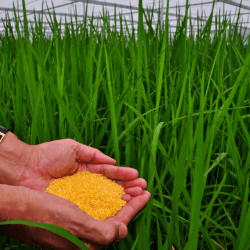




Greenpeace has more or less consistently refused to accept grants from governments (including the European Union), which does not endanger any of their funding by that token. It would have to be pointed out that the billion-dollar NGO has, in Europe in particular, benefited from financial support from green political parties, which themselves are entirely government-funded.
As for the political debate that the Austrian Greenpeace spokesperson addresses, it is interesting hearing such a thing from this particular organization. As far back as 1996, Greenpeace was seen protesting the arrival or a transport ship in the harbour of Hamburg, Germany, containing “the first set of genetically modified soybeans in Germany”. The protest had shown its effects: The then German minister for research demanded that producers label all of their foods if they have been genetically modified. So people talk about an issue that Greenpeace raised, and now this is the only topic it can address. Greenpeace is, in a beautiful fashion, fulfilling its own prophecies.
By any means, it is one thing to oppose genetically modified food in 1996 than it is more than 20 years later. The recent Nature-published meta-analysis on genetically engineered maize on agronomic, environmental and toxicological traits shows clearly that insect that do not feed off of maize are not effected, and that genetically modified maize shows considerably lower concentrations of cancer-causing mycotoxins. But for Greenpeace, it’s not the scientific evidence that counts, but the fear it can spread as an effective business model. This is confirmed in the same Austrian report, by former Greenpeace activist Ludger Wess, who is now a science writer who was one of the first journalists in Europe to cover the emerging biotechnology and high-tech industries:
“Greenpeace was actually open-minded towards the idea of genetically modified foods. They said: “If it’s true that plants become resistant to insects, then that’s great because we’ll use less insecticides. So we’re for it.”
After getting back from a science-conference on genetically modified maize in 1989, Wess returned to Greenpeace:
I came back, armed with a whole suitcase of papers, and after having a lot of conversations with scientists, and they were all able to defuse my worries. I wasn’t convinced anymore that it would be a danger to human health. I told them [Greenpeace]: we cannot continue to claim that genetically modified foods are bad for human health, it’s simply not true. I was told that Greenpeace would still continue to make that claim, because only if people are in fear over their health or the health of their children, they’ll open their wallets for donations. Everything else, they said, isn’t suitable for campaigns.
Greenpeace has a history of being more interested in publicity than actual constructive debate and informed discussions. Be it violently blocking petrol stations in Luxembourg, aggressively disrupting the work of an oil rig, or even painting a massive roundabout in Berlin yellow, with water-polluting paint, and causing car damages and thousands of euros of cleaning costs: Greenpeace is an attention-seeking, anti-science activist group, that uses the environment as an excuse to propagate it’s illiterate bias against anything that advances human health and nutrition.
Current donors of this organization need to ask themselves the question whether they want to support this self-admitted political organization, which has no regard for the truth.
Bill Wirtz is a policy analyst for the Consumer Choice Center in Washington, DC. Follow him on Twitter @wirtzbill.