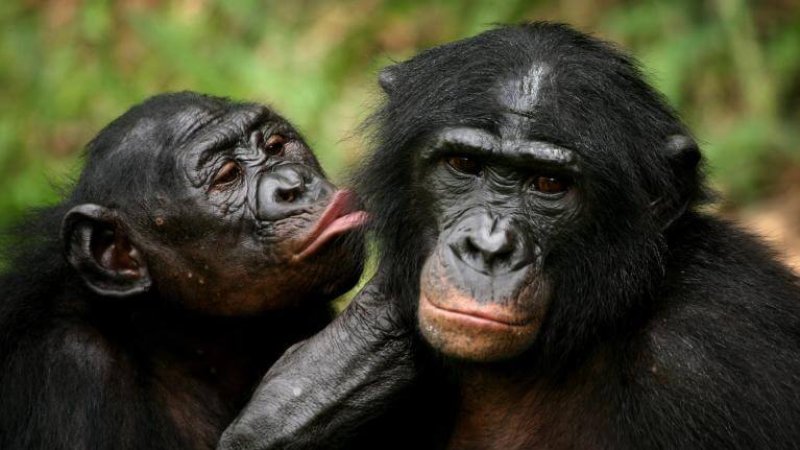
Compared to humans, most primates produce a limited range of vocalizations: At one end of the spectrum, there’s the Calabar angwantibo, an arboreal west African critter capable of offering up just two distinct calls. At the other end, there’s the bonobo, a skilled chatterbox known to voice at least 38 different calls.
A new study published in Frontiers in Neuroscience suggests these variations can’t be attributed simply to inadequate vocal anatomy. Like their hominid cousins, non-human primates possess a functional larynx and vocal tract. The crux of the matter, according to lead author Jacob Dunn, a zoologist at Anglia Ruskin University in Cambridge, is brainpower.
…
Dunn and co-author Jeroen Smaers of New York’s Stony Brook University ranked 34 primate species according to vocal ability, as represented by the number of distinct calls the animals produce. The pair then analyzed these rankings in relation to existing studies of the respective species’ brains.

Apes with varied vocalization patterns tended to have larger cortical association areas (neural regions responsible for responding to sensory input) and brainstem nuclei involved in control of the tongue muscles, Victoria Gill reports for BBC News.
These findings, according to a press release, reveal a positive correlation between relative size of cortical association areas and primates’ range of distinct vocalizations. In layman’s terms, speech ability comes down to neural networks, not vocal anatomy.
Read full, original post: Why Humans Are the Only Primates Capable of Talking