Sending tiny organs into space in search for aging, disease secrets

2-6-2019 e f a f z
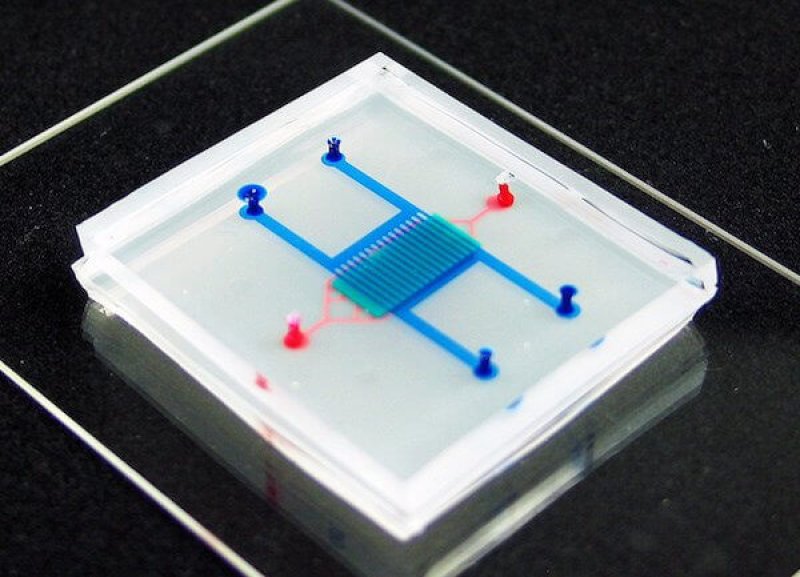
Blood-brain barrier on a chip. Image credit: Vanderbilt University/Flickr

In research that sounds like something out of a science fiction movie, astronauts are conducting experiments on miniature human organs—such as hearts, lungs and kidneys—in devices roughly the size of a USB key. Such experiments hold the potential to advance our understanding of disease on Earth.

There is no more dramatic environmental change than sending organs to space where they experience very little gravity, intense radiation and a host of other extreme conditions. This is the environmental equivalent of flipping the switch on a gene.

One study will look at how microgravity weakens the immune system and the ability of astronauts to fight infections. In this experiment, astronauts will test the effects of microgravity on the lung and bone marrow’s immune responses to bacterial infection.

Another study hopes to shed light on the wall known as the blood-brain barrier (BBB), which acts as a gate between our brains and the blood circulating through our body.

Together, the research that is taking place above us holds potential to advance our basic understanding of how disease comes about and can open the door—just like our advances in genetic research—to promising new treatments and cures down the road.

Read full, original post: Tiny Organs in Orbit

{{ reviewsTotal }}{{ options.labels.singularReviewCountLabel }}
{{ reviewsTotal }}{{ options.labels.pluralReviewCountLabel }}
{{ options.labels.newReviewButton }}
{{ userData.canReview.message }}

Related Articles

Infographic: Global regulatory and health research agencies on whether glyphosate causes cancer

Infographic: Global regulatory and health research agencies on whether glyphosate causes cancer

Does glyphosate—the world's most heavily-used herbicide—pose serious harm to humans? Is it carcinogenic? Those issues are of both legal and ...

Most Popular

ChatGPT Image Jun 3, 2026, 03_54_37 PM
Viewpoint: “Turn on, tune in, drop out”—Kennedy embraces the Timothy Leary psychedelic revolution
ChatGPT Image Jun 3, 2026, 03_14_43 PM
Viewpoint: How Earthjustice became the poster child for the abuse of special interest activist funding
ChatGPT-Image-Jun-11-2026-01_15_03-PM
Selective Pressure, Selective Silence
Screenshot-2026-06-05-at-2.12.30-PM
Some plants can poison you. So how did humans figure out what is safe to eat?
ChatGPT Image Jun 1, 2026, 11_39_17 AM
Viewpoint: When food myths go viral, farmers pay the price
Screenshot-2026-06-03-at-1.24.46-PM
Challenging anti-GMO disinformation: Why genetically-tweaked crops offer bushels of benefits
ChatGPT Image May 28, 2026, 08_16_38 PM
Viewpoint: Why the EPA mismeasures cancer risk of chemicals and what should be done to fix it
artificial intelligence brain think illustration md
Viewpoint — Digital gods and human extinction: Will we be the first species ever to design our own descendants?

Sorry. No data so far.

glp menu logo outlined

Get news on human & agricultural genetics and biotechnology delivered to your inbox.