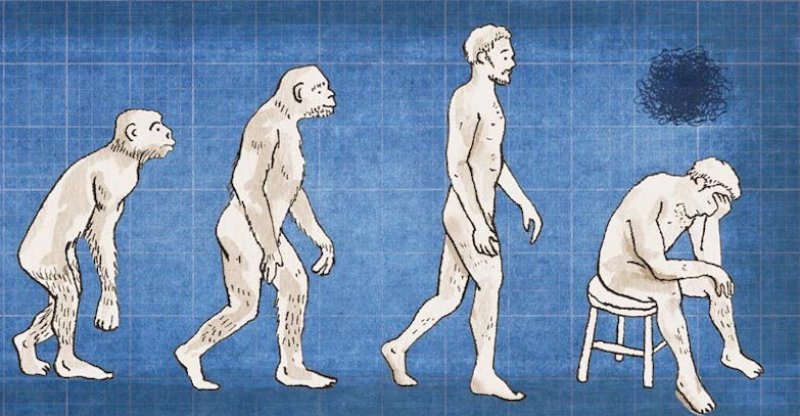
‘Good Reasons for Bad Feelings’: Understanding evolution’s role in anxiety, depression and making us human

evolution b
[In] the thought-provoking Good Reasons for Bad Feelings, [evolutionary] psychiatrist Randolph Nesse offers insights that radically reframe psychiatric conditions.

In his view, the roots of mental illnesses, such as anxiety and depression, lie in essential functions that evolved as building blocks of adaptive behavioural and cognitive function. Furthermore, like the legs of thoroughbred racehorses — selected for length, but tending towards weakness — some dysfunctional aspects of mental function might have originated with selection for unrelated traits, such as cognitive capacity.

…

The future success of clinical psychiatry might depend on an evolutionary framework being integrated with whole-genome sequence-data analysis; this could help to identify mutations predisposing people to mental illness. Given the small contributions of individual genes and the diverse mechanisms involved, this will demand analysis of the genomes of hundreds of thousands of people. As a result of the extensive and often paradoxical entanglement of genetic networks, future treatments might, by necessity, require mental circuits to be engineered to release them from hard-wired evolutionary constraints.

…

As Good Reasons for Bad Feelings boldly posits, many of the core dysfunctional components of mental illness ultimately help to make us human.

Read full, original post: The biological basis of mental illness

Related Articles

Infographic: Global regulatory and health research agencies on whether glyphosate causes cancer

Infographic: Global regulatory and health research agencies on whether glyphosate causes cancer

Does glyphosate—the world's most heavily-used herbicide—pose serious harm to humans? Is it carcinogenic? Those issues are of both legal and ...

Most Popular

ChatGPT-Image-Mar-10-2026-01_39_01-PM
Viewpoint—“Miracle molecule” debunked: Why acemannan supplements don’t work
Screenshot-2026-09-22-at-12.26.15-PM
‘Forever chemical’ concerns: Separating hysteria from reasonable concern in the debate over PFAS danger
Screenshot-2026-10-06-at-11.13.59-AM
RFK Jr.’s plan to curb America’s appetite for ultra-processed foods and artificial dyes blocked by the White House
Screenshot 2026-10-08 at 1.34
Hooked on kratom: The unregulated, natural, alcohol-free “social tonic” that is destroying lives 
Screenshot-2026-10-06-at-2.36.47-PM
Is organic farming really more sustainable? 100 recent studies say ‘no’
Resolute-Portrait-with-Injured-Teddy-Bear
Anti-vax Texas Senate candidate Ken Paxton alleges conspiracy by doctors, drugmakers, and insurers to push childhood vaccination for profit
Screenshot-2026-09-28-at-11.26.17-AM
Viewpoint: Wellness movement activists reposition nicotine from a killer addictive drug into a cure-all for brain ills
Radioactive-Americana-Collage-2
The kooky logic behind the raft of spurious cancer claims from Harvard’s T.H. Chan School of Public Health
No-Data-Center-Farm-Protest-Sign-2
Rural revival or corporate windfall? Trump’s One Big Beautiful Bill tax law opens the door to big breaks for data centers—but tech giants aren’t cashing in
ChatGPT-Image-Sep-21-2026-11_21_39-AM
Viewpoint: Food cults: Online ‘nutrition communities’ can pose unique dangers
Screenshot 2025-09-17 at 12.41
Jump-starting global warming: Rising temperatures are driving up emissions from wildfires, fermenting wetlands, and melting permafrost
Supreme-Court-Amid-Climate-Crisis
Should fossil fuel companies be shielded from lawsuits over climate change damage? The Supreme Court takes up the question
glp menu logo outlined

Get news on human & agricultural genetics and biotechnology delivered to your inbox.