World’s favorite banana faces extinction. Are GMOs, CRISPR the final hope?

dale lab bananas
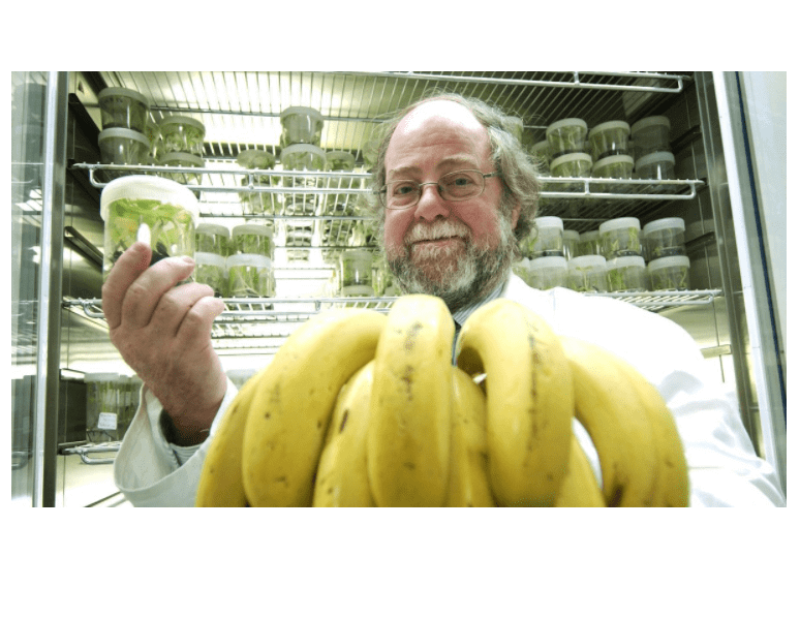
Biotechnology professor James Dale holds banana seedlings in his lab

The race to engineer the next-generation banana is on. The Colombian government confirmed [in August] that a banana-killing fungus has invaded the Americas — the source of much of the world’s banana supply. The invasion has given new urgency to efforts to create fruit that can withstand the scourge.

Scientists are using a mix of approaches to save the banana. A team in Australia has inserted a gene from wild bananas into the top commercial variety — known as the Cavendish — and are currently testing these modified bananas in field trials. Researchers are also turning to the powerful, precise gene-editing tool CRISPR to boost the Cavendish’s resilience against the fungus, known as Fusarium wilt tropical race 4 (TR4).

In an attempt to make biotech bananas more palatable to regulators, [James Dale, a biotechnologist at Queensland University of Technology in Brisbane, Australia] is …. editing the Cavendish’s genome with CRISPR to boost its resilience to TR4, instead of inserting foreign genes.

Specifically, he’s trying to turn on a dormant gene in the Cavendish that confers resistance to TR4 — the same gene that he identified in M. acuminate. But the work is still in its early stages. “It’ll be a couple of years before these get into the field for trials,” Dale says.

Read full, original article: CRISPR might be the banana’s only hope against a deadly fungus

Related Articles

Infographic: Global regulatory and health research agencies on whether glyphosate causes cancer

Infographic: Global regulatory and health research agencies on whether glyphosate causes cancer

Does glyphosate—the world's most heavily-used herbicide—pose serious harm to humans? Is it carcinogenic? Those issues are of both legal and ...

Most Popular

ChatGPT-Image-Mar-10-2026-01_39_01-PM
Viewpoint—“Miracle molecule” debunked: Why acemannan supplements don’t work
Screenshot-2026-09-10-at-11.50.46-AM
Did COVID vaccines kill 2,500 service members? RFK Jr. hires an investigator who compares vaccine promoters to Nazi doctors
ChatGPT-Image-Sep-13-2026-10_24_17-AM
Bayer urges court to approve $7.25 billion Monsanto Roundup settlement that could limit its future liabilities
ChatGPT-Image-Sep-15-2026-06_05_13-PM
CRISPR fine-tuning unlocks vitamin C-rich potatoes without yield loss
Screenshot-2026-09-11-at-2.26.23-PM
Newly approved GMO chestnut trees planted across from the White House are stirring debate
ChatGPT-Image-Sep-15-2026-05_59_18-PM
RFK Jr. spent two years distancing himself from Children’s Health Defense. Now he’s keynoting its anti-vaccine DC conference.
Screenshot-2026-09-10-at-12.20.19-PM
'Jet fuel didn't melt the steel': 9/11 conspiracy theories debunked
ChatGPT-Image-Aug-28-2026-03_33_46-PM
Viewpoint: Bad science—Five bogus Trump administration claims about vaccines and autism
Screenshot-2026-09-15-at-11.04.54-AM
Viewpoint: Childhood deaths in dispute: Why the CDC vs Pennsylvania conflict over measles vaccines matters
Screenshot 2026-09-10 at 11.28
A meaty problem: How to make cell-grown protein taste like steak, chicken, and seafood
ChatGPT-Image-Aug-14-2026-11_16_47-AM
Fibermaxxing: Latest Instagram diet craze raises hope that a fiber-rich diet can improve health
ChatGPT-Image-Sep-2-2026-10_30_14-PM
Zero: That is the official American measles death toll for 2026. Here is what RFK Jr.’s CDC leaves out.
glp menu logo outlined

Get news on human & agricultural genetics and biotechnology delivered to your inbox.