
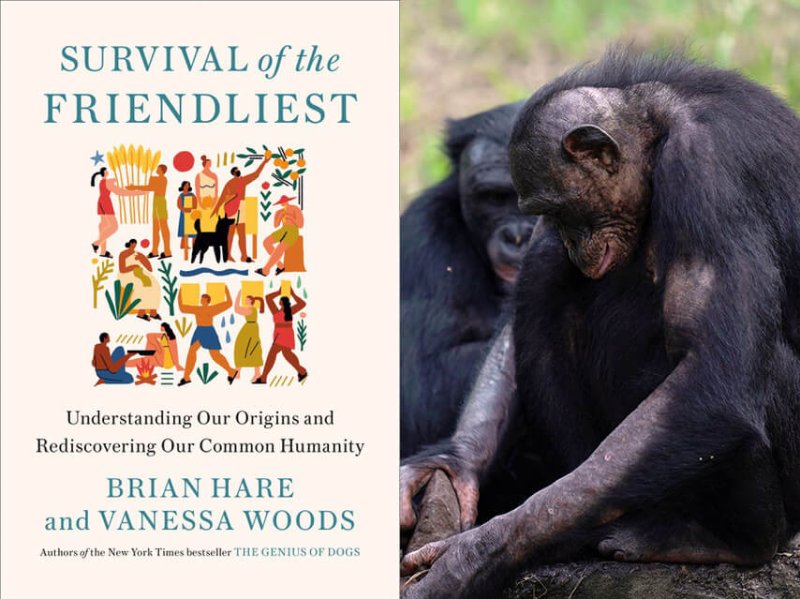
Maybe Darwin got it wrong: ‘Survival of the Friendliest’

ec dkmxxsaezdkd
Credit: Lola Ya Bonobo

Most people assume that Darwin was talking about physical strength when referring to “survival of the fittest,” meaning that a tougher, more resilient species always will win out over its weaker counterparts. But what if he didn’t mean that at all?

Scientists Brian Hare and Vanessa Woods, both researchers at Duke University’s Center for Cognitive Neuroscience, believe something else has been at work among species that have thrived throughout history, successfully reproducing to sustain themselves, and it has nothing to do with beating up the competition.

Their new book, “Survival of the Friendliest: Understanding Our Origins and Rediscovering Our Common Humanity,” posits that friendly partnerships among species and shared humanity have worked throughout centuries to ensure successful evolution. Species endure — humans, other animals and plants — they write, based on friendliness, partnership and communication. And they point to many life examples of cooperation and sociability to prove it.


Mis- and disinformation are distorting science and public policy. Subscribe to our Daily and Weekly Digests for incisive coverage of ‘disruptive’ innovations in AI, agricultural biotechnology, food, chemicals, nuclear energy, vaccines, and other disruptive innovations.

“Dogs are exhibit A,” [Hare] says. “They are the extremely friendly descendants of wolves. They were attracted to humans and became friendly to humans, and changed their behavior, appearance and developmental makeup. Sadly, their close relative, the wolf, is threatened and endangered in the few places where they live, whereas there are hundreds of millions of dogs. Dogs were the population of wolves that decided to rely on humans — rather than hunting — and that population won big.”


Read the original post

Related Articles

Infographic: Global regulatory and health research agencies on whether glyphosate causes cancer

Infographic: Global regulatory and health research agencies on whether glyphosate causes cancer

Does glyphosate—the world's most heavily-used herbicide—pose serious harm to humans? Is it carcinogenic? Those issues are of both legal and ...

Most Popular

ChatGPT-Image-Mar-10-2026-01_39_01-PM
Viewpoint—“Miracle molecule” debunked: Why acemannan supplements don’t work
Screenshot 2026-11-23 at 11.51
Calley Means’ demonization of glyphosate is ‘just craziness’. Farmers are responding with science.
Pastel Breakfast Pedestals with Yogurt Bowl
RFK Jr. is about to issue an edict defining ultra-processed foods. What could go wrong?
Neon-AI-Globe-Network
Viewpoint: The three biggest threats posed by AI hyper-intelligence
Screenshot-2026-11-24-at-11.07.44-AM
Here's a sure way to increase testosterone levels and jack up your sex drive
Glassy Molecules Above Floral Pads
Viewpoint: ‘Forever' PFAS chemicals in panty liners? The only ‘forever’ truth is endless lawsuits that do not protect women’s health 
glp menu logo outlined

Get news on human & agricultural genetics and biotechnology delivered to your inbox.














