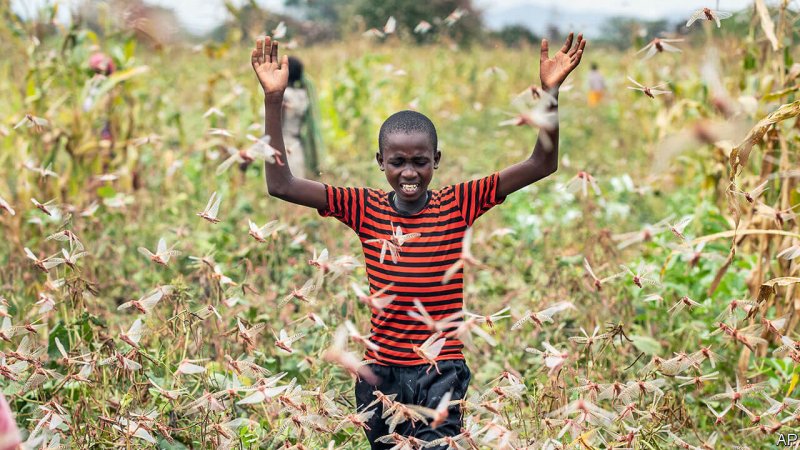
New crop-destroying locust swarms hitting East Africa ‘nearly every day,’ UN warns in renewed call to fight major food security threat

Credit: AP
Credit: AP

Dominique Burgeon, FAO’s [the UN’s Food and Agriculture Organization] Director of Emergencies and Resilience, said the huge [African] desert locust swarms in 2020, some as wide as 60 kilometers, had not been seen in decades, threatening food security in a region where many were already going hungry. 

Surveillance and response led to 1.6 million hectares of land being treated.  As a result, more than three million tonnes of cereals, valued at approximately $940 million, were protected: enough to feed 21 million people for a year. 

“We can say that huge progress has been made, capacities of the countries have been tremendously augmented…but yet the situation is not over”, he told journalists. “We have made a huge effort, we are much better prepared, but we should not be complacent. We should not relax.”  

Locusts began migrating south to northern Kenya and southern Ethiopia when the waters dried up, as experts had predicted. 

“We had forecasted this in October. We had provided early warning to both countries to expect this shortly after mid-December, and that’s indeed what happened”, he said. “And since then, they have been arriving nearly every day.”  

Follow the latest news and policy debates on sustainable agriculture, biomedicine, and other ‘disruptive’ innovations. Subscribe to our newsletter.

“This is a cause of concern, and this is also why it’s extremely important that the control operations…are not disrupted”, said [the FAO’s Senior Locust Forecasting Officer Keith] Cressman.


Read the original post 

{{ reviewsTotal }}{{ options.labels.singularReviewCountLabel }}
{{ reviewsTotal }}{{ options.labels.pluralReviewCountLabel }}
{{ options.labels.newReviewButton }}
{{ userData.canReview.message }}

Related Articles

Infographic: Global regulatory and health research agencies on whether glyphosate causes cancer

Infographic: Global regulatory and health research agencies on whether glyphosate causes cancer

Does glyphosate—the world's most heavily-used herbicide—pose serious harm to humans? Is it carcinogenic? Those issues are of both legal and ...

Most Popular

wuhan institute of virology main entrance
​​COVID lab leak? Making a case that the Wuhan market origins theory is wrong
Screenshot-2026-06-18-at-11.41.51-AM
Viewpoint—Protecting baloney science: Far right senators move to protect the phony homeopathy industry
Screenshot-2026-06-17-at-9.44.03-AM
Viewpoint: Embryos are becoming the newest battleground of love, loss, and legal uncertainty
ChatGPT-Image-Mar-10-2026-01_39_01-PM
Viewpoint—“Miracle molecule” debunked: Why acemannan supplements don’t work
Screenshot-2026-06-16-at-10.02.22-PM
Viewpoint: ‘Industrial food’ primer—Challenging the dangerous delusions of the alternative food movement
ChatGPT-Image-Jun-9-2026-01_11_37-PM
Turmeric supplements: More risks than benefits
Screenshot-2026-06-17-at-11.57.12-AM
Viewpoint: Raw milk and the myth of safety—ProPublica exposes the growing anti-homogenization movement
Screenshot-2026-06-18-at-2.52.05-PM
Activist organization accuses Trump of protecting methane-generating stripper wells to benefit billionaire and donor Jeffrey Hildebrand 

Sorry. No data so far.

glp menu logo outlined

Get news on human & agricultural genetics and biotechnology delivered to your inbox.