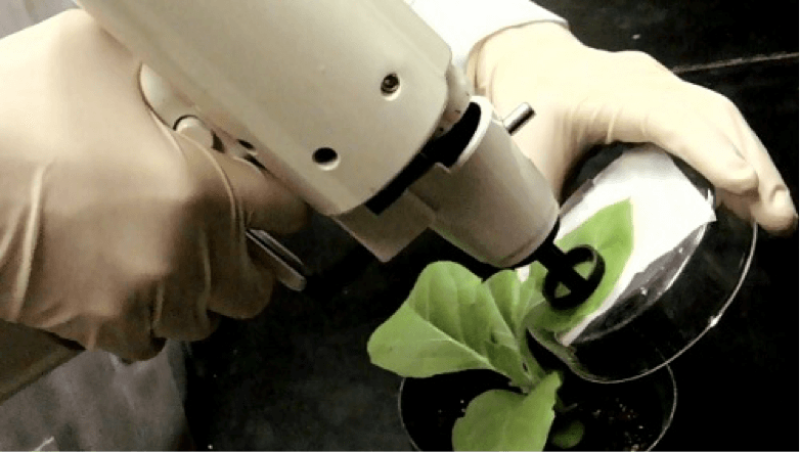
Gene gun: The tool that revolutionized plant breeding and brought GMOs into agriculture

Credit: Agracetus
Credit: Agracetus

A plywood-mounted transformer, a voltmeter-equipped wand and a pair of bulbous vacuum tubes might appear to be just a random collection of components. But Brian Martinell and Dennis McCabe turned them into a tool that would revolutionize plant breeding and help usher in genetic engineering in agriculture. Their gene gun prototype is now displayed at the Smithsonian’s National Museum of American History.

The Agracetus researchers invented the device in 1986, and it played an integral role in the development of Roundup Ready soybeans and biotech crops.

The first prototype didn’t have switches, so the scientists manually touched wires to electric terminals to create a high-voltage shock to transform a water droplet into a shock wave that drove DNA-coated microparticles of gold into plant tissue. 

Follow the latest news and policy debates on sustainable agriculture, biomedicine, and other ‘disruptive’ innovations. Subscribe to our newsletter.

Robb Fraley, former executive vice president and chief technology officer at Monsanto, helped the company develop a strain of bacteria containing genes that would make plants resistant to glyphosate, the active ingredient in Roundup herbicide. Even though Monsanto was working with Agrobacterium to deliver genes of interest into host plants, Fraley indicated the Agracetus gene gun was more efficient at inserting the glyphosate-resistance gene into soybean plants at the time.

Monsanto produced the first Roundup Ready soybeans in 1989, which were commercialized seven years later.


Read the original post

{{ reviewsTotal }}{{ options.labels.singularReviewCountLabel }}
{{ reviewsTotal }}{{ options.labels.pluralReviewCountLabel }}
{{ options.labels.newReviewButton }}
{{ userData.canReview.message }}

Related Articles

Infographic: Global regulatory and health research agencies on whether glyphosate causes cancer

Infographic: Global regulatory and health research agencies on whether glyphosate causes cancer

Does glyphosate—the world's most heavily-used herbicide—pose serious harm to humans? Is it carcinogenic? Those issues are of both legal and ...

Most Popular

d-b
Blocked arteries, kidney stones, nausea, constipation, fatigue: Long list of health problems caused by too much vitamin D 
Screenshot-PM-24
Viewpoint: The herbicide glyphosate isn’t perfect. Banning it would be far worse.
circular-bioeconomy-should-focus-on-sustainable-wellbeing
GLP podcast: What's wrong with 'doomsday' environmentalism? It's false.
Screenshot 2026-02-25 at 11.20
Why the herbicide glyphosate is key to sustainable agriculture
screen shot at pm
Word games: How Moderna is selling its newest vaccine without using the “v” word
ChatGPT-Image-Feb-16-2026-01_04_32-PM
Raw milk myth wake-up call
ChatGPT-Image-Apr-28-2026-12_46_14-PM-2
Kennedy has quietly stopped touting problematic raw milk. Health concerns aren’t why
ChatGPT-Image-Feb-16-2026-01_57_31-PM
Viewpoint: ‘Science-as-Satan’ unites the MAHA—MAGA movements. Is a breakup in the works?
ChatGPT-Image-Apr-22-2026-11_06_18-AM
Wellness influencer nonsense: No, nicotine does not boost cognition and productivity, but it can damage your health 
glp menu logo outlined

Get news on human & agricultural genetics and biotechnology delivered to your inbox.