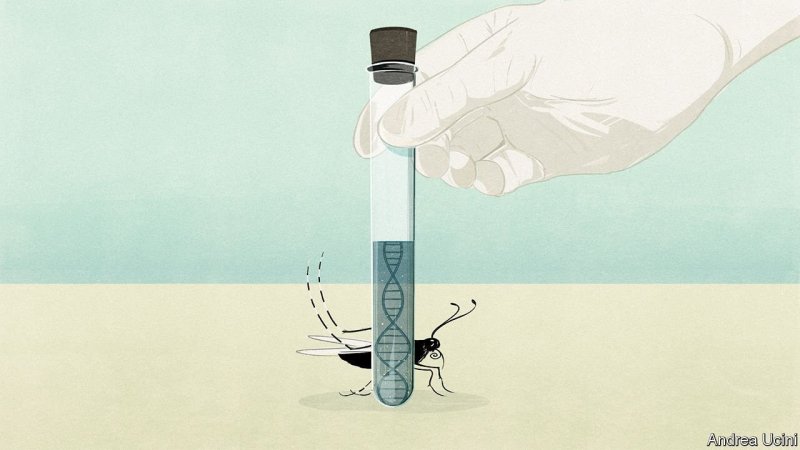
Critics say gene drives could lead to species extinction. Scientists have developed a brake system

Credit: Andrea Ucini

By exerting control over the degree of spread, those who unleash gene drives may realize the benefits promised by gene drives—the suppression of disease-carrying or crop-destroying insects—while minimizing the risks that unintended genetic changes could occur that would lead to undesirable ecological outcomes.

A gene drive engineered to allow for a high degree of control was recently introduced by scientists based at the University of California, San Diego (UCSD). 

While classic gene drives are designed to spread autonomously, the newly developed system, a split-drive system, is designed with controls that separate the genetic implementation processes. The split-drive system consists of a non-spreadable Cas9 component inserted into one location in the genome and a second genetic element that can copy itself—along with a beneficial trait—at a separate site.

When both elements are present together in an individual, an “active gene drive” is created that spreads the element carrying the beneficial trait to most of its progeny. Yet, when uncoupled, the element carrying the beneficial trait is inherited under typical generational genetics rules, or Mendelian frequencies, rather than spreading unrestrained.

Follow the latest news and policy debates on sustainable agriculture, biomedicine, and other ‘disruptive’ innovations. Subscribe to our newsletter.

By creating slight fitness costs that eventually eliminate the Cas9 enzyme from the population, the split-drive system vastly increases control and safety of the genetic deployments.


Read the original post

{{ reviewsTotal }}{{ options.labels.singularReviewCountLabel }}
{{ reviewsTotal }}{{ options.labels.pluralReviewCountLabel }}
{{ options.labels.newReviewButton }}
{{ userData.canReview.message }}

Related Articles

Infographic: Global regulatory and health research agencies on whether glyphosate causes cancer

Infographic: Global regulatory and health research agencies on whether glyphosate causes cancer

Does glyphosate—the world's most heavily-used herbicide—pose serious harm to humans? Is it carcinogenic? Those issues are of both legal and ...

Most Popular

ChatGPT-Image-May-7-2026-12_16_37-PM-2
Viewpoint: Are cancer rates ‘skyrocketing’ as RFK, Jr. and MAHA claims? The evidence says mostly the opposite
Screenshot-2026-04-22-at-10.46.29-AM
Viewpoint: How to counter science disinformation? Science journalist offers 12 practical tips
Screenshot-2026-04-13-at-1.39.26-PM
Viewpoint: ‘Safer for children?’ Stonyfield yogurt under fire for deceptive organic marketing
Picture1-14
When superbugs threaten vulnerable children: Can AI help solve antibiotic resistance?
Screenshot-2026-04-23-at-11.00.36-AM
Regulators' dilemma: Thalidomide, Metformin, and the cost of getting drug approvals wrong
Picture1-1
Cooling the planet with balloons: Could a geoengineering gamble slow global warming?
ChatGPT-Image-May-12-2026-08_39_41-PM
GLP podcast: Big Pharma, Big Ag, Big Food—health harming industries or life-saving innovators?
bigstock opioids on chalkboard with rol
GLP podcast: 'Safe injection sites': enabling drug addiction or saving lives?

Sorry. No data so far.

glp menu logo outlined

Get news on human & agricultural genetics and biotechnology delivered to your inbox.