Forest of the future: Maine conservationists plant American genetically modified chestnut trees in hopes of reviving near-dead species

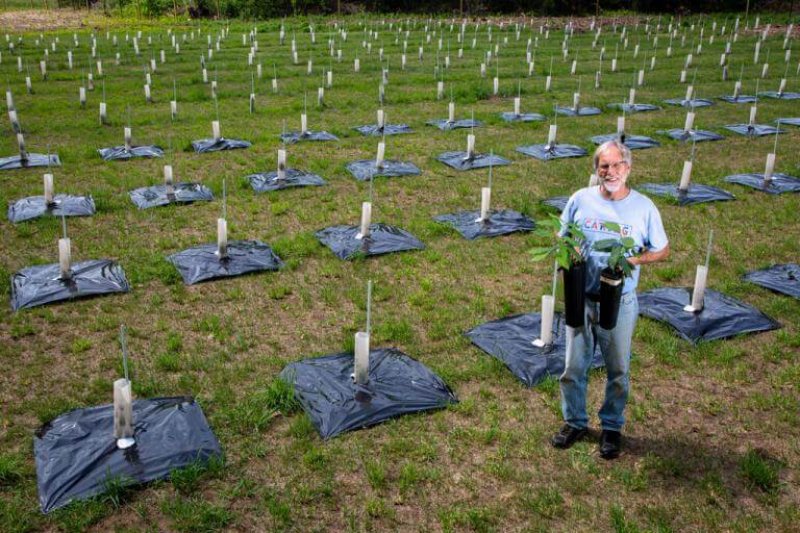
University of New England Professor Thomas Klak stands in a field of 550 fungal blight-tolerant American chestnut seedlings he helped develop in Cape Elizabeth. Credit: Troy R. Bennett/BDN

Though some are still scattered across the country, the [American] chestnut has been functionally extinct for 70 years. 

But science has other ideas. 

“This is a wild chestnut tree with 35,000 American chestnut genes — and one extra gene,” [gene conservationist Thomas] Klak told his crew of volunteers [recently] as he held a sapling.

That extra gene is a simple wheat gene also found in strawberries and barley, and which contains blight. Klak, who teaches environmental studies at the University of New England, hopes the gene will inoculate the young chestnut to help it withstand blight’s effects in the wild.

Besides that, transgenic chestnuts act the same as the originals did 150 years ago, Klak has found — in other words, substantially more useful than most trees. In experiments, tadpoles feeding on transgenic chestnut leaves grow 50 percent faster than with maple leaves, suggesting the nutritious qualities of the original American chestnuts are intact. 

Follow the latest news and policy debates on sustainable agriculture, biomedicine, and other ‘disruptive’ innovations. Subscribe to our newsletter.

The transgenic trees at the Cape Elizabeth orchard were planted alongside traditional chestnuts, blight-tolerant Chinese chestnuts and hybrids. In three years, Klak will introduce the trees with the chestnut blight and see who survives.


Read the original post

{{ reviewsTotal }}{{ options.labels.singularReviewCountLabel }}
{{ reviewsTotal }}{{ options.labels.pluralReviewCountLabel }}
{{ options.labels.newReviewButton }}
{{ userData.canReview.message }}

Related Articles

Infographic: Global regulatory and health research agencies on whether glyphosate causes cancer

Infographic: Global regulatory and health research agencies on whether glyphosate causes cancer

Does glyphosate—the world's most heavily-used herbicide—pose serious harm to humans? Is it carcinogenic? Those issues are of both legal and ...

Most Popular

Screenshot 2026-05-26 at 10.15
Viewpoint: Double standard—Why does the wellness industry get a free pass while Big Healthcare is treated as morally suspect?
Screenshot 2025-08-25 203032
Mazzenga’s 20-year old muscles: How a still-going-strong 92-year old sprinter wins every race she enters
global warming
‘Implausible’: Top climate scientists reject worst-case scenario—soaring temperatures and fast-rising sea levels
Screenshot-2026-06-03-at-3.33.44-PM
Viewpoint: Vaccine deniers are attacking a life-saving Vitamin K shot for newborns that isn’t even a vaccine
Screenshot-2026-06-05-at-1.44.09-PM
Viewpoint: Scientists have scrapped the worst-case climate scenario. Is that proof that climate change is a hoax, as Trump claims?
Screenshot-2026-06-08-at-1.35.30-PM
Viewpoint: Social media and fake natural health propaganda fuel surge in use of mostly useless supplements
px extra strength tylenol and tylenol pm
Why ‘null-findings’ on Tylenol’s safety for pregnant women barely move the needle on countering misinformation
Screenshot-2026-06-08-at-10.19.30-AM
‘Natural’ wellness supplements linked to liver injury
Screen Shot at AM
Facts & Fallacies Podcast: Right-wing politics bad for your health? Separating speculation from science
ChatGPT-Image-Jun-10-2026-12_57_24-PM
Viewpoint: Why gene-editing babies is moral and certain to happen
ChatGPT-Image-May-28-2026-12_56_54-PM
Viewpoint: Vaccines' non-specific effects? The ‘shoddy’ Danish couple whose 'research’ inspires RFK, Jr.’s health delusion
Credit: ACSH
Viewpoint: Who and what’s to blame for the surge in vaccine-preventable diseases?
Screenshot-2026-06-05-at-2.12.30-PM
Some plants can poison you. So how did humans figure out what is safe to eat?
glp menu logo outlined

Get news on human & agricultural genetics and biotechnology delivered to your inbox.