Agriculture originated in the Middle East’s Fertile Crecent. Who were the world’s first farmers? 

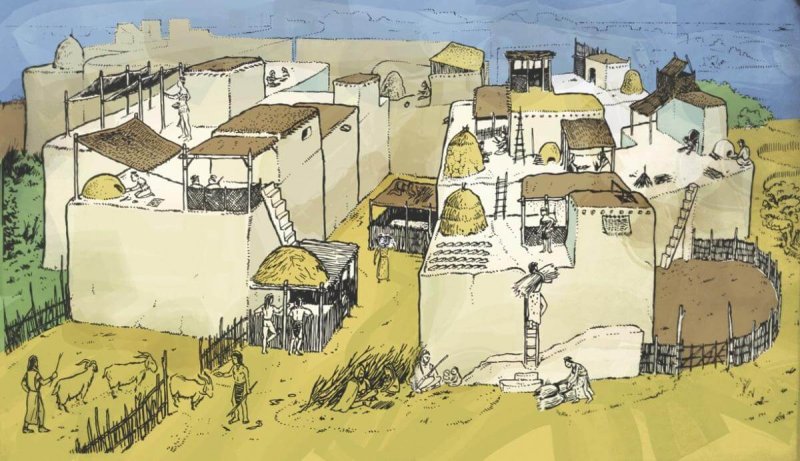
Illustration of Ҫatalhöyük , an ancient settlement that included small but diverse farming. Credit: John Swogger

The first signs of agriculture and a sedentary lifestyle are found in the so-called ‘Fertile Crescent’, a region in the Near East where people began to settle down and domesticate animals and plants about 11,000 years ago. The question of the origin of agriculture and sedentism has occupied researchers for over 100 years: did farming spread from the Near East through cultural diffusion or through migration?

Genetic analyses of prehistoric skeletons so far supported the idea that Europe’s first farmers were descended from hunter-gatherer populations in Anatolia. While that may well be the case, this new study shows that the Neolithic genetic origins cannot clearly be attributed to a single region.

Mis- and disinformation are distorting science and public policy. Subscribe to our Daily and Weekly Digests for incisive coverage of ‘disruptive’ innovations in AI, agricultural biotechnology, food, chemicals, nuclear energy, vaccines, and other disruptive innovations.

Nina Marchi, one of the study’s first authors from the Institute of Ecology and Evolution at the University of Bern and SIB says: “We now find that the first farmers of Anatolia and Europe emerged from a population admixed between hunter-gatherers from Europe and the Near East.”

According to the authors, the mixing process started around 14,000 years ago, which was followed by a period of extreme genetic differentiation lasting several thousand years.


This research was made possible by combining two techniques: the production of high-quality ancient genomes from prehistoric skeletons, coupled with demographic modeling on the resulting data.


This is an excerpt. Read the original post here

Related Articles

Infographic: Global regulatory and health research agencies on whether glyphosate causes cancer

Infographic: Global regulatory and health research agencies on whether glyphosate causes cancer

Does glyphosate—the world's most heavily-used herbicide—pose serious harm to humans? Is it carcinogenic? Those issues are of both legal and ...

Most Popular

ChatGPT-Image-Sep-2-2026-02_03_32-PM
AI data centers and water usage: It’s a genuine and growing problem
ChatGPT-Image-Mar-10-2026-01_39_01-PM
Viewpoint—“Miracle molecule” debunked: Why acemannan supplements don’t work
Screenshot-2026-09-16-at-3.14.20-PM
19%: Plunging support for Trump-RFK, Jr. measles vaccine safety oversight
ChatGPT-Image-Sep-16-2026-11_28_54-AM
Viewpoint: Study links childhood vaccination to autism!!! Here’s how anti-vaxxers twist evidence to corrupt science
ChatGPT-Image-Sep-10-2026-01_44_53-PM
Viewpoint: Why medical and health nonsense spreads so casually on pop culture media
ChatGPT-Image-Sep-17-2026-12_28_43-PM
Vitamin D, omega-3 fish oil and glucosamine supplements could cause brain damage 
ChatGPT-Image-Sep-21-2026-10_18_59-AM-2
Viewpoint: Is corporate embrace of regenerative agriculture greenwashing?
Screenshot-2026-09-18-at-11.35.25-AM
RFK Jr.’s latest crank obsession: Protecting Americans from perfectly safe electromagnetic radiation
ChatGPT-Image-Sep-20-2026-09_47_55-AM
Trump says he’ll require drugmakers to end multiple vaccine doses, reviving discredited autism claims
ChatGPT-Image-Sep-21-2026-10_55_04-AM
Viewpoint: America’s food-safety system is being methodically dismantled by the Trump administration.
Screenshot-2026-09-16-at-2.26.42-PM
Viewpoint: How to ecologically damage America’s forests: Ban glyphosate
glp menu logo outlined

Get news on human & agricultural genetics and biotechnology delivered to your inbox.