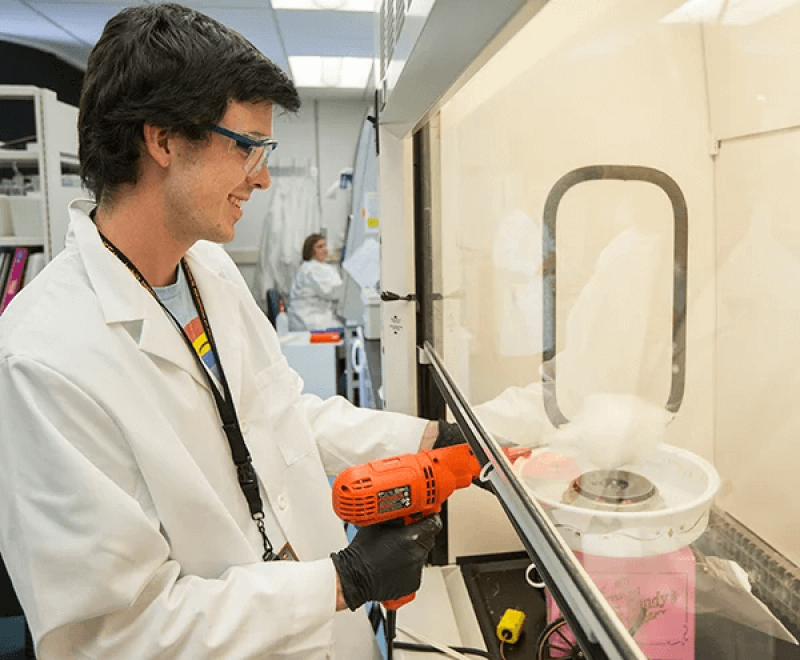
A ‘cotton candy machine’ that prints cardiac fibers brings us one step closer to easily repairing heart injuries

Researchers at Vanderbilt University use a "cotton candy machine" to generate tissue fibers. Credit: Popular Science

Researchers at Harvard’s John A. Paulson School of Engineering and Applied Sciences (SEAS) believe they have taken a step towards solving a centuries-old heart muscle mystery — and towards the ability to eventually fabricate entire human hearts for transplantation.

Using a new form of textile manufacturing, akin to a cotton candy machine, the SEAS team was able to build a model of human ventricles (those beefy chambers in the heart that pump blood out into the body) that were not only capable of beating, but recreated the unique structure of heart muscles — a structure that scientists have been trying to tease out the meaning of since 1669. 

Mis- and disinformation are distorting science and public policy. Subscribe to our Daily and Weekly Digests for incisive coverage of ‘disruptive’ innovations in AI, agricultural biotechnology, food, chemicals, nuclear energy, vaccines, and other disruptive innovations.

The device spins, forcing out a polymer that can be adjusted by using an airstream. By angling and rotating it, the team found they could form scaffolding that could recreate heart muscle’s spirals.


“The human heart actually has multiple layers of helically aligned muscles with different angles of alignment,” Huibin Chang, SEAS postdoctoral fellow and co-first author, said. “With FRJS, we can recreate those complex structures in a really precise way, forming single and even four chambered ventricle structures.”

The team created spiral scaffolding in the shape of ventricles, then rat and human heart muscle cells were then spread on, like a cardiac chia pet, growing multiple thin layers of beating muscle tissue.


This is an excerpt. Read the original post here

Related Articles

Infographic: Global regulatory and health research agencies on whether glyphosate causes cancer

Infographic: Global regulatory and health research agencies on whether glyphosate causes cancer

Does glyphosate—the world's most heavily-used herbicide—pose serious harm to humans? Is it carcinogenic? Those issues are of both legal and ...

Most Popular

ChatGPT-Image-Mar-10-2026-01_39_01-PM
Viewpoint—“Miracle molecule” debunked: Why acemannan supplements don’t work
ChatGPT-Image-Sep-2-2026-02_03_32-PM
How much of a problem is AI’s water use?
ChatGPT-Image-Sep-22-2026-10_32_46-AM
There has been a slew of recent reports of food recalls and foodborne outbreaks. Do we face an escalating problem?
ChatGPT-Image-Aug-26-2026-12_46_16-PM
Viewpoint: The fake controversy over whether combining childhood vaccines is dangerous— a debate science resolved 25 years ago
ChatGPT-Image-Sep-18-2026-01_38_09-PM
Microsoft exec: AI is a ‘doom loop’ scraping the ‘largest theft of labor in human history'
ChatGPT-Image-Sep-10-2026-01_44_53-PM
Viewpoint: Why medical and health nonsense spreads so casually on pop culture media
Screenshot-2026-09-17-at-12.00.30-PM
Investigative group ProPublica finds links between ectopic pregnancy deaths and abortion bans
ChatGPT-Image-Sep-21-2026-03_41_02-PM
Viewpoint: Does IQ really measure intelligence? BBC gets it wrong.
ChatGPT-Image-Sep-23-2026-11_47_32-AM
Facing pressure from Trump administration, fewer hospitals offer medical treatment for transgender minors
Screenshot-2026-09-16-at-3.14.20-PM
19%: Plunging support for Trump-RFK, Jr. measles vaccine safety oversight
ChatGPT-Image-Sep-17-2026-11_03_54-AM-2
AI sparks a bioweapons race
Screenshot-2026-09-16-at-2.26.42-PM
Viewpoint: How to ecologically damage America’s forests: Ban glyphosate
ChatGPT-Image-Sep-17-2026-12_28_43-PM
Vitamin D, omega-3 fish oil and glucosamine supplements could cause brain damage 
glp menu logo outlined

Get news on human & agricultural genetics and biotechnology delivered to your inbox.