


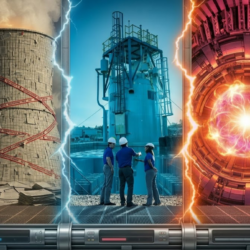
Today’s nuclear power plants generate energy through a process called nuclear fission. … This fission chain reaction provides a steady stream of energy but also results in long-lived nuclear waste. … With fusion, forms of hydrogen, called deuterium and tritium, would join to create heavier atoms. This process, which powers stars in the universe, releases a large amount of energy and, unlike fission, produces very little radioactive waste.
While deuterium is readily available, the U.S. currently lacks a secure and predictable supply of tritium.
So, [Terence Tarnowsky, a physicist at Los Almos National Laboratory (LANL)] saw an opportunity to assess the feasibility of using still-radioactive nuclear waste to generate valuable tritium. He has conducted multiple computer simulations of potential tritium reactors to evaluate the designs’ production and energy efficiency.
The simulated reactor designs use a particle accelerator to jump-start atom-splitting reactions in the nuclear waste. As atoms divide in the simulation, they release neutrons and ultimately produce tritium after a series of other nuclear transitions.



This is an excerpt. Read the original post here





















