For years, the country’s major environmental groups stood shoulder to shoulder against nuclear power. That unanimity may be starting to crack. There are the die-hards, of course, who remain staunch opponents. Greenpeace still insists that “the only solution is to halt the expansion of all nuclear power.” Friends of the Earth says “nuclear power is extremely expensive and creates a legacy of radioactive waste that lasts for thousands of years.” Beyond Nuclear calls small modular reactors — usually shortened to SMRs, meaning smaller nuclear reactors designed to be factory-built, mass-produced, and easier to deploy — “too expensive, too small, too late,” and “irrelevant for climate change.”
But in a promising sign, the Natural Resources Defense Council, in a striking break from its decades-old orthodoxy, has admitted that a proposed reactor restart could bring “decarbonization, consumer and grid benefits.” And two years ago in Brussels, 20 environmental groups signed an “NGO Declaration on the Future of Nuclear Energy” calling nuclear a “uniquely valuable clean energy source” and saying civil-society groups can help support its expansion safely and securely. These signatories publicly describe themselves as climate-focused nonprofits and explicitly support nuclear as part of decarbonization.
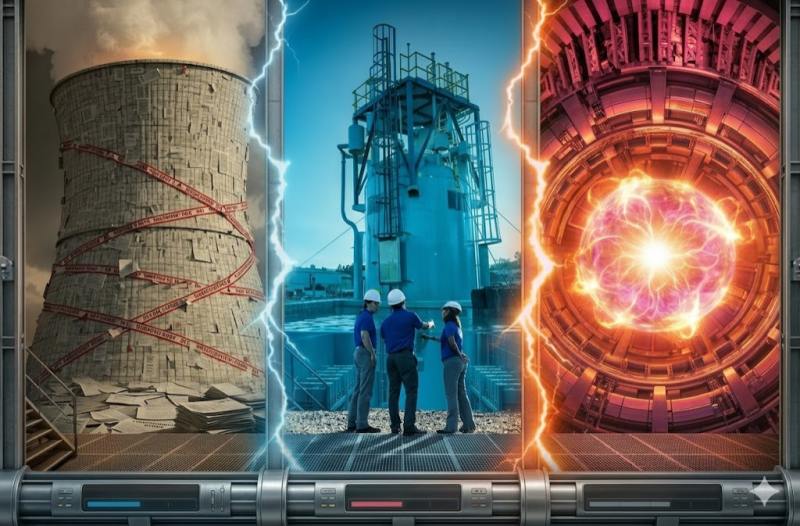
This split matters because the nuclear debate is changing. It is no longer mainly about huge, aging plants that shaped public fears after the accidents at Three Mile Island, Chernobyl, and Fukushima — all accidents involving nuclear fission, the process of generating power by splitting heavy atoms such as uranium. Today, commercial nuclear power still comes entirely from fission. The real argument is over what comes next: whether the future belongs to those older, large, custom-built reactors; a new generation of advanced fission reactors, including small modular reactors (SMRs) and microreactors — both are now moving through development and early deployment; or fusion, the long-promised technology that sounds cleaner and more ideal but is still far from commercial reality. Fusion works differently from fission: Instead of splitting atoms, it joins light atoms, usually forms of hydrogen, releasing enormous energy in the same basic process that powers the sun.
But we should not let perfection become the enemy of the excellent — not just the good.
Fusion has a built-in advantage in this fight, at least in theory. It sounds like nuclear power without the baggage. It promises abundant clean energy without the accidents, waste-disposal problems, or political scars that still cling to conventional fission. That helps explain why it attracts so much money and attention. But attention is not the same as readiness, or even practicality. The Lawrence Livermore National Laboratory, home to the government’s headline-grabbing fusion experiments, describes its National Ignition Facility as an experimental research effort, not a commercial power source. And the National Academies says a U.S. fusion pilot plant is still a goal for the 2035-2040 period, not the near future.
The latest dubious example of that misplaced enthusiasm is the push to invest billions chasing the dream of nuclear fusion because it is seen as “perfect” for the environment.
For years, energy development resources have been steered toward other, non-nuclear alternatives with significant limitations. We have already described the misallocation of resources into renewables such as solar and wind, which have significant disadvantages. That appeal is understandable, but it draws funding and attention away from nuclear technologies that are less glamorous and less ideologically seductive.
There are already ways that nuclear fission can generate large amounts of clean, reliable energy, while nuclear fusion remains an engineering challenge of extraordinary complexity. Even with help from artificial intelligence, today’s efforts at a fusion prototype still require enormous energy inputs for only modest gains in output. AI may accelerate some advances, but for now, it has not changed the basic reality: These projects consume vast amounts of energy to produce only a small additional return.
Nuclear fusion today is analogous to building a 50-ton automobile to achieve a one-mile-per-gallon improvement in fuel efficiency: huge input for only incremental improvement.
We understand the long-term allure of fusion. It promises abundant fuel, no combustion emissions, and a cleaner image than conventional nuclear power. However, true commercialization is probably decades away.
The operative question, then, is whether any of today’s fusion approaches can get to market before advanced fission does — especially SMRs and microreactors. Both are designed for mass production and easier deployment in the near future — while fusion remains more promise than product.
Several factors cloud that choice: fusion hype mixed with technical uncertainty; cost and regulatory questions; and the tendency to blur distinctions between older nuclear plants and newer designs.
As to the promise of nuclear power generally, skeptics point out that the U.S. has built only one or two nuclear power plants in the last 40 years, while many have been decommissioned; that much of Europe (except for France) has soured on it; and that nuclear waste is a significant, unsolved problem. In addition, there were the safety incidents at Three Mile Island, Fukushima, and Chernobyl.
Those skeptics would be correct if the future of nuclear was in large, unique, civil works projects where there is little mass production involved; if older, less safe designs were still being used; if we were to discourage innovation in handling the very modest amount of nuclear waste involved; and if outdated methods of packaging the uranium fuel continued to be employed. But those reservations ignore a new, dramatically more cost-effective and manageable way to deliver power from fission — SMRs and microreactors.

The U.S. government and the entrepreneurial forces of technology have finally awakened to the potential of SMRs. The vision is straightforward: smaller reactors roughly the size of one or two shipping containers, designed to be manufactured more efficiently, transported more easily, and installed as needed.
Each SMR is expected to produce 100 to 300 megawatts of power — enough, on an annual-energy basis, to match the output of roughly 90 to 360 wind turbines; around 100 acres of solar panels; or one typical public utility-grade natural gas turbine, which requires a continuous feed of fuel. Individual microreactors produce less but can be easily aggregated as needed and typically require limited site preparation. The nuclear fuel itself is contained in small, ceramic-encased pellets designed for high durability and resilience — in contrast to the enormous concrete containment structures used in today’s nuclear plants. The aim is to make nuclear power more accessible, manageable, and, ultimately, cheaper.
While many startups are attempting to advance the science and engineering needed to make fusion feasible, there are others on the verge of producing cheaper, safer, and more deployable SMRs and microreactors. They should not be starved of funds or regulatory flexibility in pursuit of the distant dream of fusion.
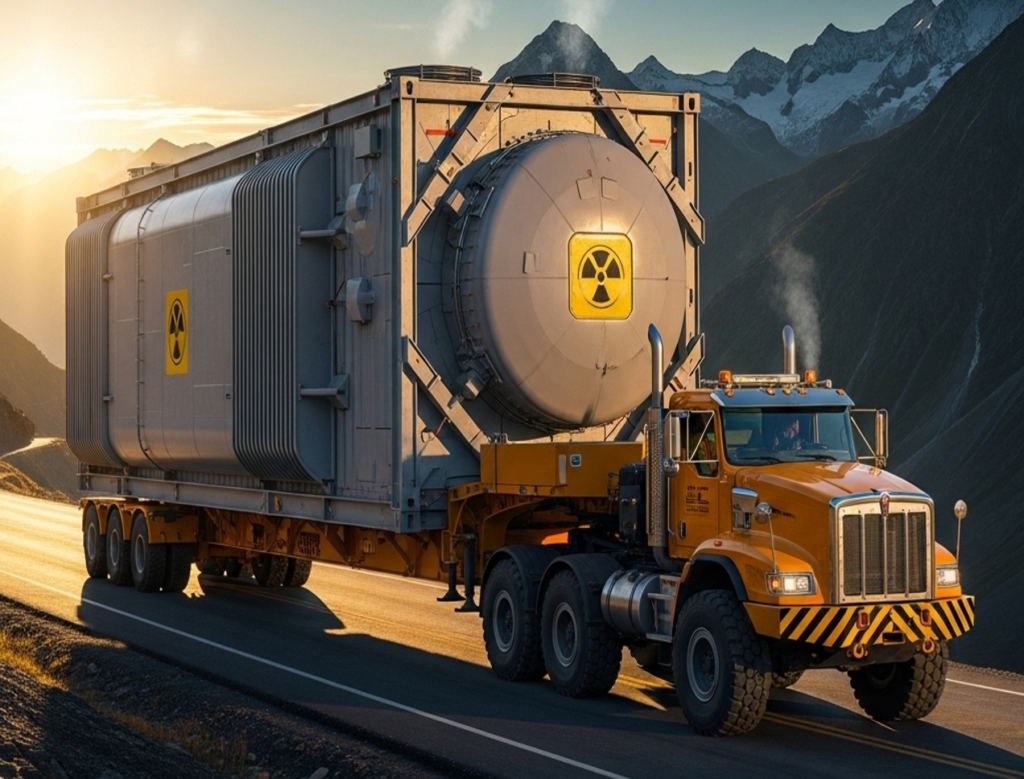
Without delving into the economics of mining, enriching, and packaging uranium, and building the SMR vessel itself, all these steps except mining are amenable to economies of scale and automation. But the raw ore is plentiful and relatively easy to unearth. Though it may take several years and iterations to achieve, the cost of power should begin to decrease significantly as savings from co-location — putting generation close to the customers who need it — mass production, and automation take hold. All this can happen without massive one-off works projects with their inevitable high costs and lack of economic scale.
SMRs will allow power from nuclear fission to move along the innovation curve far faster than nuclear fusion, in anything resembling its current forms, can become competitive. Development money can be far better spent in the SMR space, while what fusion requires is mainly research money to discover a design that improves significantly from the energy-intensive, low-yield approaches of today’s technology. Innovative solutions could include new, exotic materials to provide containment or new reaction-triggering mechanisms.
The tide has already begun to turn in favor of SMRs. Google’s agreement with Kairos Power is intended to bring the company’s first reactor online by 2030, followed by additional deployments through 2035, with up to 500 megawatts (MW) of carbon-free power eventually delivered to U.S. grids. That is roughly enough electricity, if sustained for over a year, to match the annual consumption of about 425,000 average U.S. homes, or several large hyperscale data centers. Separately, Kairos, Google and the Tennessee Valley Authority announced that by 2030 the Hermes 2 plant in Oak Ridge, Tennessee, “will deliver up to 50 megawatts (MW) of reliable, 24/7 energy to the TVA grid that powers Google data centers in Tennessee and Alabama.”
For a half-century, energy “innovators” have misallocated energy development resources to high-profile but often impractical technologies like large-scale wind and solar, which cannot by themselves provide the abundant, always-on power that modern economies require — but were more attractive to climate-change activists. We should not repeat that mistake by chasing fusion as an environmental fantasy while overlooking the nuclear fission technologies that can be built, improved, and deployed on a reasonable timetable.
Some environmental groups are beginning to acknowledge that reality. Others are not. But if the goal is abundant, reliable, cleaner energy in the foreseeable future, the choice is between nuclear technologies that can be ready in time — namely, advanced fission, especially SMRs — and those that may not.
Andrew I. Fillat spent his career in technology venture capital and information technology companies. He is also the co-inventor of relational databases.
Henry I. Miller, a physician and molecular biologist, is the Glenn Swogger Distinguished Scholar at the Science Literacy Project. Find Henry at his website: henrymillermd.org
[Editor’s note]: Fillat and Miller were undergraduates together at M.I.T. and have no economic stake in their recommendations.