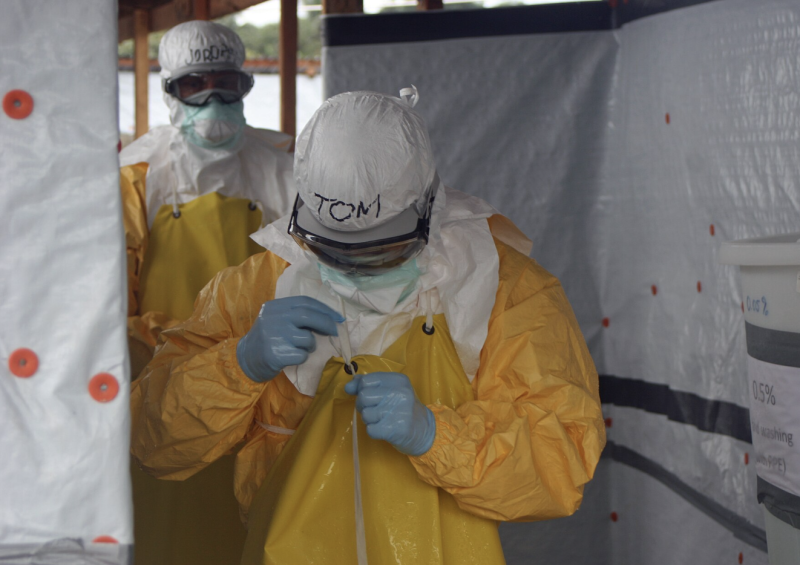
Viewpoint: Doctors who are battling Ebola are incredulous that U.S. government is not utilizing specially designed emergency health units meant to fight virulent disease

Credit: Creative Commons

Doctors around the country are baffled, disturbed, and in some cases aghast at the Trump administration’s plan for Americans who get Ebola overseas—in particular, the decision not to bring these patients back home, to one of the facilities that the federal government created precisely for this purpose.

And if you want to know why these medical professionals are upset, ask infectious disease physician Tara Palmore.

Palmore knows better than most what Ebola care looks like in the American facilities, because she provided it during the 2014 outbreak. Although most of the cases were in West Africa, nearly a dozen infected Americans got treatment in the United States, including one who ended up at a facility inside the National Institutes of Health Clinical Center in Bethesda, Maryland.

Follow the latest news and policy debates on sustainable agriculture, biomedicine, and other ‘disruptive’ innovations. Subscribe to our newsletter.

That is where Palmore was working at the time. And in a phone interview…, she described the unit to me—how the surfaces are all nonporous, lest they absorb infected bodily fluids that can’t be fully wiped away, and how there’s extra space for medical equipment, because staff have to bring machines to the patient rather than the other way around.


This is an excerpt. Read the original post here

{{ reviewsTotal }}{{ options.labels.singularReviewCountLabel }}
{{ reviewsTotal }}{{ options.labels.pluralReviewCountLabel }}
{{ options.labels.newReviewButton }}
{{ userData.canReview.message }}

Related Articles

Infographic: Global regulatory and health research agencies on whether glyphosate causes cancer

Infographic: Global regulatory and health research agencies on whether glyphosate causes cancer

Does glyphosate—the world's most heavily-used herbicide—pose serious harm to humans? Is it carcinogenic? Those issues are of both legal and ...

Most Popular

ChatGPT Image Jun 3, 2026, 03_54_37 PM
Viewpoint: “Turn on, tune in, drop out”—Kennedy embraces the Timothy Leary psychedelic revolution
ChatGPT-Image-Jun-11-2026-01_15_03-PM
Selective Pressure, Selective Silence
Screenshot-2026-06-05-at-2.12.30-PM
Some plants can poison you. So how did humans figure out what is safe to eat?
ChatGPT Image Jun 3, 2026, 03_14_43 PM
Viewpoint: How Earthjustice became the poster child for the abuse of special interest activist funding
ChatGPT Image Jun 1, 2026, 11_39_17 AM
Viewpoint: When food myths go viral, farmers pay the price
Screenshot-2026-06-11-at-3.40.06-PM
'Toxin' detox: A gastroenterologist weighs in on $71 billion health trend
Screenshot-2026-06-03-at-1.24.46-PM
Challenging anti-GMO disinformation: Why genetically-tweaked crops offer bushels of benefits
Screenshot-2026-06-11-at-4.00.17-PM
Gen Z burned by sunscreen misinformation and tanning myths
ChatGPT Image May 26, 2026, 08_42_17 AM (1)
Viewpoint: Greenpeace and poison: How environmental advocacy groups rely on compliant (and often ignorant) journalists to spread disinformation and spark litigation

Sorry. No data so far.

glp menu logo outlined

Get news on human & agricultural genetics and biotechnology delivered to your inbox.