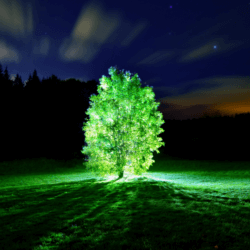
Can color-changing flowers quell fears about GMOs?

In a couple years, if you’re at the florist and are trying to decide between red roses or yellow roses, you might have the choice to, well, not choose: Synthetic biologists are working on making flowers that change colors throughout the day, coordinated with the plant’s internal circadian rhythm.

It’s a project that’s reminiscent of the glow-in-the-dark plants that biohackers have created in the lab, except the scientists working on it say that they hope to create a product that the layperson can inherently understand and will want to buy at their local flower shop. It’s synthetic bio for your mom—or for people who might be a bit freaked out by synthetic bio in general.

So, in that spirit, Havens and her colleague, Nikolai Braun, have chosen to create petunias that change color every 12 hours. Rather than plucking a gene from a glow-in-the-dark bacteria or some other creature with a desirable trait, the team simply has to use a gene from another species of petunia.

If you didn’t realize that the flowers are genetically engineered, you probably wouldn’t see them and immediately think of them as “mutants.” Which is the point.

In that sense, it might be a little less scary to the anti-GMO crowd: Botanists have been crossbreeding and hybridizing plants for centuries—Havens and Braun are doing it in a laboratory, with a bit of circadian trickery, of course.

Read the full, original story: Will people actually buy color changing, biohacked flowers?

Related Articles

Infographic: Global regulatory and health research agencies on whether glyphosate causes cancer

Infographic: Global regulatory and health research agencies on whether glyphosate causes cancer

Does glyphosate—the world's most heavily-used herbicide—pose serious harm to humans? Is it carcinogenic? Those issues are of both legal and ...

Most Popular

Nurturing Care Beneath the Crunchy Moms Logo
Crunchy Moms disinformation flood: Zuckerberg's Facebook has opened floodgates on measles and vaccines
Screenshot-2026-11-19-at-7.54.57-PM
European General Court sides with scientists, dismisses activist claims that glyphosate is toxically dangerous
Screenshot-2026-11-16-at-2.37.32-PM
30 years of GMO farming: Is the boom in glyphosate and glufosinate use harming the environment? Data show they’re the most sustainable choice
Stormlit Portrait Over Golden Mountains
Searching for life where no one thought to look: A renowned astrophysicist’s seemingly quixotic quest to explore Venus’s clouds
Soybean Harvest in Cupped Hands
30 years of GMO farming: Defying cynics, we’ve had larger harvests, lower costs, and $385 billion in added global farmer income
Screenshot-2026-11-19-at-7.23.23-PM
Viewpoint: After a yearlong hiatus, the U.S. Preventive Services Task Force is back in business—gutted by RFK Jr. and promoting junk science
Screenshot-2026-11-18-at-2.44.24-PM
Why should thousands of Americans die every year waiting for a kidney transplant? There’s an easy fix to this morbid reality
ChatGPT-Image-Mar-10-2026-01_39_01-PM
Viewpoint—“Miracle molecule” debunked: Why acemannan supplements don’t work
Screenshot-2026-11-17-at-12.18.09-PM
Challenging glyphosate fear-mongering: Statewide Nebraska study finds no link between weedkiller use and non-Hodgkin lymphoma
glp menu logo outlined

Get news on human & agricultural genetics and biotechnology delivered to your inbox.