Even if organic food was as cheap as conventional, not everyone would buy it, study finds

[Editor’s note: Jayson Lusk is a professor in the Department of Agricultural Economics at Oklahoma State University.]

I presumed most people would choose organic if it were priced the same as conventional. [A European food retailer said], however, that his retail experience was … [that] even when he substantially lowered the price premium for organic, the market share remained relatively low.

We conducted studies with apples and with milk [to test this observation].

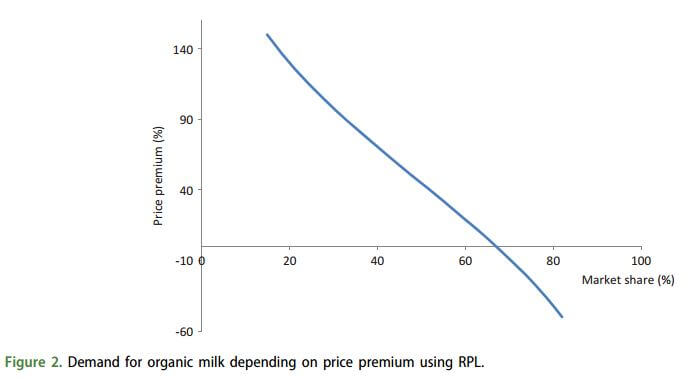
Even in these controlled studies, we find that if organic were priced the same as conventional (a price premium of 0%), not everyone would buy organic. Priced evenly with conventional, organic would pick up only about 60% of the apple market (the remaining 40% going to conventional), and organic would pick up only about 68% of the milk market (the remaining 32% going to conventional).

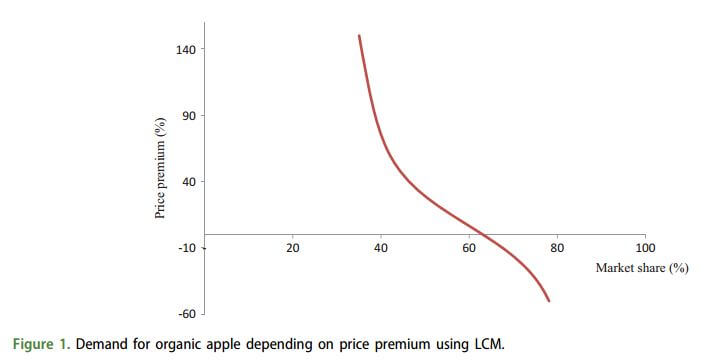
Given differences in yield and production costs, organic is almost surely going to be routinely higher priced than conventional. But, even if this weren’t the case and organic could be competitively priced, these survey results show us that not everyone prefers organic food.

[Read the full study here (behind paywall).]

The GLP aggregated and excerpted this blog/article to reflect the diversity of news, opinion, and analysis. Read full, original post: Does everybody prefer organic?

{{ reviewsTotal }}{{ options.labels.singularReviewCountLabel }}
{{ reviewsTotal }}{{ options.labels.pluralReviewCountLabel }}
{{ options.labels.newReviewButton }}
{{ userData.canReview.message }}

Related Articles

Infographic: Global regulatory and health research agencies on whether glyphosate causes cancer

Infographic: Global regulatory and health research agencies on whether glyphosate causes cancer

Does glyphosate—the world's most heavily-used herbicide—pose serious harm to humans? Is it carcinogenic? Those issues are of both legal and ...

Most Popular

ChatGPT Image Jun 3, 2026, 03_54_37 PM
Viewpoint: “Turn on, tune in, drop out”—Kennedy embraces the Timothy Leary psychedelic revolution
ChatGPT-Image-Jun-11-2026-01_15_03-PM
Selective Pressure, Selective Silence
Screenshot-2026-06-05-at-2.12.30-PM
Some plants can poison you. So how did humans figure out what is safe to eat?
ChatGPT Image Jun 3, 2026, 03_14_43 PM
Viewpoint: How Earthjustice became the poster child for the abuse of special interest activist funding
Screenshot-2026-06-11-at-4.00.17-PM
Gen Z burned by sunscreen misinformation and tanning myths
Screenshot-2026-06-03-at-1.24.46-PM
Challenging anti-GMO disinformation: Why genetically-tweaked crops offer bushels of benefits
Screenshot-2026-06-05-at-1.44.09-PM
Viewpoint: Scientists have scrapped the worst-case climate scenario. Is that proof that climate change is a hoax, as Trump claims?
ChatGPT Image May 28, 2026, 08_16_38 PM
Viewpoint: Why the EPA mismeasures cancer risk of chemicals and what should be done to fix it
ChatGPT Image Jun 1, 2026, 11_39_17 AM
Viewpoint: When food myths go viral, farmers pay the price

Sorry. No data so far.

glp menu logo outlined

Get news on human & agricultural genetics and biotechnology delivered to your inbox.