
US life expectancy rose 5 years since 1980, but many poorer Americans dying younger

Expectancy

Your life expectancy can vary by as much as 20 years depending on which county in the U.S. you live in.

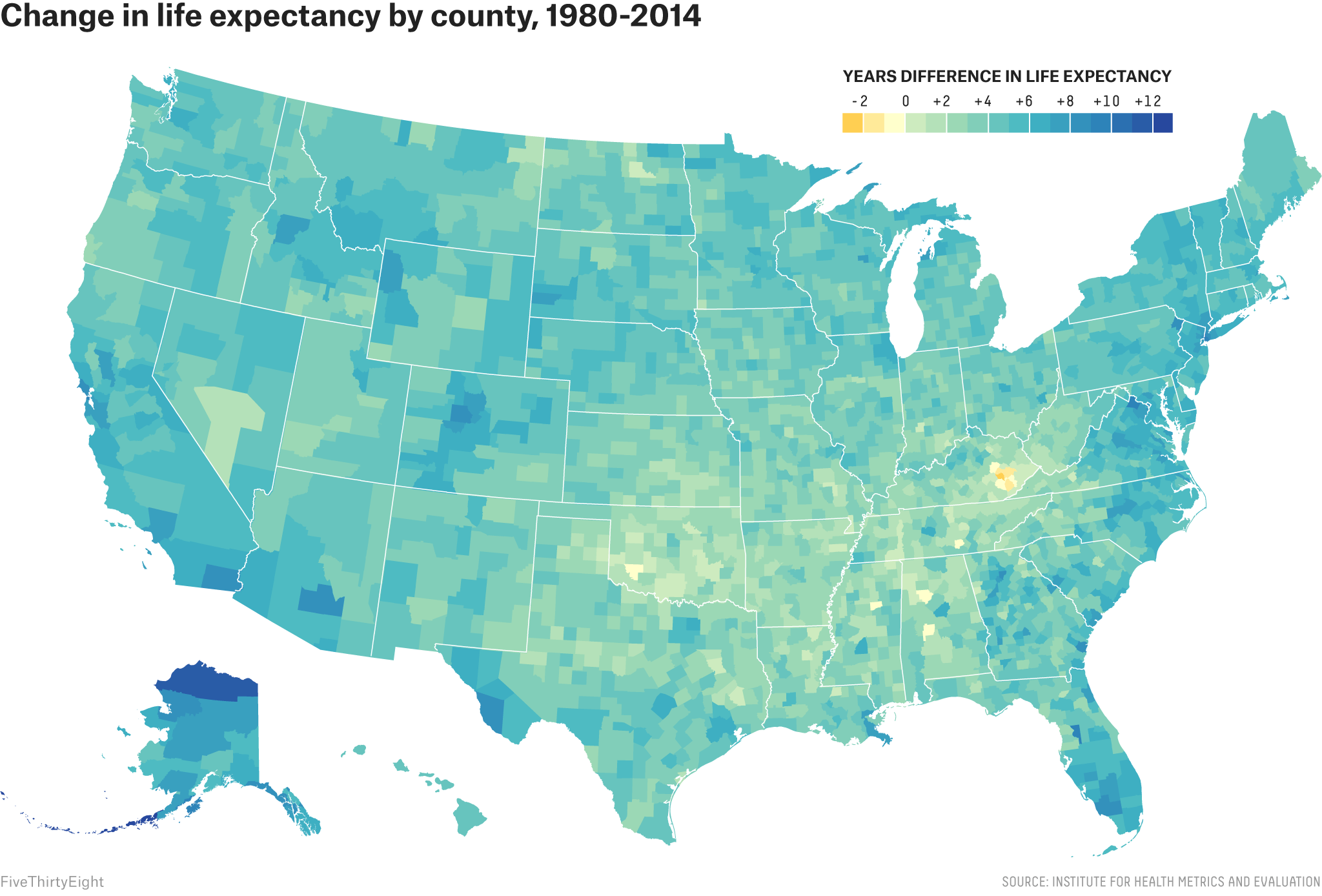
That’s according to new research published [May 8] in the journal JAMA Internal Medicine. Life expectancy for the country as a whole grew by more than five years from 1980 to 2014, to an average of 79.1 years. During that time, however, some areas saw increases of more than 13 years, while a few others saw declines of up to 2.3 years. This new study adds to a growing body of research showing that race, education, wealth and where you live can help determine how long you will live.
barry jester life expectancy b

In Kentucky, for example, average life expectancy increased from 72.9 to 76.3 years over the 35-year span the authors studied. But in the eastern part of the state, in the heart of Appalachia, life expectancy decreased. Babies born in eastern Kentucky, along the Mississippi Delta and on Native American reservations in the Dakotas have the lowest life expectancies in the country. If current health trends continue, they aren’t expected to live much beyond an average of 70 years. Meanwhile, a baby born along the wealthy coast of California can be expected to live as long as 85 years, the authors found.

The GLP aggregated and excerpted this blog/article to reflect the diversity of news, opinion, and analysis. Read full, original post:  As U.S. Life Expectancies Climb, People In A Few Places Are Dying Younger

{{ reviewsTotal }}{{ options.labels.singularReviewCountLabel }}
{{ reviewsTotal }}{{ options.labels.pluralReviewCountLabel }}
{{ options.labels.newReviewButton }}
{{ userData.canReview.message }}

Related Articles

Infographic: Global regulatory and health research agencies on whether glyphosate causes cancer

Infographic: Global regulatory and health research agencies on whether glyphosate causes cancer

Does glyphosate—the world's most heavily-used herbicide—pose serious harm to humans? Is it carcinogenic? Those issues are of both legal and ...

Most Popular

ChatGPT-Image-Mar-10-2026-01_39_01-PM
Viewpoint—“Miracle molecule” debunked: Why acemannan supplements don’t work
ChatGPT-Image-Jul-8-2026-12_32_48-PM
Viewpoint: SCOTUS strikes a blow against junk science in Bayer glyphosate case. Will it deter mass tort litigators?
afb-a-b
As the EU loosens restrictions on agricultural gene editing, it remains years behind the rest of the world on equally-safe GMO foods
ChatGPT-Image-Jul-7-2026-01_57_55-PM
Viewpoint: Europe’s rejection of air conditioning is the poster child for misunderstanding how to mitigate the impact of climate change
ChatGPT-Image-Jun-25-2026-12_23_17-PM
No, Bill Gates did not secretly engineer ticks to promote veganism
Screenshot-2026-07-10-at-2.02.54-PM
Viewpoint: In abortion-restricting Florida, misinformation abounds when Republican congresswoman faces an ectopic pregnancy
Screenshot-2026-07-10-at-3.25.10-PM
Using AI for health questions? Here are 4 tips for the most accurate answers.
Screenshot-2026-07-10-at-3.10.50-PM
Snake-oil cures throughout history
Screen-Shot-at-PM-pe-vra-kipgaprbdo-vd-ms-jpule-n-jqqaxf-l-e
Viewpoint: Will new breeding techniques help make European agriculture more competitive?
Screenshot-2026-07-10-at-12.55.21-PM
Cancer health facts are particularly susceptible to online misinformation
Screenshot-2026-07-08-at-2.14.27-PM
Belief in unproven dietary regimes, vitamins, and crank therapies is putting patients’ health in danger and increasing the risk of getting cancer

ChatGPT-Image-Jul-1-2026-03_33_49-PM
‘Alternative’ cancer treatments that could kill you
glp menu logo outlined

Get news on human & agricultural genetics and biotechnology delivered to your inbox.