Sharpening CRISPR gene-editing accuracy with ‘molecular glue’

crispr editorial
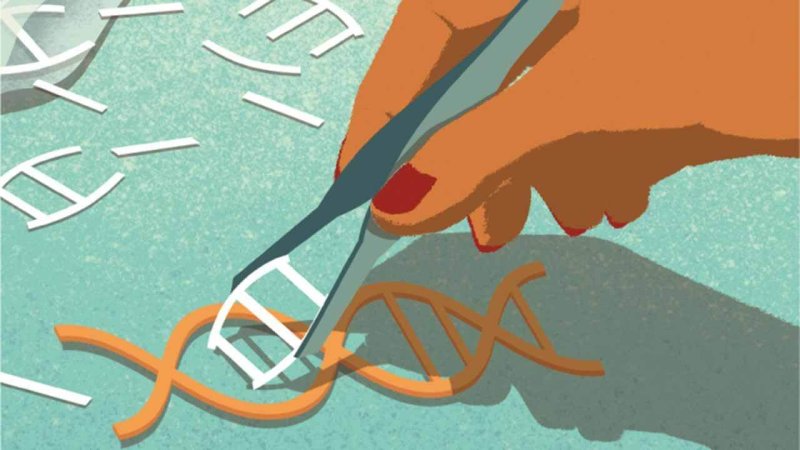
[A]lthough [CRISPR] technology reliably finds and cuts the targeted stretch of DNA sequence, fixing that cut as desired has been something of a hit-or-miss process. Error rates as high as 50 percent are a particular problem when the goal is to correct typos in the DNA that cause genetic disease.

Now, a team of researchers led by Krishanu Saha, a professor of biomedical engineering at the University of Wisconsin–Madison, has made the fix less error-prone and published its approach [November 23] in the journal Nature Communications.

Compared to standard CRISPR technology, the new method improves the likelihood of rewriting the DNA sequence exactly as desired by a factor of 10. The researchers achieved this much greater precision by taking advantage of a molecular glue, called an RNA aptamer, to assemble and deliver a complete CRISPR repair kit to the site of the DNA cut.

The new method has several other advantages over current technology. First, the off-the-shelf kit contains only non-viral reagents, which simplifies the manufacturing process and reduces safety concerns for clinical applications of genetic surgery in the future. Second, attaching an RNA aptamer to the kit is much easier than modifying the Cas9 protein and provides greater flexibility.

The GLP aggregated and excerpted this blog/article to reflect the diversity of news, opinion, and analysis. Read full, original post: All-in-one repair kit makes CRISPR gene editing more precise

{{ reviewsTotal }}{{ options.labels.singularReviewCountLabel }}
{{ reviewsTotal }}{{ options.labels.pluralReviewCountLabel }}
{{ options.labels.noReviewsLabel }}
{{ options.labels.newReviewButton }}
{{ userData.canReview.message }}

Related Articles

Infographic: Global regulatory and health research agencies on whether glyphosate causes cancer

Infographic: Global regulatory and health research agencies on whether glyphosate causes cancer

Does glyphosate—the world's most heavily-used herbicide—pose serious harm to humans? Is it carcinogenic? Those issues are of both legal and ...

Most Popular

ChatGPT-Image-Jul-22-2026-09_13_07-AM
Viewpoint—The Strategic Litigation boom: Understanding the tightening coalition among NGOs, foundations, journalists, and tort lawyers
ChatGPT-Image-Mar-10-2026-01_39_01-PM
Viewpoint—“Miracle molecule” debunked: Why acemannan supplements don’t work
close up arabica coffee farmer s hands picking beans plant his farm colombia
Viewpoint: Why do so many ‘mainstream’ and ‘respected’ media outlets exaggerate climate change threats?
How to Include More Strawberries in Your Diet
Strawberries are berries—and 35 other surprising food and drink myths
organic scaled
Facts & Fallacies podcast: Organic food cuts pesticide exposure? A response to Dr. Rhonda Patrick
diversity
We are entering a new era of personalized medicine—if you’re white
Screenshot-2026-07-07-at-12.55.44-PM
Viewpoint: Yes, we can adapt to a changing climate without devastating the environment and the economy
ChatGPT-Image-May-22-2026-10_26_09-AM
Trump-RFK, Jr. National Science Board firings: Accountability vs. partisan meddling
kratom
Viewpoint: Kratom ‘supplement’ crisis: DEA sits on its hands while patient addictions to this ineffective drug  rise
Screenshot 2026-07-22 at 10.25
Science brain drain escalates as Trump purge extends to USDA
using genetics to reverse aging

Is the longevity obsession a new form of ageism?
Screenshot-2026-07-01-at-2.49.48-PM
Dr. TikTok and male fertility: Viral claims tout GLP-1 drugs as fertility boosters. What does the science say?
ChatGPT-Image-Jun-25-2026-02_53_56-PM
Embryo gene editing is on the horizon, stirring mixed emotions
glp menu logo outlined

Get news on human & agricultural genetics and biotechnology delivered to your inbox.