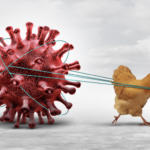
The Black Plague can still pull some headlines. A Guardian story last week that overstated the possibility that rat fleas might not have been the culprit of transmission went viral, garnering more than 80,000 shares in two days.
Seven hundred years later, we are still compelled by the story of the Black Death and the mysteries that surround it. How is it some people survived? Were they inherently immune? And how did a disease that killed so many seem to disappear?
Scientist estimate the plague killed nearly half the population of Europe in the mid-1300s, but what happened to the other half? NIH researcher Stephen O’Brien’s work with AIDS identified a particular genetic mutation, Delta 32, that prevents both HIV and plague bacteria from entering human cells and causing infection–what geneticists cause a “positive mutation” because it confers survival benefits on those who carry it.
As O’Brien explained to PBS’ Secrets of the Dead, both the AIDS virus and plague bacteria hijack the body’s white blood cells. In the case of plague, this spreads infection into the lymph nodes. O’Brien discovered this same positive mutation in about 14% of the living descendants of plague survivors from the English town of Ewly. He hypothesized that the mutation became more wide spread after the plague because survivors, carrying the mutated allele, reproduced together. This same mutation explains why some European populations are less susceptible to HIV infection, according to O’Brien.
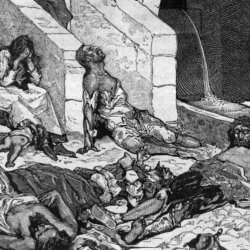




Within five years of the most severe outbreak in Europe, the plague was on its way out, most likely, scientists believe, because it was so virulent, it ran out of hosts to infect. Steven Salzberg at Forbes explains:
Evolutionary theory tells us that a pathogen that kills all its victims will eventually run out of victims, leading to its own extinction. The plague bacteria needed to evolve into something less virulent, and that seems to be what happened. A bug that doesn’t kill its host is far more successful evolutionarily. (Just look at the common cold, which we can’t seem to get rid of.)
That same principal of over-virulence has been implicated in keeping Ebola and other hemorrhagic fevers contained: it kills people too fast for them to have children and spread it.
Additional Resources:
- Genetic odd couple: Humans traveling with (friendly?) infection-causing African bacteria for 100,000 years, Genetic Literacy Project
- Bacterial genetics helps defeat antibiotic-resistant “super-bugs”, Genetic Literacy Project