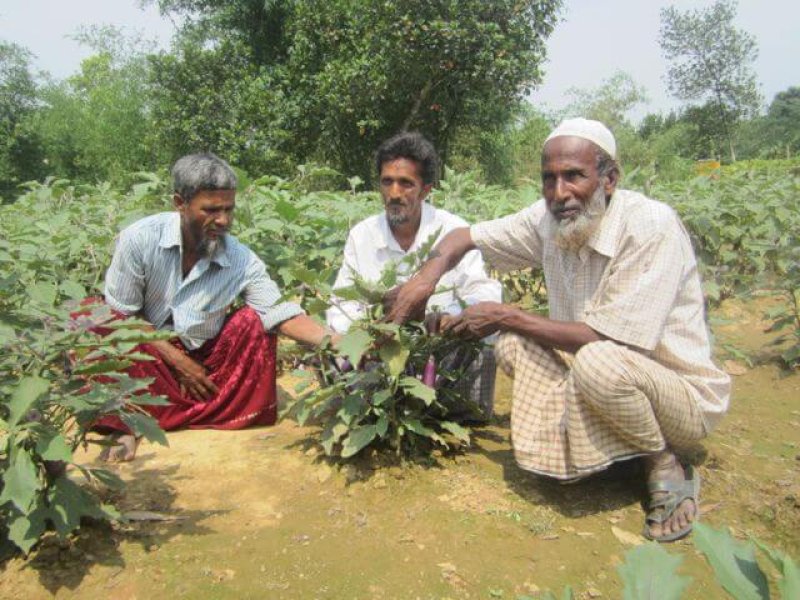
In early April, a controversy erupted over a report in Bangladesh newspaper The Financial Express that claimed Bt brinjal (eggplant), Bangladesh’s only approved genetically modified crop, was failing in several fields. Correspondent, Yasir Wardad, based his report on his visit to the Bt brinjal fields of farmers Haidul Islam and Mojibur Rahman in Gazipur, Bangladesh:
Bt brinjal, introduced in the country by the government for its pest resistance, has severely been attacked by pests this season for which farmers are now forced to spray a lot of pesticides, farmers alleged. … Visiting his [Islam’s] brinjal field on Tuesday, the FE correspondent found 25-30 percent of the plants dead and the rest struggling for survival.
The article was widely circulated by anti-GMO activist sites. Similar articles have appeared elsewhere, the most recent example in the Bangladeshi tabloid newspaper, New Age, known for its sensationalist spin on stories:
Farmers in Gazipur who were given the controversial Bt brinjal saplings have said they would no more cultivate the genetically engineered crop as the cultivation has ruined them. During a spot visit on Monday at four Bt brinjal fields in Gazipur, New Age found that Bt brinjal plants faced several troubles – they did not grow up and came under attack of different pests including shoot borers.
But photos and a video documentary by prominent environmental journalist Mark Lynas show that the reports are not true. He visited the same farm a day before New Age claims to have gone there and documented what he saw. He also went to several other farms to investigate the performance of Bt brinjal. Watch the video:
Bt brinjal is the first GM crop cultivated in South Asia. Engineered to resist the fruit and shoot borer, one of the most destructive pests for brinjal, Bt brinjal was approved last October for limited cultivation in Bangladesh. Bt brinjal is a public sector project owned and led by government-run Bangladesh Agricultural Research Institute (BARI) in collaboration with scientists at Cornell University, with funding from USAID. Lynas noted that high stakes are involved in the successful commercialization of Bt brinjal in Bangladesh:
This is South Asia’s first GMO food crop, and has been developed in the public sector for distribution to resource-poor smallholder farmers. The powerful anti-GMO lobby knows that if Bangladeshi farmers successfully adopt this new crop, other GMO crops in the pipeline such as Golden Rice (also being developed in Bangladesh) will be advantaged and their cause of banning the technology permanently will be harmed.

Lynas was not the only one to visit the farmers in Bangladesh to find out what really happened. Tony Shelton, a professor from Cornell who was in Bangladesh conducting environmental safety assessments for the Bt brinjal project, visited Haidul Islam’s farm and reported that his fields with Bt brinjal were doing fine. His testimony:




I visited Haidul Islam’s Bt brinjal fields on April 9. Mr. Islam was the same farmer whose crop the Financial Express on April 7 alleged was ridden with insects that Mr. Islam was spraying with insecticides. I found the exact opposite to be true. Mr. Islam and his associate proudly showed me his field of Bt brinjal. It was free of pest damage, and they were very pleased with the crop.
BARI officials also went to Islam’s fields on the same day that Wardad’s article in Financial Express appeared. Their report:
The BARI delegation reports that the Bt brinjal crop in farmer Haidul Islam’s field is currently “healthy and infestation-free”. The project team also spoke to the supposedly distressed farmer Haidul Islam, who revealed that the story began when two young men visited his farm and told him that he was growing a “poisonous” crop on his vegetable patch which would be bad for the health of him and his family.
Financial Express journalist Wardad did not contact BARI or Cornell University researchers involved in the Bt brinjal project for comment. Financial Express later published an editorial acknowledging the backlash against their reporter’s story, but did not correct or retract the original article.
In his visit to the Bangladeshi farms, Lynas found that the farmers have also planted conventional brinjal near their Bt brinjal fields in order to compare their performances. Having no innate protection against the fruit and shoot borer, the conventional brinjal plants were infested. Lynas then suggested that the journalists could have made a mistake in identifying the Bt brinjal, leading to the false claims:
So the most likely explanation for these reports of Bt brinjal having failed is that visitors have misidentified the non-Bt controls, not realizing the difference.