US farmers adopt biotech cotton, corn and soy in record numbers

biotechcrops
Chart via USDA

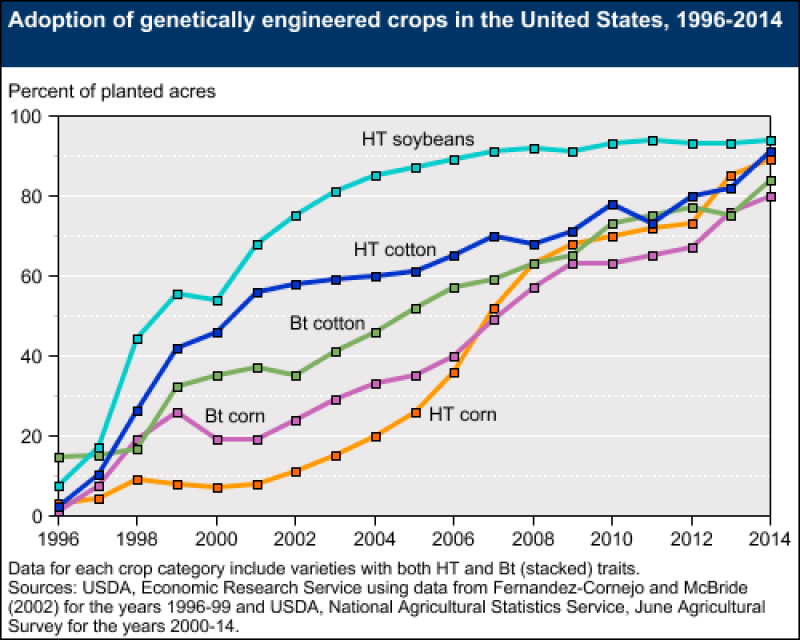
New data released by the United States Department of Agriculture (USDA) last week indicates that farmers in the U.S. continue to adopt genetically engineered corn, soy and cotton crops that are herbicide-tolerant, insect-resistant or a combination of both. Plantings of all biotech cotton reached 96 percent of cotton acreage, while plantings of all biotech soy reached 94 percent of soy acreage and plantings of all biotech corn reached 93 percent of corn acreage in 2014.

The new data is obtained by USDA’s National Agricultural Statistics Service (NASS) in the June Agricultural Survey. The NASS conducts the June Agricultural Survey during the first two weeks of June and publishes their findings at the end of June. To collect information on genetically engineered crops, randomly selected farmers across the U.S. were asked if they planted biotech seed that was resistant to herbicides, insects or both.
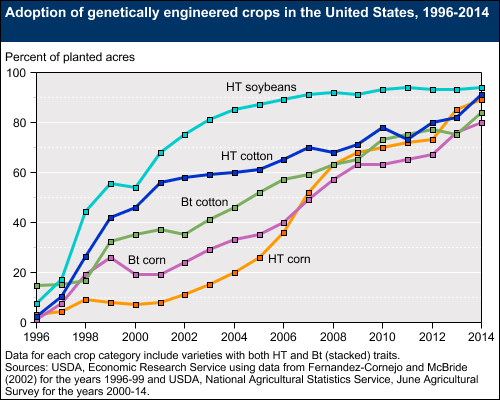
Chart via USDA
Chart via USDA

In particular, adoption of “stacked” varieties of corn and cotton has been accelerating in recent years. These “stacked” varieties are resistant to both herbicides and insects. No insect-resistant variety of soy has been developed as insects have not posed major problems for growing soy. “Stacked” cotton plantings reached 79 percent of cotton plantings while “stacked” corn plantings reached 76 percent of corn plantings in 2014.


Chart via USDA Chart via USDA

Read the full, original article: Recent trends in GE adoption

Additional Resources:

{{ reviewsTotal }}{{ options.labels.singularReviewCountLabel }}
{{ reviewsTotal }}{{ options.labels.pluralReviewCountLabel }}
{{ options.labels.newReviewButton }}
{{ userData.canReview.message }}

Related Articles

Infographic: Global regulatory and health research agencies on whether glyphosate causes cancer

Infographic: Global regulatory and health research agencies on whether glyphosate causes cancer

Does glyphosate—the world's most heavily-used herbicide—pose serious harm to humans? Is it carcinogenic? Those issues are of both legal and ...

Most Popular

ChatGPT-Image-Jul-8-2026-12_32_48-PM
Viewpoint: SCOTUS strikes a blow against junk science in Bayer glyphosate case. Will it deter mass tort litigators?
ChatGPT-Image-Mar-10-2026-01_39_01-PM
Viewpoint—“Miracle molecule” debunked: Why acemannan supplements don’t work
Screenshot-2026-07-08-at-9.36.03-AM
Viewpoint: Long-contained diseases are on the rise in the U.S. Are Trump cuts to blame?
afb-a-b
As the EU loosens restrictions on agricultural gene editing, it remains years behind the rest of the world on equally-safe GMO foods
Viewpoint: Consensus as truth? How ‘misinformation police’ control policy narratives
Which among war, weather and cyber attacks is the biggest world threat? None of the above. It’s misinformation, and here’s why.
c9f0a584-46e9-4dd8-9a77-f5f5a7a51a84
Across Eastern Europe, science disinformation has spread far beyond COVID and vaccine denialism. Here’s the grim list.
Screenshot 2026-07-11 100209
Viewpoint: Supplements to clean your liver? Not a good idea.
ChatGPT-Image-Jul-7-2026-01_57_55-PM
Viewpoint: Europe’s rejection of air conditioning is the poster child for misunderstanding how to mitigate the impact of climate change
Gemini_Generated_Image_gabo48gabo48gabo
Viewpoint: A plastic surgeon on why banning gender-transition surgery without further research is wrong and harmful
ChatGPT-Image-Jun-25-2026-12_23_17-PM
No, Bill Gates did not secretly engineer ticks to promote veganism
ChatGPT-Image-Jul-1-2026-03_33_49-PM
‘Alternative’ cancer treatments that could kill you
Screenshot-2026-07-10-at-3.10.50-PM
Snake-oil cures throughout history
ChatGPT-Image-Jul-1-2026-12_37_08-PM
Viewpoint: Trump poised to politicize all U.S.-supported science research
glp menu logo outlined

Get news on human & agricultural genetics and biotechnology delivered to your inbox.