Map highlights where cropland has room to grow

inline i figure copy

If we don’t start producing more food, we’re going to run out in the future. With world population growing and climate change affecting crop yields, studies show a “calorie gap” of as much as 70 percent by 2050.

To start to tackle this, experts know we need to reduce food waste, develop new technology, like seeds that are more drought-resistant, and raise yields from farmland in a way that doesn’t just involve using more fertilizers and pesticides.

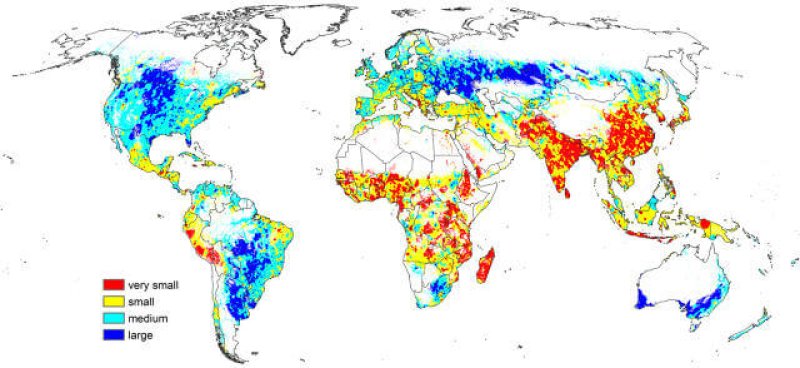
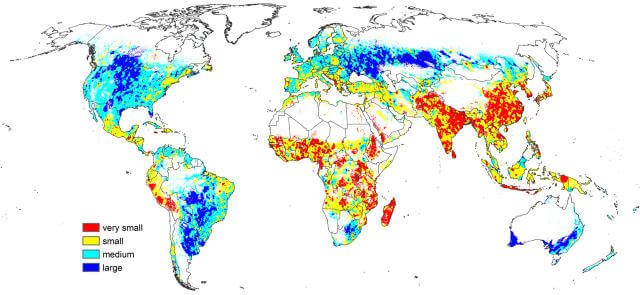
These are not easy things to do, but these maps show where we might look to start to increase food production. They show existing cropland and how intensely the land is farmed today. For each area, it shows both the percentage of cropland and the type of farm—whether it’s small, very small, medium or large. The maps are at a better resolution than anything available previously. The field size map—a proxy for farm mechanization—is the first of its kind.

“If you want to close yield gaps, you need to know where you are currently cultivating and what kind of soil there is,” says Steffen Fritz, a scholar at the International Institute for Applied Systems Analysis, in Vienna.

The maps also help develop land sustainably. You can see where small, inefficient farms could be developed into bigger, more effective farms, or where virgin land is uncultivated. They might also help avoid deforestation, which would only fuel more climate change.
3042106-inline-i-4-figure4-copy

Read full, original article: The Most Detailed Map Of The World’s Cropland Shows Where There’s Room To Feed Everyone

{{ reviewsTotal }}{{ options.labels.singularReviewCountLabel }}
{{ reviewsTotal }}{{ options.labels.pluralReviewCountLabel }}
{{ options.labels.newReviewButton }}
{{ userData.canReview.message }}

Related Articles

Infographic: Global regulatory and health research agencies on whether glyphosate causes cancer

Infographic: Global regulatory and health research agencies on whether glyphosate causes cancer

Does glyphosate—the world's most heavily-used herbicide—pose serious harm to humans? Is it carcinogenic? Those issues are of both legal and ...

Most Popular

Screenshot-PM-24
Viewpoint: The herbicide glyphosate isn’t perfect. Banning it would be far worse.
79d03212-2508-45d0-b427-8e9743ff6432
Viewpoint: The Casey Means hustle—Wellness woo opportunism dressed up as medical wisdom
d-b
Blocked arteries, kidney stones, nausea, constipation, fatigue: Long list of health problems caused by too much vitamin D 
ChatGPT-Image-Mar-10-2026-01_39_01-PM
Viewpoint—“Miracle molecule” debunked: Why acemannan supplements don’t work
ChatGPT-Image-Apr-30-2026-05_00_48-PM
Wellness grifter physician turned wellness influencer out as surgeon general nominee
Screenshot-2026-04-30-at-11.33.46-AM
Anti-seed-oil to anti-vax pipeline: MAHA movement spreads to teen influencers
lab grown meat research kelly schultz lehighuniversity main
Profiles of the 10 top global cultured meat companies
ChatGPT-Image-Mar-27-2026-11_27_05-AM
The myths of “process”: What science says about the “dangers’ of synthetic products and ultra-processed foods
Screenshot-2026-04-28-at-1.21.37-PM
How America’s medical system encourages psychiatric overdiagnosis
ChatGPT-Image-Apr-30-2026-12_21_05-PM-2
The tech billionaires behind the immortality movement

Sorry. No data so far.

glp menu logo outlined

Get news on human & agricultural genetics and biotechnology delivered to your inbox.