With the agricultural biotech expected to have a global market of $38.6 billion by 2019 and venture capital investment in data solutions for agriculture rising to $269 million in the third quarter of this year, it’s not surprising that there there is overlap between these two industries. In fact, $28 million of the $268 million VC investment went to companies working in plant genetics. DNA represents a huge amount of data and genomics in healthcare has always made extensive use of data analysis.
Monsanto’s purchase of Climate Corp last year signaled to many the shift to integrating data with biotechnology solutions. Climate Corp focuses on data regarding climate, soil and crops. However, while the move into information technology may seem like a leap for Monsanto, any company that works genomics will already be familiar with large amounts of data. Grist‘s Tim McDonnell pointed out:
Sprawling databases have long been an essential item in the Monsanto toolkit. Locating the genes for favorable traits in plants — drought or insect resistance, for instance — so they can be bred into new seed varieties requires sifting through the billions of base pairs in a genome, which is one reason why biotechnology has grown in tandem with computer processing power over the last two decades.
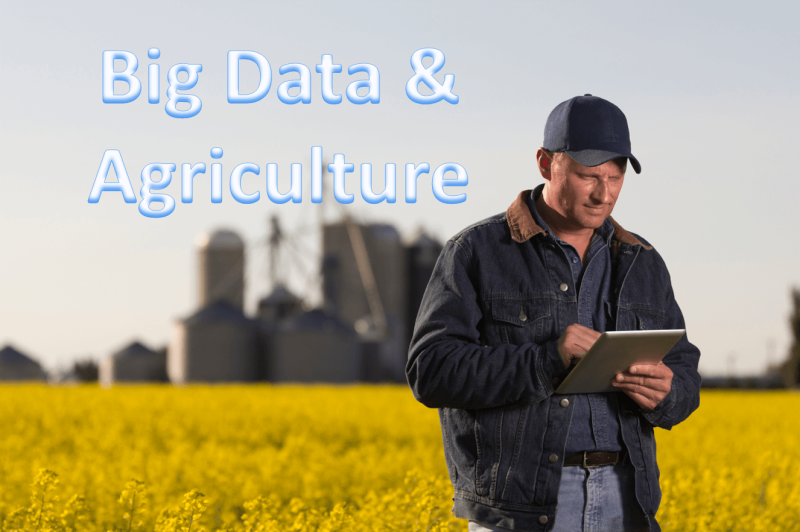
Both biotechnology and big data are working to increase the productivity of farms. Late last year, the New York Times profiled a farmer in Indiana, who has expanded his farm from 700 acres to more than 20,000 acres in part by using sensors and large-scale data analysis. He’s increased his return on investment by 50 percent compared with conventional farming. Just making data widely available can help farmers in remote areas or developing countries.
There is another recognized trend ushered in by the streamlining encouraged by Big Data: an incentive to grow single crops in large scale to maximize the effectiveness of technology. Farmers with diverse crops and livestock need many different systems. Smaller farmers without technology could also grow one crop, but they would not capture as much of the gains. That raises questions about whether tech trends might squeeze out smaller farms:
“We’ve seen a big uptick in the productivity of larger farms,” said David Schimmelpfennig, an economist at the Agriculture Department. “It’s not that smaller farms are less productive, but the big ones can afford these technology investments.”
However, others argue that with the fast dropping cost of Big Data, smaller farmers can utilize the technology too. As Quentin Hardy wrote in a New York Times blog as a follow to the feature story:
The so-called consumerization of IT is moving once-expensive software onto smartphones that can connect to cheaper cloud systems. The ever-shrinking cost of semiconductors is making once exotic tech a commonplace on much farm equipment. And, in the prairie tradition of agricultural cooperatives, smaller farmers may pool resources to get a better result.
“I’d argue against the idea of a widening gap” between large and small farms, said Jesse Vollmar, co-founder and chief executive of FarmLogs, which makes smartphone-type software for the scheduling of farm tasks and analysis of yields. “There is a gap in management practices, but that is our reason to exist.”
And there’s still potential to use data more, according to John Fulton’s, associate professor in the Department of Food, Agricultural, and Biological engineering at Ohio State University:

Eighty percent of the data being generated by farm machinery in the U.S. today still resides on those machines — it never gets into a form that can be analyzed and ultimately used by the farmer or others.
In most cases, data and biotechnology are being used together to address problems related to climate change and food security. The Global Open Data for Agriculture and Nutrition initiative includes sharing information on genes and phenotype. Portals such as Cassavabase record the information, in this case for the cassava plant, from all the institutes involved. Equality of access to data extends into biotechnology and is a large part of enabling food security worldwide.
Agricultural biotechnology and big data are not necessarily linked. One reason they may seem separate is because agricultural biotech is led by large companies such as Syngenta and Monsanto while many data solutions have sprung from start-ups. If larger companies absorb the smaller the ones, the lines would become more blurred.
Lakshmi Santhosh is a writer for the Genetic Literacy Project.
Additional resources:
- Big Data hits the dirt, Forbes
- Monsanto Is Using Big Data to Take Over the World, Mother Jones