Monsanto’s next horizon: Big Data

You probably know Monsanto as the world’s leading producer of genetically engineered seeds—a global agribusiness giant whose critics accuse it of everything from boosting our reliance on pesticides to driving Indian farmers to suicide.

But that’s actually just the latest in a long series of evolving corporate identities. When the company was founded in 1901 by a St. Louis pharmacist, its initial product was artificial sweetener. Over the next few decades Monsanto expanded into industrial chemicals, releasing its first agricultural herbicide, 2,4-D, in 1945. In the ’50s it produced laundry detergent, the infamous insecticide DDT, and chemical components for nuclear bombs. In the ’60s it churned out Agent Orange for the Vietnam War. In the ’70s it became one of the largest producers of LED lights.

It was around this time that Robb Fraley, now Monsanto’s chief technology officer, joined the company as a mid-level biotechnology scientist. Back then, he recalls, the company had its hand in oil wells, plastics, carpets—you name it. It wasn’t until the early ’80s that Monsanto began to shift its focus to biotechnology, conducting the first US field trials of bioengineered plants in 1987. By the end of the ’90s, it was a full-fledged biotech company. And over the last 10 years, after a series of seed company acquisitions, it has become the company we all know and love—or hate—today.

Now, there’s a new evolution on the horizon: “I could easily see us in the next five or 10 years being an information technology company,” says Fraley.
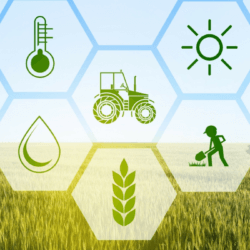

That’s right: Monsanto is making a big move into big data. At stake is an opportunity to adapt to climate change by using computer science alongside the controversial genetic science that has been the company’s signature for a generation.

Read the full, original article: Monsanto Is Using Big Data to Take Over the World

Related Articles

Infographic: Global regulatory and health research agencies on whether glyphosate causes cancer

Infographic: Global regulatory and health research agencies on whether glyphosate causes cancer

Does glyphosate—the world's most heavily-used herbicide—pose serious harm to humans? Is it carcinogenic? Those issues are of both legal and ...

Most Popular

ChatGPT-Image-Mar-10-2026-01_39_01-PM
Viewpoint—“Miracle molecule” debunked: Why acemannan supplements don’t work
Screenshot-2026-09-22-at-12.26.15-PM
‘Forever chemical’ concerns: Separating hysteria from reasonable concern in the debate over PFAS danger
Screenshot-2026-10-06-at-11.13.59-AM
RFK Jr.’s plan to curb America’s appetite for ultra-processed foods and artificial dyes blocked by the White House
Screenshot 2026-10-08 at 1.34
Hooked on kratom: The unregulated, natural, alcohol-free “social tonic” that is destroying lives 
Screenshot-2026-10-06-at-2.36.47-PM
Is organic farming really more sustainable? 100 recent studies say ‘no’
Resolute-Portrait-with-Injured-Teddy-Bear
Anti-vax Texas Senate candidate Ken Paxton alleges conspiracy by doctors, drugmakers, and insurers to push childhood vaccination for profit
Screenshot-2026-09-28-at-11.26.17-AM
Viewpoint: Wellness movement activists reposition nicotine from a killer addictive drug into a cure-all for brain ills
No-Data-Center-Farm-Protest-Sign-2
Rural revival or corporate windfall? Trump’s One Big Beautiful Bill tax law opens the door to big breaks for data centers—but tech giants aren’t cashing in
Radioactive-Americana-Collage-2
The kooky logic behind the raft of spurious cancer claims from Harvard’s T.H. Chan School of Public Health
ChatGPT-Image-Sep-21-2026-11_21_39-AM
Viewpoint: Food cults: Online ‘nutrition communities’ can pose unique dangers
Supreme-Court-Amid-Climate-Crisis
Should fossil fuel companies be shielded from lawsuits over climate change damage? The Supreme Court takes up the question
strand of dna genetics
No, GMO foods do not “damage genes, natural disposition and hormones, or decrease physical health and intelligence”
glp menu logo outlined

Get news on human & agricultural genetics and biotechnology delivered to your inbox.