Ebola poses major threat to chimpanzee survival

The GLP aggregated and excerpted this blog/article to reflect the diversity of news, opinion and analysis.

The most recent Ebola epidemic is the largest in history, but smaller outbreaks have been erupting at least since the 1970s. Ebola is a zoonosis, a disease that can be transmitted from animals to people, and by some measures its impact on animal populations has been even more dramatic than its effect on the people of west Africa. Hard numbers are hard to come by, but some conservationists estimate that Ebola has wiped out around a third of the world’s wild chimpanzees and gorillas over the past few decades.
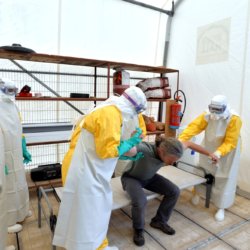
Peter Walsh, a wildlife biologist spearheading an experimental chimpanzee vaccine project, is trying to find a way to protect the rest. Walsh is a professor of biological anthropology at the University of Cambridge, but to do this work he’s come to the New Iberia Research Center, part of the University of Louisiana at Lafayette. It’s the largest primate-research facility in the United States.Now he’s leading a research project that many believe shouldn’t exist. 2011, the Institute of Medicine issued a report concluding that most biomedical research using chimpanzees was unnecessary.In June, the U.S. Fish and Wildlife Service classified captive chimpanzees as “endangered,” a move that forbids scientists to use them for medical research.One key difference: Walsh’s chimpanzees aren’t being poked and prodded in the service of human medicine. The work is on behalf of the chimps themselves, part of a plan that Walsh believes may be vital to the survival of their species. With the new Fish and Wildlife rule, though, the future of that plan is uncertain.


Read full, original post: Should Apes Be Saved From Ebola?

Related Articles

Infographic: Global regulatory and health research agencies on whether glyphosate causes cancer

Infographic: Global regulatory and health research agencies on whether glyphosate causes cancer

Does glyphosate—the world's most heavily-used herbicide—pose serious harm to humans? Is it carcinogenic? Those issues are of both legal and ...

Most Popular

ChatGPT-Image-Mar-10-2026-01_39_01-PM
Viewpoint—“Miracle molecule” debunked: Why acemannan supplements don’t work
Screenshot-2026-09-24-at-3.25.18-PM
No, organic eggs are not more nutritious or necessarily healthier than regular eggs. They are far more expensive.
Screenshot-2026-09-28-at-2.41.21-PM
Viewpoint: 7-OH controversy: An opioid is available over-the-counter–even at gas stations. Should we be concerned?
Screenshot-2026-09-17-at-1.07.08-PM
'We are dangerously addicted to antidepressants': Should we heed RFK Jr.’s sobering warning?
ChatGPT-Image-Sep-25-2026-11_36_56-AM
Now AI almost started a war with China
ChatGPT-Image-Sep-2-2026-02_03_32-PM
How much of a problem is AI’s water use?
ChatGPT-Image-Sep-25-2026-11_57_15-AM
RFK, Jr. likely violated federal ethics guidelines in accepting more than $4,275,000 in gifts and book advances from MAHA allies
ChatGPT-Image-Sep-25-2026-10_36_43-AM
New federal autism committee head has financial ties to leucovorin
ChatGPT-Image-Sep-22-2026-11_17_31-AM
The exploding controversy over AI’s built-in survival drive
Screenshot-2026-09-16-at-10.27.33-AM
Viewpoint: SCOTUS poised to address First Amendment tension between mandatory vaccines, children’s health and religious freedom 
Screenshot-2026-08-19-at-6.19.42-PM
Facts & Fallacies podcast: 'Regenerative farming'? RFK Jr.’s federal push romanticizes the past and risks food security
glp menu logo outlined

Get news on human & agricultural genetics and biotechnology delivered to your inbox.