CRISPR’s promise may expand beyond genome editing

The GLP aggregated and excerpted this blog/article to reflect the diversity of news, opinion and analysis.

Three years ago, Stanley Qi took CRISPR — the world’s most versatile gene-editing tool — and stopped it from editing any genes.

CRISPR is a young and ferociously hyped technique that allows scientists to easily and precisely tweak almost any gene they want, opening up experiments that were once unfeasible or impractical, and triggering a new round of ethical debates about messing with the human genome. During these debates, CRISPR has become almost synonymous with the editing of genes. But gene-editing might not be its most promising use.

The technique relies on two components: an enzyme called Cas9 that cuts DNA like a pair of scissors, and a guide molecule that directs Cas9 to a specific target like a genetic GPS system. Qi, now at Stanford University, found a way of blunting the scissors, creating a “dead” version of Cas9 that can’t cut anything at all.
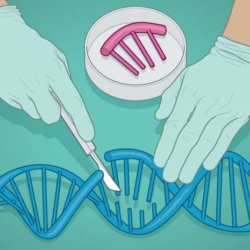
The dead enzyme can now act as a platform for other molecules, including activator molecules that switch genes on, repressors that turn them off, or glowing substances that reveal their locations. And with the right guide molecules, scientists can now direct these payloads to any gene they like.

With this technique, you can actually control any gene you want. You don’t just have an editor. You have a stimulant, a muzzle, a dimmer switch, a tracker.

Read full, original post: CRISPR’s Most Exciting Uses Have Nothing to Do With Gene-Editing

{{ reviewsTotal }}{{ options.labels.singularReviewCountLabel }}
{{ reviewsTotal }}{{ options.labels.pluralReviewCountLabel }}
{{ options.labels.newReviewButton }}
{{ userData.canReview.message }}

Related Articles

Infographic: Global regulatory and health research agencies on whether glyphosate causes cancer

Infographic: Global regulatory and health research agencies on whether glyphosate causes cancer

Does glyphosate—the world's most heavily-used herbicide—pose serious harm to humans? Is it carcinogenic? Those issues are of both legal and ...

Most Popular

wuhan institute of virology main entrance
​​COVID lab leak? Making a case that the Wuhan market origins theory is wrong
ChatGPT-Image-Mar-10-2026-01_39_01-PM
Viewpoint—“Miracle molecule” debunked: Why acemannan supplements don’t work
Screenshot-2026-06-05-at-2.12.30-PM
Some plants can poison you. So how did humans figure out what is safe to eat?
ChatGPT-Image-Jun-9-2026-01_11_37-PM
Turmeric supplements: More risks than benefits
ChatGPT Image May 26, 2026, 08_42_17 AM (1)
Viewpoint: Greenpeace and poison: How environmental advocacy groups rely on compliant (and often ignorant) journalists to spread disinformation and spark litigation
Screenshot-2026-06-17-at-9.44.03-AM
Viewpoint: Embryos are becoming the newest battleground of love, loss, and legal uncertainty
ChatGPT-Image-Jun-14-2026-09_41_44-AM-2
Viewpoint—‘The gleeful efficiency of an arsonist’: Administration’s health and science research cuts are ‘sabotaging’ America’s future
ChatGPT-Image-May-18-2026-12_06_18-PM-2
Defying death: The immortality movement goes mainstream

Sorry. No data so far.

glp menu logo outlined

Get news on human & agricultural genetics and biotechnology delivered to your inbox.