How one rare disease led to painting of blue people

Most stories about the blue people of Kentucky include an eerie, compelling drawing of a family, with the stark faces of 5 of the 9 members a striking bluish-gray, due to an inherited disease.

The blue people of Troublesome Creek had methemoglobinemia, a metabolic condition affecting hemoglobin, the four-part protein that carries oxygen bound to an iron atom at each subunit’s core…it is a tale of an autosomal recessive disease that has dissipated over time as the descendants of the original carrier couple left home.

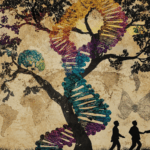
The blue people of Kentucky and the deaf of Martha’s Vineyard illustrate the dilution of genetic disease. Yet Facebook groups have enabled the meeting of many people who have mutations in the same gene. This is wonderful, but it could facilitate transmission of the disease when carriers have children together.

The straightforward treatment for methemoglobinemia came from Madison Cawein,…who drove hours…to visit the blue people in the hollows of Appalachia…The lesson: Sometimes a treatment arises from understanding the biochemistry of an inherited disease – not just sequencing DNA.

The GLP aggregated and excerpted this blog/article to reflect the diversity of news, opinion and analysis. Read full, original post: Finding The Famous Painting of the Blue People of Kentucky

{{ reviewsTotal }}{{ options.labels.singularReviewCountLabel }}
{{ reviewsTotal }}{{ options.labels.pluralReviewCountLabel }}
{{ options.labels.newReviewButton }}
{{ userData.canReview.message }}

Related Articles

Infographic: Global regulatory and health research agencies on whether glyphosate causes cancer

Infographic: Global regulatory and health research agencies on whether glyphosate causes cancer

Does glyphosate—the world's most heavily-used herbicide—pose serious harm to humans? Is it carcinogenic? Those issues are of both legal and ...

Most Popular

Screenshot 2025-07-30 at 10.48
Can gene editing eliminate Down syndrome? Scientists have done it in lab-grown cells
ChatGPT Image May 26, 2026, 08_42_17 AM (1)
Viewpoint: Greenpeace and poison: How environmental advocacy groups rely on compliant (and often ignorant) journalists to spread disinformation and spark litigation
Screenshot-2026-05-28-at-1.36.28-PM
Viewpoint: Can mRNA research survive the Trump administration?
ChatGPT Image May 26, 2026, 08_21_36 AM
Limiting gender affirming interventions: Trump administration targets Texas even though it already bans youth access
Screenshot-2026-06-03-at-1.24.46-PM
Challenging anti-GMO disinformation: Why genetically-tweaked crops offer bushels of benefits
ChatGPT-Image-May-26-2026-07_51_21-AM-2
Viewpoint: There are more than 1,000 chemicals in a cup of coffee—including many substances that can cause cancer. Why isn’t it banned?
ChatGPT-Image-Jun-2-2026-03_04_17-PM
Viewpoint: Why the hyper-promoted doping ‘enhanced games’ pseudo Olympics flopped
tick-DNA
GLP podcast: Spread meat allergy with gene-edited ticks? Bioethicists pose vile ‘thought experiment’
ChatGPT-Image-Jun-2-2026-11_39_58-AM
Viewpoint: Who is RFK, Jr.’s newly-appointed CDC senior counselor, Sara Brenner — Vaccine skeptic and self-proclaimed “MAHA mom”
ChatGPT-Image-Jun-3-2026-12_33_40-PM-2-1
Viewpoint—The end of ‘ivory tower science’: What does that even mean, and what comes next
Picture1
Sounds we can’t hear — the hidden planetary signals behind science, fear, and misinformation
ChatGPT-Image-Mar-10-2026-01_39_01-PM
Viewpoint—“Miracle molecule” debunked: Why acemannan supplements don’t work
Screenshot 2025-11-18 at 3.45
Viewpoint—GMOs and sustainability: Why buying organic foods is the least environmentally-sensitive food choice—without offering any health benefits
glp menu logo outlined

Get news on human & agricultural genetics and biotechnology delivered to your inbox.