This summer, more than a hundred Nobel laureates sent a clear message to Greenpeace: Abandon the campaign against GMOs.
The letter, published on the site Support Precision Agriculture, asked the environmental NGO to stop efforts to hinder the adoption of Golden Rice, a genetically engineered variety developed to mitigate Vitamin-A deficiency in the developing world, a scourge leading to blindness and death in millions. The rice gets its golden color from beta-carotene, a precursor to Vitamin-A and the same stuff that pigments carrots and other colorful fruits and vegetables.
Sir Richard Roberts, who was awarded the 1993 Nobel Prize in Physiology or Medicine for his discovery of split-genes, spearheaded the letter and organized the laureates to sign on.
“We urge Greenpeace and its supporters to re-examine the experience of farmers and consumers worldwide with crops and foods improved through biotechnology, recognize the findings of authoritative scientific bodies and regulatory agencies, and abandon their campaign against ‘GMOs’ in general and Golden Rice in particular,” the letter states.
The hashtag #Nobels4GMOs quickly grew across social networks in support of the laureates. With additional Nobel laureates and more than 6,000 from the general public signing on since the June 30 news conference. But, the letter and petition are only the first steps in this initiative.
For Roberts, this campaign isn’t about agribusiness or even science. It’s about justice.
“The science on this is solid,” Roberts says. He believes that communicating scientific facts to the public doesn’t necessarily have a big impact. “It’s these moral questions that are important, these actually do have an effect,” he says, adding that the GMO issue is “one of the most worthy causes for the future of humanity that I can think of.” He explains that Greenpeace has “cleverly conflated” the issues of technologies and big corporate interests. “I don’t like big corporations either,” he says, agreeing that opposition to GMOs prevents small entities from using these technologies. (Several experts and scientists assert that the anti-GMO lobby creates an overly stringent and prohibitively expensive regulatory landscape that stifles innovation.)
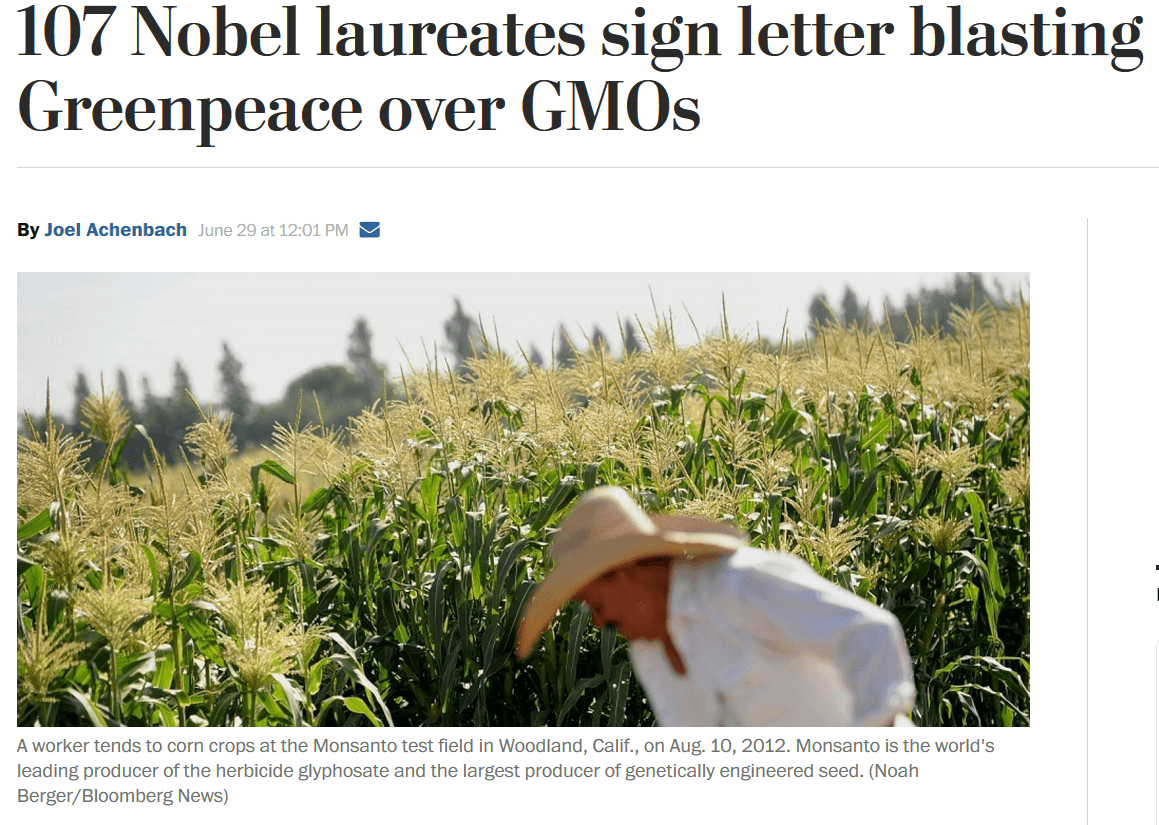
The future of the Nobel laureates’ campaign isn’t only about Golden Rice, but the role genetic engineering and newer precision breeding technologies will play to help people, and Roberts plans to involve world leaders in wielding science to that end.
The president of Uganda is among many government leaders the Nobel laureate hopes to reach. One reason: Banana Xanthomonas Wilt (BXW). A bacterial disease, BXW affects all banana cultivars and is considered one of the greatest threats to banana productivity in eastern Africa.
“Traditional methods are incredibly slow, because the banana plant is essentially sterile,” says Roberts. A GMO solution is already in field trials, but legislation to allow it to reach farmers and consumers doesn’t exist, he explains. “It’s sitting in parliament and languishing there.” This is a serious and pressing need, he says, because for many Ugandans up to 30 percent of caloric intake is from bananas. They’re a staple food in Kenya, Rwanda, Ethiopia and Tanzania.
Roberts condemns the European Union’s legislation and blocking of GMO cultivation in Africa. He’ll be speaking at the European Parliament in a couple of weeks.
“I intend to make the point that you don’t see a lot of thin Europeans. They can choose not to eat GMOs, but to pretend that they’re dangerous, it’s really terrible, it rebounds around the world.” He stresses that in much of the world, just getting food is a problem. “We need to make sure that we in the developed world understand that it is an indulgence for us to be either for or against a particular food.”
Government leaders aren’t the only ones Roberts will call on. He wants to persuade Buddhist leadership, Pope Francis, and other religious heads to make positive statements about GMOs. Though Roberts identifies as atheist, he says, “I understand the appeal of religion, and I am perfectly happy to engage with figures like the Pope – especially this one who seems head and shoulders better than most.” Secular humanitarian organizations like the Rotary Club are also on his list of potential allies.
Roberts’ initiative isn’t without backlash, though. Tenuous accusations that the laureates were exploited demonstrate that anti-technology activists would rather throw tantrums than accept that GMO technologies are safe and beneficial. The accusations also confirm the well-documented trend of GMO opposition being rooted not in fact-based criticism, but in ideology and money. The burgeoning organic industry, for one, spreads frightening myths about genetic engineering, largely because organic farmers are prohibited from growing GMO crops.
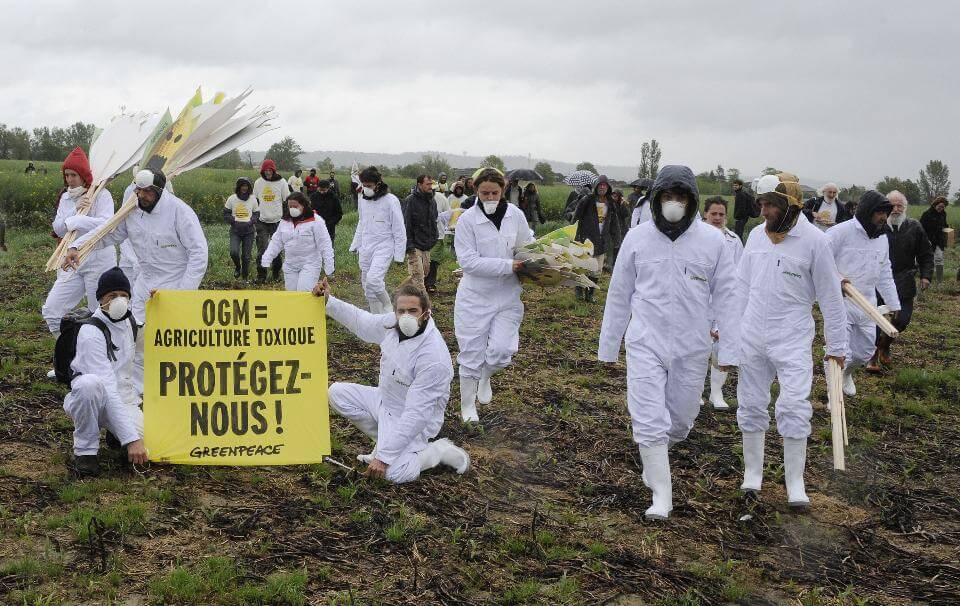 Consider U.S. Right to Know (USRTK). Founded with donations from anti-GMO organic industry groups, the non-profit organization boasts the tagline “pursuing truth and transparency in America’s food system.” The group is known for using public records laws to harass scientists, and for scaring people about GMOs in the name of consumer advocacy. The group’s co-founder and director Gary Ruskin quickly issued a California Public Records Act (CPRA) request for Nobel laureate Professor Randy Schekman’s emails following the National Press Club news conference where Schekman, Roberts, and Columbia University Professor Martin Chalfie, who shared the 2008 Nobel Prize in Chemistry, officially announced the initiative.
When used well, open records laws help the government stay transparent. But when a line is crossed, these checks and balances become a weapon to intimidate and create roadblocks. As the Union of Concerned Scientists said following a glut of abusive public records requests in 2015, “the harassment of scientists through open records requests is just one method of many that an expert’s antagonists use to discredit him or her.”
Roberts agrees. “The plant community has been totally abused by this,” he says. He explains that USRTK targeted Schekman for a simple reason: Of the three laureates at the press conference, he was the only one subject to an open records request because of his role at a public institution (University of California, Berkeley). Roberts calls the move a “particularly foolish” misuse of the law.
Schekman guesses that USRTK thinks the CPRA request will intimidate him and keep him from speaking out further in support of GMOs. “They’re wrong. If anything they might have encouraged me,” he tells me of his plan to use his platform to advocate for Golden Rice and agricultural biotechnology. Schekman intends to not release his emails because he isn’t paid by a public institution. While the Schekman Lab is at UC Berkeley, the laureate is an employee of the Howard Hughes Medical Institute, a private, non-profit research organization. According to Schekman, HHMI rents university facilities on his behalf.

Another attack on the Nobel laureates came from Vandana Shiva, an author, environmentalist and anti-biotechnology leader known to command $40,000 per public appearance. Heralded by some as an “eco goddess,” Shiva is a front-runner in the opposition to modern agriculture, especially crops created with modern molecular genetic engineering. Anti-globalization factions tout Shiva as a hero and the voice of downtrodden people, farmers, and the environment. On the other end, her butchering of science and deceptive rhetoric have earned Shiva monikers like “Luddite,” “dangerous fabulist” and even part of the “lunatic fringe.”
Making light of the death of Dr. Alfred G. Gilman, one of the letter’s signatories, she writes, “How many Nobel laureates does it take to write a letter? Easily ascertained — the dead Gilman and 106 others were enlisted in ‘supporting GMOs and Golden Rice.’ Correct answer — 107, dead or alive.” Declaring that only “chosen folk” have the luxury of “getting Nobel laureates to write 1/107th of a letter,” Shiva says that Golden Rice is a “false miracle.” Ironically, in the same diatribe decrying the laureates’ letter as “luxury,” Shiva writes, “avoid ‘miracle rice,’ just eat a carrot,” advising that people in the developing world eat chutneys, mangoes, and other nutritious foods to meet the necessary daily intake of vitamin A.
It reeks of “let them eat cake”– recent research from The Lancet shows that the majority of Indians can’t afford enough fruits and vegetables. While increasing access to varied and nutritious diets for all people is a worthy objective, the laureates say opposition to this potentially lifesaving rice is unconscionable.
“It is true that Golden Rice has been slow to develop but it seems rather disingenuous for the anti-GMO people to use every strategy possible to slow its development and then accuse it of not being ready,” Roberts says. “Indeed it has been generally true that the anti-GMO activists have been constantly erecting roadblocks by spreading misinformation about dangers [of genetic engineering].” He adds that opponents are “doing everything in their power to prevent GMO products from reaching the marketplace.”
It’s important to note that, while commonly used colloquially and in the media, “GMO” is an arbitrary term not used in scientific literature. GMO (for Genetically Modified Organism) applies to diverse techniques and products, from crops engineered to prevent boring insect damage and carcinogenic mycotoxin contamination the insects can bring, to non-browning, non-bruising Arctic apples bred with a gene silencing technique. GMO technologies aren’t limited to use by large corporations, nor are GMO crops the only patented varieties (even non-GMO and organic seeds are often patented).
Many breeding techniques involve modifying plants’ genomes in the field or in a lab. GMO varieties are typically the result of scalpel-like precision, while so-called non-GMO methods are akin to whacking a piñata blindfolded. Some techniques involve using radiation and chemicals to roll the mutation dice, and developing and commercializing desired results. Yet the food products that result from these lab manipulations can be certified and sold as organic and “non-GMO.” The weight of scientific literature shows that modern techniques are no less safe than other breeding methods, including new precise methods like gene editing.
Shiva and other GMO opponents like GM Watch discredit Roberts’ efforts, claiming the laureates’ letter was an industry-backed maneuver.
“The laureates were rounded up by Val Giddings (senior fellow, Information Technology and Innovation Foundation), Jon Entine (author of Abraham’s Children: Race, Identity and the DNA of the Chosen People) and Jay Byrne (former head of corporate communications, Monsanto),” she writes, without supporting evidence for the allegations. Telling tall tales about her adversaries is a classic Shiva move. Tarnishing critics’ reputations is a clever tactic — the case for defamation, libel or slander are expensive and difficult to pursue. Tarring any party who might put a damper on her anti-technology money train, she leaves swaths of misinformation in her wake.
I spoke with Entine, Byrne, and Giddings, and all three deny involvement in rounding up the laureates.
“I had zero to do with the Nobel initiative. I didn’t even know about it until it was publicly announced,” says Jon Entine, executive director of the Genetic Literacy Project.
Jay Byrne, president of v-Fluence, a public affairs, issues, and reputation management company, left Monsanto 16 years ago. He provided public affairs guidance to Roberts over the year leading up to the #Nobels4GMOs going public, not for pay but, “because I care about this stuff, and I want to make a difference. Not everything is about making money, even though that’s the only possible answer activists have when anyone stands up for technology that they oppose.”
Val Giddings, the senior fellow at The Information and Technologies Innovation Center with three decades of experience in science and regulatory policy, calls Shiva a demagogue.
“Those, like Shiva, looking for ways to avoid acknowledging the weight of the laureates’ statement in opposition to their fear mongering, and trying to find some nefarious origin for it would do well to consider [Roberts’] history,” he urges. Giddings points out that Roberts has gathered and organized the clout of Nobel laureates before. He was instrumental in gathering over a hundred Nobel laureates in signing a 2006 letter addressed to Muammar Gaddafi denouncing the persecution of medical professionals in Libya for introducing and spreading AIDS. Roberts organized a similar initiative in 2012 calling for the release of Nobel Peace Prize laureate Liu Xiaobo. “As anybody who takes the time to consult the data can easily discover, Sir Richard Roberts has a long history of working to advance social justice,” Giddings says.
There’s no question that Sir Richard Roberts transformed biology. His discovery of split-genes was a giant leap in our understanding of the way genes work, and this knowledge is the basis for important medical and agricultural advances. But it’s Roberts’ passion for humanitarian issues that might resonate most with non-scientists. As a mother, I can relate to how fatherhood has shaped his worldview. “Being a father makes one truly cognizant of the value of human life,” he says. “I always strive to help everyone I can, but especially the most vulnerable who desperately need advocates. For too long those of us who grew up in the privileged environment of the developed world have focused on ourselves and forgotten, or worse exploited, those who faced the hardships of an impoverished existence.”
This article originally appeared in Forbes as Nobel Laureate Sir Richard Roberts To Ask Religious And Government Leaders To Support GMOs and was reposted with the permission of the author.
Kavin Senapathy is a freelance writer and co-author of The Fear Babe: Shattering Vani Hari’s Glass House. The science advocate and co-founder of March Against Myths’, her interests span the human and agricultural genomics and biotechnology realms. Follow Kavin on her science advocacy Facebook page, and Twitter @ksenapathy