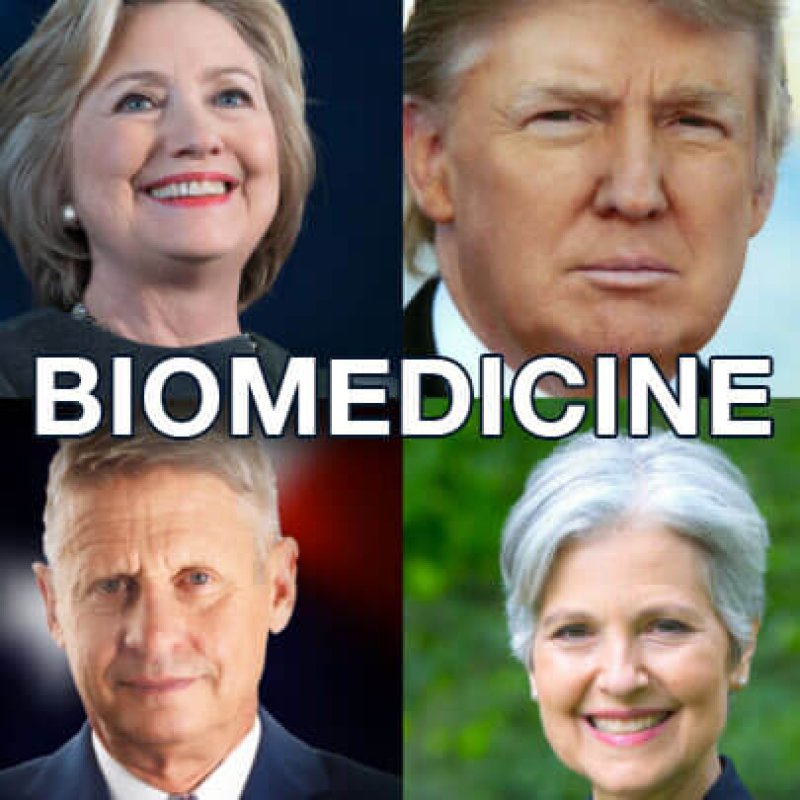
The Genetic Literacy Project continues with its three-part series on the major presidential candidates’ views on genetics and biotechnology–human and agriculture–subjects not being addressed during the presidential debates. On October 17, we focused on crop biotechnology, food, and farm policy.
The candidates have expressed plans in public statements, platforms posted on their websites and social media, and have submitted answers to a debate-style science forum online that substitutes for real-time debates. Using a combination of these published sources, we outline the candidates’ views on regenerative medicine and other new areas of biomedical science.
Online science debate
The candidates responded to 20 Science, Engineering, Tech, Health & Environmental Issues posed by the ScienceDebate.org project. This project includes a plethora of professional science, health, and energy associations. Only a few questions dealt with the genetic-related issues that we focus on at the GLP.
To express her point of view and policy positions on 20 different issues in science and technology, Hillary Clinton was the most ‘talkative’ of the candidates; her combined responses total 6,203 words, compared with 3,216 for Libertarian Gary Johnson, 2,628 for Green Party candidate Jill Stein, and 1,995 for Donald Trump. Stein used the same answers or talking points in response to more than one issue.
Hillary Clinton
The Democratic nominee said: “We will continue to invest in research to further our understanding of disease, including ramping up our investment in Alzheimer disease and related dementias to $2 billion per year, continuing Vice President Biden’s Cancer Moonshot, and scaling up our broader investment in the National Institutes of Health’s budget to combat all of the diseases of our day.”
Clinton once said she would lift the ban on embryonic stem cell research and has stated that she would increase funding to the National Institutes of Health and National Science foundation in order to drive biomedical research forward. As a US senator in the early 2000s, Clinton fought for HESC research and made a point of explaining to constituents how therapeutic cloning (creating embryos as a source of stem cells, tissues, and organs) differed from reproductive cloning (cloning to create babies that are genetically identical to the parent). She has pledged she would lift remaining federal restrictions on development of HESC technologies.
Donald Trump
The Republican nominee wrote: “Though there are increasing demands to curtail spending and to balance the federal budget, we must make the commitment to invest in science, engineering, healthcare and other areas that will make the lives of Americans better, safer and more prosperous. He says a “vibrant, robust free market system will regulate the private sector.” He says he is undecided on stem cell issues–a hot button issue on the Republican right–so it’s hard to predict what direction he might take, if elected, on this issue.
Gary Johnson
In line with the fiscal conservatism and social liberalism that defines his Libertarian Party, Johnson is on record opposing federal funding for research on human embryonic stem cells (HESC, therapeutic cloning), but does not object to the private sector researching in this area and developing resulting treatments. In his 2012 bid for president, he said that stem cell research should be done only in privately-funded laboratories.

Jill Stein
When asked about her views on science innovation, Stein asserted that “vast resources will be freed for investment in public R&D by reduced Pentagon spending.” When asked about research and education, she refocused the answer almost exclusively on climate change. She said she would fund stem cell research federally, no matter where the cells were sourced, and the Green Part candidate is listed as supporting federal funding for human embryonic stem cell research. But there are some reasons not to assume that Stein would automatically be a champion of research advancing stem cells and other areas of regenerative medicine.
For one thing, Stein’s views appear driven by the same concerns that underlie Bernie Sanders’ opinions about corporate development and pricing of pharmaceuticals and other biomedical research products–sentiments that led him to side with Senate Republicans in the early 2000s and oppose federal support of therapeutic cloning research and to conflate it in his comments with reproductive cloning. The Green Party, for which Stein is the standard-bearer, is opposed to all biomedical animal research, which most scientists believe is the backbone of critical science research around the world.
But there is evidence that Stein hasn’t put much thought into regenerative medicine policy issues. A search on votesmart.org reveals no public statements mentioning stem cells. Stein has never held an elected office at the state or national level, so she has never had to vote on the issue, nor sign or veto a bill relevant to it. Still, she is a Harvard-trained physician who ran for US president in 2012, and twice for governor of Massachusetts (2010, 2002). In all that she was based in the Boston area, and Kendall Square, in Cambridge, has been a booming center of biotech advances. That’s MIT territory, to be sure, but Stein’s own institution, Harvard, where she enjoyed a faculty appointment in medicine, has a vibrant Stem Cell Institute.
It seems unfathomable that somebody who works right in the middle of a Mecca of regenerative medicine –somebody who runs for governor twice and president twice– would have nothing to contribute to the national discussions surrounding stem cells during all those years. What medically-relevant things has Stein been talking about during those years instead?
For one thing, she has expressed concerned that wifi could be harming children’s brains; that hypothesis has been investigated and there’s no evidence to support it. Related to that, she believes that any screen time is bad for children, including use of laptops and tablets used in schools; she seems to be unaware of how the technology is applied to the children’s education (via educational apps) and equates school screens with the effect of watching television cartoons. She therefore has proposed removal of all screens from classrooms, implying that a return to all blackboards, and paper and pencil would be in the interest of children. All of this while anybody who’s anybody in the world of medicine in Boston has been talking about regenerative medicine. So yes, Stein supports federal funding for stem cells, officially, but apparently is not passionate about it, and is driven by a kind of technophobia.
Looking over the horizon
Genome editing, humanized organs grown in pigs, human genetic and bionic enhancement–just over the horizon–these and other fascinating biotechnology issues can lead to a range of policy opportunities and dilemmas, but they’re not yet on the radar screen of the presidential candidates.
David Warmflash is an astrobiologist, physician and science writer. Follow @CosmicEvolution to read what he is saying on Twitter.