What humans share with viruses: Both need as few as 3,000 genes to function healthily

Fotolia M
196e273c-48e5-4d94-b898-362e5f1a0089

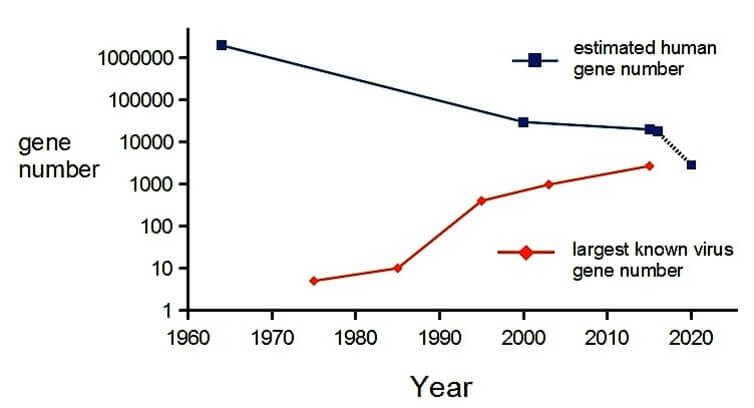
About a half-century ago the estimated number of human genes was in the millions. Today weโ€™re down to about 20,000. We now know, for example, that bananas, with their 30,000 genes, have 50 percent more genes than we do.

Itโ€™s time to rethink the question of how the complexity of an organism is reflected in its genome.

The number of genes we actually need for a healthy life is probably even lower than the current estimate of 20,000 in our entire genome…This research found over 700 genes which can be knocked out with no obvious health consequences.

Extrapolating the analysis beyond the human knockouts study leads to an estimate that only 3,000 human genes are actually needed to build a healthy human. This is in the same ballpark as the number of genes in โ€œgiant viruses.โ€image-20160901-30772-1ngr36h

So itโ€™s clear that a single cell does not need to be very complicated for large numbers of them to produce very complex outcomes. Hence, it shouldnโ€™t come as a great surprise that human gene numbers may be of the same size as those of single-celled microbes like viruses and bacteria.

What is coming as a surprise is the converse โ€“ that tiny microbes can have rich, complex lives. There is a growing field of study โ€“ dubbed โ€œsociomicrobiologyโ€ โ€“ that examines the extraordinarily complex social lives of microbes, which stand up in comparison with our own.

The GLP aggregated and excerpted this blog/article to reflect the diversity of news, opinion, and analysis. Read full, original post:ย How many genes does it take to make a person?

{{ reviewsTotal }}{{ options.labels.singularReviewCountLabel }}
{{ reviewsTotal }}{{ options.labels.pluralReviewCountLabel }}
{{ options.labels.newReviewButton }}
{{ userData.canReview.message }}

Related Articles

Infographic: Global regulatory and health research agencies on whether glyphosate causes cancer

Infographic: Global regulatory and health research agencies on whether glyphosate causes cancer

Does glyphosateโ€”the world's most heavily-used herbicideโ€”pose serious harm to humans? Is it carcinogenic? Those issues are of both legal and ...

Most Popular

ChatGPT Image May 26, 2026, 08_42_17 AM (1)
Viewpoint: Greenpeace and poison: How environmental advocacy groups rely on compliant (and often ignorant) journalists to spread disinformation and spark litigation
Screenshot 2025-07-30 at 10.48
Can gene editing eliminate Down syndrome? Scientists have done it in lab-grown cells
Screenshot-2026-05-28-at-1.36.28-PM
Viewpoint: Can mRNA research survive the Trump administration?
Screenshot-2026-06-02-at-11.59.11-AM
Magnifica Humanitas: Popeโ€™s encyclical broadside against AI naivete and overreach
Screenshot 2025-11-18 at 3.45
Viewpointโ€”GMOs and sustainability: Why buying organic foods is the least environmentally-sensitive food choiceโ€”without offering any health benefits
ChatGPT-Image-May-26-2026-07_51_21-AM-2
Viewpoint: There are more than 1,000 chemicals in a cup of coffeeโ€”including many substances that can cause cancer. Why isnโ€™t it banned?
ChatGPT-Image-Jun-2-2026-11_39_58-AM
Viewpoint: Who is RFK, Jr.โ€™s newly-appointed CDC senior counselor, Sara Brenner โ€” Vaccine skeptic and self-proclaimed โ€œMAHA momโ€
Picture1
Sounds we canโ€™t hear โ€” the hidden planetary signals behind science, fear, and misinformation
ChatGPT Image May 28, 2026, 08_16_38 PM
Viewpoint: Why the EPA mismeasures cancer risk of chemicals and what should be done to fix it
Screenshot-2026-04-14-at-11.11.06-AM
โ€˜Turbo cancerโ€™ or mRNA cancer cure? Strategies to counter misinformation
glp menu logo outlined

Get news on human & agricultural genetics and biotechnology delivered to your inbox.