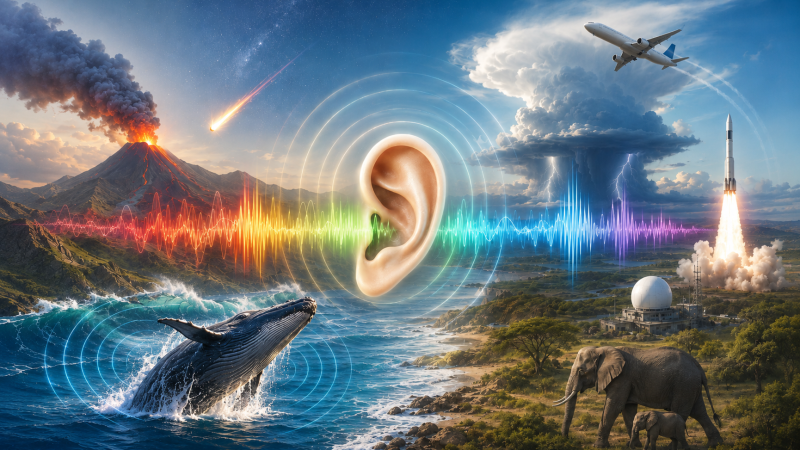
Most of us think of sound as something we can hear: music, speech, barking dogs, thunder, or the roar of traffic. But an enormous acoustic world exists beneath the threshold of human hearing. Known as “infrasound,” these ultra-low-frequency vibrations — generally below 20 hertz — travel invisibly through the atmosphere, oceans, and even the ground. Although largely imperceptible to us, they carry extraordinary information about the natural world and human activity. And, in turn, they can affect how we feel and act.
Scientists are increasingly using infrasound to monitor volcanoes, detect meteors, track storms and nuclear explosions, and possibly improve warning systems for dangerous weather events.
At the same time, artists and engineers are beginning to reveal that Earth is constantly humming with signals that humans are largely unable to perceive. A recent report from NPR Illinois described how sound artist Brian House has been using modern sensors to capture and transform infrasound into audible soundscapes. The project underscores an important scientific reality: The Earth is awash in low-frequency acoustic energy that most people never realize exists.
Humans generally hear frequencies from about 20 Hz to 20,000 Hz. Infrasound lies below that lower limit. Contrary to popular belief, however, extremely low frequencies are not always completely inaudible. Under certain conditions, humans can perceive some infrasonic frequencies as vibrations, pressure sensations, or faint tones.
What makes infrasound especially interesting is its physical behavior. Low-frequency waves possess very long wavelengths, allowing them to travel extraordinary distances while losing relatively little energy. Unlike higher-pitched sounds, infrasound can bend around obstacles, penetrate structures, and propagate across continents and oceans.
Nature generates infrasonic signals constantly. Ocean waves interacting far offshore create persistent “microbaroms” — atmospheric vibrations that can circle the globe. Earthquakes, volcanic eruptions, avalanches, tornadoes, lightning, meteors, and severe storms all produce infrasonic signatures. Human activities generate them as well, including rocket launches, aircraft, mining blasts, industrial machinery, and nuclear detonations.
Animals have exploited this acoustic channel for millions of years. Elephants use infrasonic communication to coordinate herd movements across long distances, while whales exchange low-frequency calls across vast stretches of ocean.
Listening to volcanoes, meteors, and storms
One of the most important uses of infrasound is environmental monitoring.
The U.S. Geological Survey now routinely employs infrasonic sensors to monitor volcanic activity. Explosive eruptions generate distinctive low-frequency pressure waves that can travel hundreds or even thousands of miles. Researchers can use those signals to estimate eruption intensity, identify ash-producing events, and monitor remote volcanoes in places such as Alaska, where visual observation may be impossible.
The technique is particularly valuable because infrasound often complements seismic data. Seismic waves travel through the Earth, while infrasound propagates through the atmosphere. Combining the two provides a richer understanding of eruptive behavior and debris flows.
Meteor detection represents another important application. When meteoroids enter Earth’s atmosphere, they generate shock waves detectable thousands of miles away by infrasound arrays. NASA and other researchers use these signals to estimate the energy, trajectory, and location of meteor events. The 2013 Chelyabinsk meteor over Russia produced one of the largest infrasonic events ever recorded, detected by monitoring stations around the world.
Scientists are also exploring the possibility that infrasound could improve severe-weather forecasting. Tornado formation appears to produce characteristic infrasonic signals before touchdown, raising hopes that someday detection devices could supplement radar-based warnings.
Perhaps the most consequential use of infrasound is geopolitical rather than environmental. The Comprehensive Nuclear-Test-Ban Treaty Organization operates a global infrasound network as part of its effort to detect clandestine nuclear weapons tests. The International Monitoring System includes dozens of infrasonic stations distributed worldwide, each equipped with highly sensitive microbarometers capable of detecting minute atmospheric pressure fluctuations.





Because infrasonic waves travel enormous distances, atmospheric nuclear explosions can be detected far from their source. The same technology also captures data from volcanic eruptions, meteor collisions, rocket launches, and severe storms.
Ironically, one of the best global listening systems ever created for arms control has become an invaluable scientific observatory for studying natural phenomena.
New technology opens a hidden world
Historically, studying infrasound was technically difficult. Wind noise and atmospheric turbulence can overwhelm the weak signals scientists are trying to measure. But advances in microphones, digital filtering, and signal processing have dramatically improved detection capabilities. Researchers at NASA have developed highly sensitive infrasonic microphones capable of detecting turbulence hundreds of miles away. Other investigators are using machine learning and sophisticated wave-analysis techniques to separate meaningful signals from atmospheric background noise.
These improvements are revealing that Earth possesses a remarkably dynamic low-frequency acoustic environment. The atmosphere itself acts as a gigantic resonant chamber, continuously transmitting signals generated by oceans, storms, geological activity, and human civilization.
That realization has also inspired artists such as Brian House, an Assistant Professor of Art at Amherst College, whose work attempts to translate inaudible planetary vibrations into forms accessible to human listeners. This is how he described his methods:
I constructed infrasonic “macrophones.” If a microphone amplifies small sounds, a macrophone brings large sounds with long wavelengths into our perceptual range. Each consists of a wind-noise reduction array leading to a microbarometer and a data recorder. I based the design on what the Comprehensive Nuclear Test Ban Treaty Organization uses to detect distant warhead tests.
Infrasound has occasionally become controversial because of claims that low-frequency sound from industrial equipment or wind turbines causes illness.
Some individuals living near wind turbines report headaches, dizziness, sleep disruption, anxiety, or sensations of pressure. However, the scientific evidence remains mixed. Major reviews generally conclude that while annoyance and stress are real — the levels of the stress hormone cortisol are increased by infrasound — there is limited evidence that environmental infrasound at ordinary exposure levels directly causes severe physiological harm.
The issue is complicated because human sensitivity to low-frequency sound varies substantially among individuals. Moreover, expectations, visual cues, and stress responses can amplify symptom perception. The debate illustrates how difficult it can be to disentangle biological effects from psychological and environmental factors — and how easily uncertainty can be turned into misinformation.
The emerging science of infrasound reminds us that human perception captures only a small fraction of reality. Beneath everyday hearing lies a planetary symphony generated by oceans, storms, tectonic activity, meteors, volcanoes, animals, machines, and even geopolitical events such as warfare.
As they learn to “listen” to these hidden frequencies, scientists are gaining new tools for environmental monitoring, disaster detection, aviation safety, atmospheric science, and nuclear verification. At the same time, artists and educators are helping the public to appreciate that Earth is not silent below the threshold of hearing. It is constantly resonating with signals that have always been there — waiting for us to develop the means to perceive and exploit them.
Henry I. Miller, a physician and molecular biologist, is the Glenn Swogger Distinguished Scholar at the Science Literacy Project. He was the founding director of the FDA’s Office of Biotechnology. Find Henry on his website: henrymillermd.org