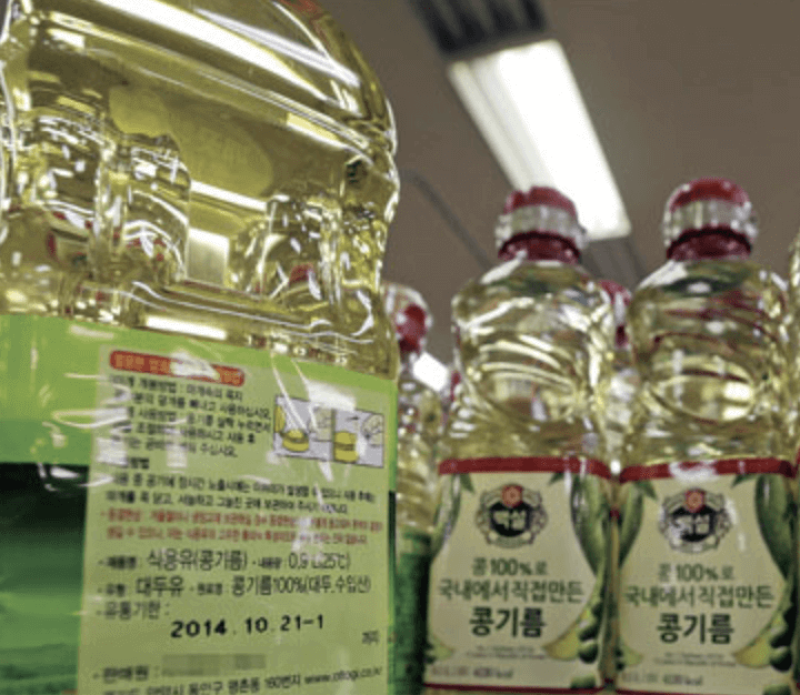
Korean labeling law exempts food grown from GMO seeds with no GMO traces in final product

Screen Shot at AM

The government’s new rules on genetically modified organism (GMO) labeling on products which will go into effect [February 4] is raising concerns about consumer rights.

First, the new regulation will require all food companies using processed GMO crops to mention that on the product labels. But it will allow an exception which will cover pretty much all cooking oil, soy sauce and corn syrup makers.

The ministry’s logic is this: Unless the final product shows traces of GMOs, GMO labeling is unnecessary.

Consumers and activists have demanded the government change this clause, but big food companies have also long pressured the government to keep it.

According to the ministry, food companies can now label products with crops that are grown naturally as “non-GMO.” But it will not apply to all crops, only six crops which have GMO versions — corn, soybeans, sugar beets, rapeseed, alfalfa and cotton. Rice, for example, is not applicable to this rule because the Korean market has no GMO rice.

Talks on GMOs began in Korea in 1999 when authorities found GMO soybeans were made into tofu and widely sold.

The GLP aggregated and excerpted this blog/article to reflect the diversity of news, opinion, and analysis. Read full, original post: New rules on GMO about to trigger debate

{{ reviewsTotal }}{{ options.labels.singularReviewCountLabel }}
{{ reviewsTotal }}{{ options.labels.pluralReviewCountLabel }}
{{ options.labels.newReviewButton }}
{{ userData.canReview.message }}

Related Articles

Infographic: Global regulatory and health research agencies on whether glyphosate causes cancer

Infographic: Global regulatory and health research agencies on whether glyphosate causes cancer

Does glyphosate—the world's most heavily-used herbicide—pose serious harm to humans? Is it carcinogenic? Those issues are of both legal and ...

Most Popular

Screenshot-2026-04-22-at-12.21.32-PM
Viewpoint: Why the retracted Monsanto glyphosate study doesn’t change the science—the world’s most popular herbicide is safe 
ChatGPT-Image-May-1-2026-11_42_59-AM-2
Viewpoint: NAD is the wellness grifters latest evidence-lite longevity fad. At least the mice are impressed.
Picture1
The FDA couldn’t find a vaccine safety crisis, so it buried its own research
ChatGPT-Image-Apr-16-2026-02_56_53-PM
Financial incentives, over diagnosis, and weak oversight: Autism claims are driving up Medicare costs
Screenshot-2026-04-12-135256
Bixonimania: The fake disease scam that AI swallowed whole

Sorry. No data so far.

glp menu logo outlined

Get news on human & agricultural genetics and biotechnology delivered to your inbox.