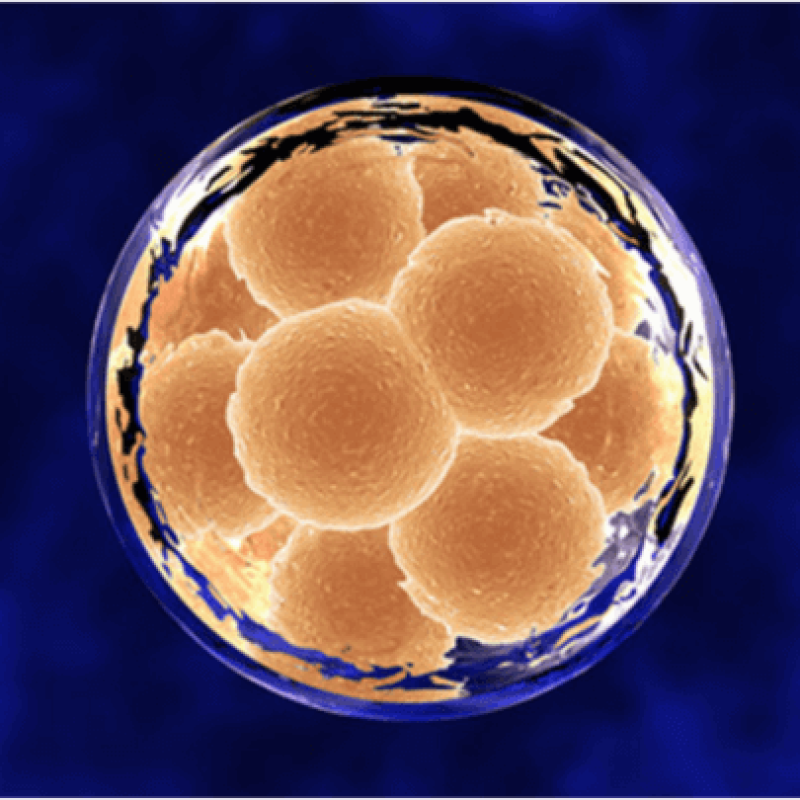
Is it time to abandon the 14-day rule limiting human embryo research?

embryo
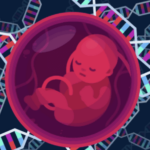
[A] group of Harvard University scientists has published a paper arguing that it is time to reconsider the 14-day rule [on human embryo research] because of advances in synthetic biology.

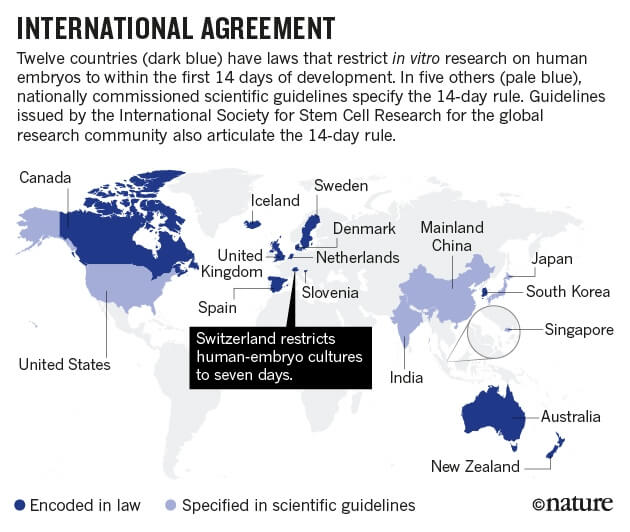
[NOTE: The ’14-day rule’ is a legal and regulatory line in the sand that has for decades limited in vitro human-embryo research to the period before the ‘primitive streak’ appears. This is a faint band of cells marking the beginning of an embryo’s head-to-tail axis.]WEBnature graphic stem cell

The U.S. has no law against growing embryos beyond two weeks…But most scientific journals will not publish studies that violate the 14-day rule, and the International Society for Stem Cell Research requires its members to agree to the rule in order to qualify for membership.

Now is the time to begin a public discussion on experiments such as these, argues [Harvard Medical School geneticist George Church], before it is scientifically viable and poses an ethical challenge to the 14-day rule.

Not surprisingly, these ideas have triggered some opposition among bioethicists. “In cases of doubt, where one has a suspicion but not certainty that one might be engendering an embryonic human, such experiments should not be continued,” [stated Rev. Tadeusz Pacholczyk, a neuroscientist and director of education at the National Catholic Bioethics Center in Philadelphia].

[The study can be found here.]

The GLP aggregated and excerpted this blog/article to reflect the diversity of news, opinion, and analysis. Read full, original post: Ethical Guidelines on Lab-Grown Embryos Beg for Revamping, Scientists Say

For more background on the Genetic Literacy Project, read GLP on Wikipedia.

{{ reviewsTotal }}{{ options.labels.singularReviewCountLabel }}
{{ reviewsTotal }}{{ options.labels.pluralReviewCountLabel }}
{{ options.labels.newReviewButton }}
{{ userData.canReview.message }}

Related Articles

Infographic: Global regulatory and health research agencies on whether glyphosate causes cancer

Infographic: Global regulatory and health research agencies on whether glyphosate causes cancer

Does glyphosate—the world's most heavily-used herbicide—pose serious harm to humans? Is it carcinogenic? Those issues are of both legal and ...

Most Popular

Screenshot-2026-05-01-at-1.29.41-PM
Viewpoint: What happens when whole grains meet modern food manufacturing? Labels don’t tell the whole story.
S
As vaccine rejectionism spreads, measles may be taking a more dangerous turn
Screenshot 2026-05-06 at 2.56
Singularity crisis ahead? Can super babies save us from rogue AI geniuses?
Screenshot-2026-05-06-at-2.07.43-PM
Manufacturing a conspiracy: The timeline of how  the White House embraced the fringe claim that scientists are being mysteriously murdered
Screenshot-2026-04-20-at-2.26.27-PM
Viewpoint — Food-fear world: The latest activist scientists campaign: Cancer-causing additives
Screenshot-2026-04-30-at-2.19.37-PM
5 myths about summer dehydration that could damage your health — or even kill you
Screenshot-2026-03-13-at-12.14.04-PM
The FDA wants to make many popular prescription drugs OTC—a great idea. Here’s why it’s unlikely to happen
ChatGPT-Image-May-6-2026-03_41_05-PM
‘Protecting the integrity of science’: Kennedy’s FDA blocks release of taxpayer-funded studies finding COVID and shingles vaccines safe
Screenshot 2026-05-06 at 12.49
Immortal dragons: The quest to ‘make death optional’
Screenshot-2026-05-01-at-11.56.24-AM
‘Science moves forward when people are willing to think differently’: Memories of DNA maverick Craig Venter
glp menu logo outlined

Get news on human & agricultural genetics and biotechnology delivered to your inbox.