Brewing resistance: Studying coffee’s genetic lineage provides clues on how to create varieties to survive climate change

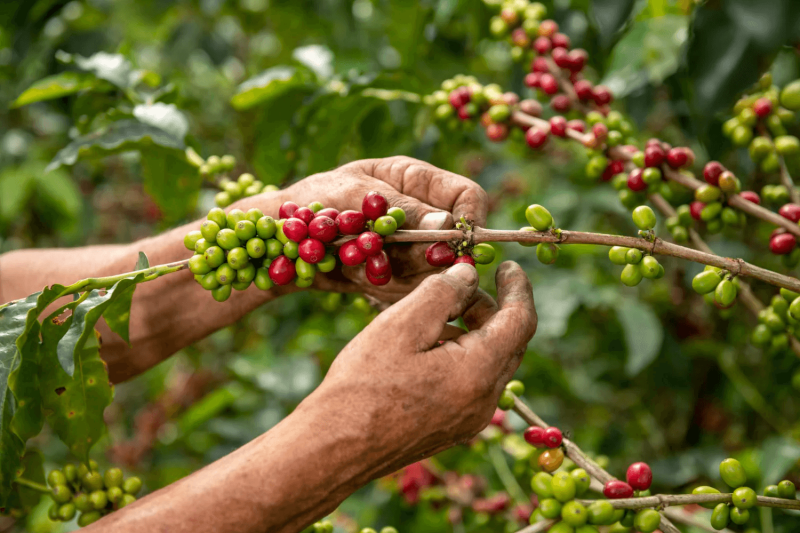
close up arabica coffee farmer s hands picking beans plant his farm colombia
Credit: Leo Coffee

A research paper released [April 15] in Nature Genetics mapped the genome and considered the possible origins of the world’s most widely consumed species of coffee: Coffea arabica.

The team of scientists who carried out the coffee genome study, led by researchers from the State University of New York at Buffalo, claimed their research could aid in the production of coffee plants more resistant to climate change and other environmental stresses.

Because arabica “harbors a particularly low genetic diversity,” the researchers said, it’s highly susceptible to pests, diseases and changes in climate. There is evidence in nature, however, of arabica hybrids being more resilient than their single-strain ancestors.

A natural hybrid of arabica and canephora coffee plants found on the southeast Asian island of Timor in the 1920s proved resistant to a fungal disease known as coffee leaf rust, and since then the hybrid has been introduced to other widely grown arabica cultivars.

Follow the latest news and policy debates on sustainable agriculture, biomedicine, and other ‘disruptive’ innovations. Subscribe to our newsletter.

Eventually scientists could modify the plant’s genome directly using CRISPR gene editing technology, said Victor Albert, an evolutionary biology professor at the University at Buffalo.

Besides making arabica plants more disease-resistant, Albert suggested that genetically modified coffee plants could be made more resistant to drought and changes in soil salinity. With sufficient changes, the plants could even be engineered to grow in temperate regions.


This is an excerpt. Read the original post here

{{ reviewsTotal }}{{ options.labels.singularReviewCountLabel }}
{{ reviewsTotal }}{{ options.labels.pluralReviewCountLabel }}
{{ options.labels.newReviewButton }}
{{ userData.canReview.message }}

Related Articles

Infographic: Global regulatory and health research agencies on whether glyphosate causes cancer

Infographic: Global regulatory and health research agencies on whether glyphosate causes cancer

Does glyphosate—the world's most heavily-used herbicide—pose serious harm to humans? Is it carcinogenic? Those issues are of both legal and ...

Most Popular

ChatGPT-Image-Jun-17-2026-10_52_43-AM
Anguished parents, doctors in tears: Utah’s long measles outbreak takes a toll
Screenshot-2026-06-15-at-1.55.27-PM
America's trust in Trump-Kennedy's CDC health recommendations is plunging
ChatGPT-Image-Jun-24-2026-11_36_47-AM
Why the human genome is less a script than a puzzle
ChatGPT-Image-Jun-23-2026-03_12_23-PM
Is cellular reprogramming junk science? Nearly 20 patients are getting eye injections in the first FDA-cleared cellular trial
Screenshot-2026-06-22-at-9.04.46-PM
Kennedy's nutrition prescription for medical schools: Real problem, bad cure
Screenshot 2026-06-25 at 10.55
Leading OB-GYN group challenges RFK, Jr. gutting of maternal vaccine schedule
ChatGPT-Image-Mar-10-2026-01_39_01-PM
Viewpoint—“Miracle molecule” debunked: Why acemannan supplements don’t work
Screenshot-2026-06-25-at-1.48.40-PM
Glyphosate affirmed as safe: Supreme Court rejects lawsuit claiming Roundup herbicide causes cancer, upholding EPA determination
Screenshot-2026-06-24-at-2.57.41-PM
Viewpoint: Trump’s Reflecting Pool algae fiasco points to a bigger culprit: Climate change
ChatGPT-Image-Jun-25-2026-12_23_17-PM
No, Bill Gates did not secretly engineer ticks to promote veganism
Screenshot-2026-06-24-at-2.40.46-PM
Hegseth reversal: As Air Force flu outbreak continues to surge, military reinstitutes mandatory vaccines for recruits
ChatGPT-Image-Jun-22-2026-01_30_11-PM
Facts & Fallacies podcast: Psychedelics for PTSD? Examining RFK, Jr's claims about ibogaine
glp menu logo outlined

Get news on human & agricultural genetics and biotechnology delivered to your inbox.