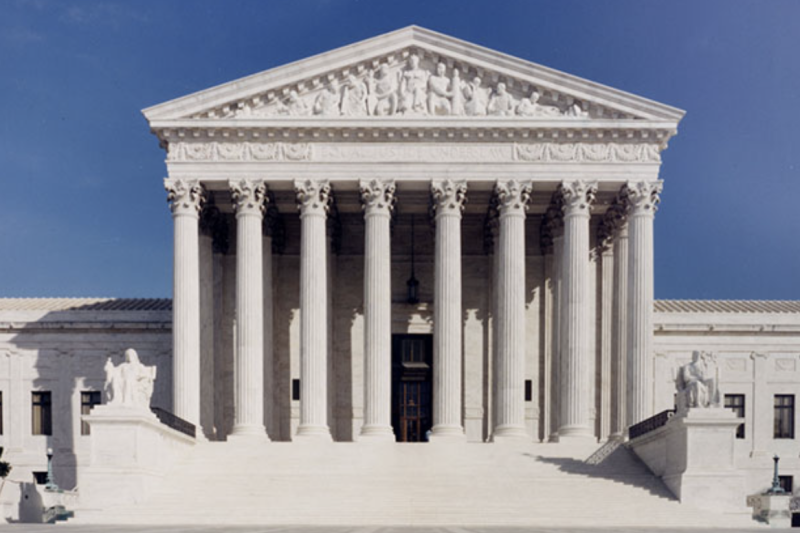

The Supreme Court on Thursday sided with Monsanto in a high-stakes dispute over cancer warnings on pesticide labels. In an opinion by Justice Brett Kavanaugh in Monsanto Company v. Durnell, the court ruled, by a vote of 7-2, that state lawsuits aimed at holding the company liable for failing to warn consumers about the potential risks of Roundup exposure are barred by the federal law governing pesticide sales.
Justice Ketanji Brown Jackson wrote a dissenting opinion, joined by Justice Neil Gorsuch. In it, she contended that Thursday’s ruling is based on “a labeling requirement that does not exist,” and described the effects of the majority’s interpretation of the law as “both remarkable and regrettable.”
The court’s ruling comes after decades of debate and litigation over the safety of glyphosate, a highly effective and popular herbicide that serves as the main active ingredient in Monsanto’s Roundup weedkiller. Since 1974, when the Environmental Protection Agency first reviewed and registered glyphosate-based pesticides, clearing the way for their sale in the United States, the EPA has repeatedly concluded that such products do not need to carry a cancer warning. However, the EPA’s determinations have not dispelled concerns about Roundup’s cancer risks. These concerns increased in 2015, when a working group of the International Agency for Research on Cancer, part of the World Health Organization, classified glyphosate as “probably carcinogenic to humans.”
The IARC’s report led to tens of thousands of lawsuits against Monsanto over how Roundup products were labeled. Plaintiffs such as John Durnell, who brought the case that was before the court, contended that the company was liable for failing to warn them about the alleged link between glyphosate and cancer, while Monsanto countered that the EPA, which oversees pesticide labeling, had not required a cancer warning.
Over the past decade, Monsanto has paid billions in damages and settlement agreements in these lawsuits even as it has continued to assert that state-level claims over Roundup labels are preempted by the Federal Insecticide, Fungicide, and Rodenticide Act, which authorizes the EPA to regulate the use, sale, and labeling of pesticides and which includes a uniformity requirement prohibiting states from imposing “any requirements for labeling or packaging in addition to or different from those required” by the federal government.
When it asked the Supreme Court to clarify the scope of FIFRA, Monsanto emphasized that thousands of lawsuits over Roundup’s label remain pending and claimed that the future of U.S. agriculture was at stake in the case. In January, the justices agreed to weigh in.
On Thursday, the court held that FIFRA expressly preempts a state-law failure-to-warn claim against Monsanto, because such a claim would require the company “to add a cancer warning to Roundup’s label” that is not part of the EPA-approved label. That outcome, Kavanaugh wrote, runs afoul of FIFRA’s uniformity requirement.




Kavanaugh also noted that the EPA has repeatedly assessed the safety of glyphosate-based pesticides and “repeatedly concluded that glyphosate is not likely to cause cancer.” “Therefore, as a matter of federal law,” Kavanaugh wrote, “Monsanto legally must use a label without a cancer warning unless and until EPA approves or requires a change.”
In her 24-page dissent, Jackson wrote that the court should have joined the “chorus” of “state and federal courts that have rejected this preemption argument,” asserting that FIFRA gives the EPA the authority to review product labels when assessing pesticides, but not the authority to have the final say on cancer warnings. “In accepting Monsanto’s argument and holding that Durnell’s failure-to-warn claim is preempted, the Court misunderstands FIFRA’s requirements, misinterprets the scope of FIFRA’s preemption, and ultimately leaves Durnell without a remedy for the significant harms he has suffered,” she wrote.
Kelsey Dallas is SCOTUSblog’s managing editor. Find Kelsey on X @kelsey_dallas
A version of this article was originally posted at SCOTUSblog and is reposted here. Any reposting should credit both the GLP and original article. Find SCOTUSblog on X @SCOTUSblog
.