




Promoted as high-tech nutrient delivery, over-the-counter vitamin patches are rapidly gaining popularity among consumers looking to bypass daily capsules. However, these products straddle a major regulatory loophole. When coupled with the impenetrable nature of the skin barrier, the science reveals these patches deliver far more marketing hype than active vitamins.
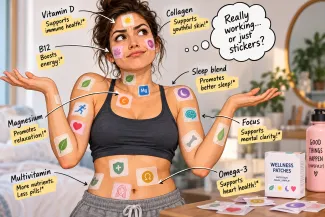
Capsules are the most common form of supplementation, but patches are growing in popularity. Wellness patches, or as I like to call them, stickers, claim to infuse your body with a specific vitamin, mineral, or combination. But these patches don’t need to prove anything to anyone before hitting the market, and they’re betting you don’t know that.
To address the elephant in the room, wellness patches that claim to provide vitamins, minerals, etc. are technically not supplements, at least not according to the Food and Drug Administration (FDA). According to Cara Welch, the Director of the FDA’s Office of Dietary Supplement Programs, supplements are defined as:
“Dietary supplements are vitamins, minerals, botanicals, probiotics, and similar products … sold in a variety of forms, including pills, tablets, but also liquids, gummies, and powders. Importantly, they have to be ingested, or swallowed, so a topical or inhaled product is not a dietary supplement [my emphasis].”
Patches are topical. Since they’re not technically supplements under the FDA, patches fall into one of two other categories: drugs that need approval or nothing at all. Which category a patch falls into depends upon the claims being made. If a company selling a patch claims it can cure, treat, prevent, or mitigate a specific disease or condition, then the patch needs FDA approval, typically through the new drug application process. If, however, a patch makes broad generalizations to “promote” your health, then it is neither a drug nor a supplement; in the eyes of the FDA, it is, as I stated earlier, a sticker.
Despite the legal niceties, many consumers think of them as supplements. As a result, people may forgo typical capsules for a vitamin patch. So, how do these patches claim to work?
Do Patches Work?
Your skin is the first line of defense against pathogens and other external agents, and it works pretty well. As a result, most drugs are administered in ways that bypass the skin: orally or intravenously. An FDA-approved “transdermal” drug patch is engineered and demonstrated to move a predictable amount of active drug across the skin and into the systemic circulation. Arguably the most famous of these patches is nicotine. Wellness companies are banking on your belief that all patches are the same. “If a patch can help someone quit smoking, why wouldn’t it be able to deliver supplements?”
Size matters. Nicotine, for example, is a small molecule, and when administered through a patch, it is paired with enhancers to help it travel from the skin to the bloodstream. Vitamins, minerals, etc., basically all molecules that you would take in capsule form as a supplement, are often the wrong size molecule, too big to pass through the skin barrier. Biological delivery isn’t plug-and-play. Slapping a multi-vitamin onto an adhesive backing doesn’t change the laws of biochemistry. Without specialized delivery tech, those vitamins remain trapped on the outside of your skin.
And then, of course, there is the persistent question with any supplement, which is: do you actually need it or not? If you aren’t deficient, you won’t benefit from supplementation. The common thought attached to supplementation is “This is good for me and how I take it doesn’t matter as long as it gets into my body!” but given the aforementioned pitfalls, this thought falls apart at every junction.





Are Patches Regulated?
Thanks to the Dietary Supplement Health and Education Act, supplements enjoy their own carve-out in how they are regulated. They aren’t regulated like drugs, and the FDA takes a very light touch with them. Patches, since they aren’t technically supplements, are regulated even less. Whether they are regulated at all really depends on the claims being made about them. For example, in 2021, XanFree received a letter from the FDA stating that, because of claims they made about treating specific diseases with the patches they were selling, the product required a new drug application form, or they had to remove/amend those claims from their website and marketing materials:
“Various claims… establish that these products are drugs… because they are intended for the treatment, cure, mitigation, or prevention of disease. Your website recommends or suggests [these products] to treat or prevent depression… cancer, asthma, and/or Alzheimer’s… Before a new drug may be marketed… it must be approved by FDA.”
Since patches fall into an even grayer area than traditional dietary supplements, the onus is even more on the consumer to investigate the claims being made, the company, and the potential pitfalls of investing in a patch. For me, that’s an awful lot of work for something that either won’t work the way the marketing suggests or will give me a rash.
Transdermal nutrient research does exist (e.g., specialized microneedle patches or liposomal carrier tech being studied for B12), but over-the-counter wellness stickers do not use this multi-million-dollar technology, and this is the whole point. If patches actually work to address a condition or disease, they’ve gone through the drug approval process. That process isn’t perfect, but it’s substantially better and backed by real science, unlike broad wellness claims based on squishy verbs like “supports” and “promotes.”
If you’re buying a patch over the counter and it’s a vitamin patch or something similar, odds are extremely high that you’re buying an expensive sticker. For the record, I’m not anti-sticker. I actually love stickers! My water bottles prove this point, but I’m not dropping my hard-earned cash on stickers, telling myself they’re going to help me feel physically better in any way. After all, they’re just decoration.
Katie Suleta is a regional director of research in graduate medical education. Her background is in public health, health informatics, and infectious diseases. Follow Katie on Instagram @dr.katiesuleta
A version of this article was originally posted at American Council on Science and Health and has been reposted here. Any reposting should credit the original author and provide links to both the GLP and the original article. Find American Council on Science and Health on X @ACSHorg





























