Plants engineered with algae genes could increase crop yields

sp

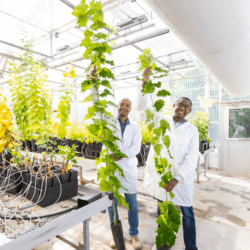
To meet the food demands of a rising global population, innovative strategies are required to increase crop yields. Improvements in plant photosynthesis by genetic engineering show considerable potential towards this goal. One prospective approach is to introduce a CO2 concentrating mechanism into crop plants to increase carbon fixation by supplying the central carbon-fixing enzyme, Rubisco, with a higher concentration of its substrate, CO2. A promising donor organism for the molecular machinery of this mechanism is the eukaryotic alga Chlamydomonas reinhardtii.

…

The Chlamydomonas CCM [CO2 concentrating mechanism] elevates CO2 around Rubisco, thereby enhancing photosynthesis…It is anticipated that the pace of advancement will accelerate with both the availability of the Chlamydomonas mutant library and the maturation of large-scale systems biology approaches. Modeling studies are urgently needed to guide the stepwise transfer of components from Chlamydomonas to higher plants. In addition, approaches adapted from synthetic biology and pathway-engineering fields could facilitate the assembly of a CCM in a fast growing, ‘stepping stone’ organism, which could aid our understanding of the minimal components needed for a functional CCM. Engineering a Chlamydomonas or hybrid CCM into a C3 [crop] plant is a grand challenge and with the correct resources could become a reality.
The GLP aggregated and excerpted this article to reflect the diversity of news, opinion and analysis. Read full, original post: The Chlamydomonas CO2-concentrating mechanism and its potential for engineering photosynthesis in plants


Related Articles

Infographic: Global regulatory and health research agencies on whether glyphosate causes cancer

Infographic: Global regulatory and health research agencies on whether glyphosate causes cancer

Does glyphosate—the world's most heavily-used herbicide—pose serious harm to humans? Is it carcinogenic? Those issues are of both legal and ...

Most Popular

Diet Soda with Measuring Tape 2
Science challenges anti-soda activists: No, sodas won’t make you fat
ChatGPT-Image-Mar-10-2026-01_39_01-PM
Viewpoint—“Miracle molecule” debunked: Why acemannan supplements don’t work
Strawberry Clamshell with Warning Sticker
Viewpoint: Activists hype ‘dangerous level’ of pesticide residues in Driscoll berries: Separating health concerns from fear-mongering
Silhouettes Beneath the Mosquito Nets
Guinea-Bissau halts widely condemned RFK Jr.-backed vaccine trial that would have withheld life-saving vaccines from thousands of newborns
Author-Presenting-Good-Energy
'Disillusioned': Controversial RFK Jr. ally and MAHA leader Calley Means quits Trump advisory role
Rustic Skillet of Raw Brains
‘Weird food’? Testicle- and brain-eating, supplement-gulping MAHA health food enthusiasts defend their ‘natural’ diets
Vibrant Social Media Confetti Explosion
Health misinformation minefield: Countering online deluge by copying its style
Generations United for Immunization
Police raid Guinea-Bissau offices of RFK Jr.-backed vaccine researchers, seize hepatitis B doses
Justice Under Prideful Skies
Supreme Court blocks Trump’s order halting transgender surgeries and hormone treatments for inmates
Screenshot-2026-10-21-at-10.38.39-AM
Viewpoint: The libertarian case for getting the government out of the business of regulating food choices
Screenshot-2026-10-19-at-12.04.51-PM
Victims of their own success: As memories of killer diseases fade, vaccine rejectionism soars
Prescription Capsules Scattered on Twenty-Dollar Bills
Facts & Fallacies podcast: America's health care system is broken. A doctor explains how to fix it, Part 2
Screenshot 2026-10-16 at 5.38
PFAS in Agriculture: Science, Uncertainty, and Risk Communication
glp menu logo outlined

Get news on human & agricultural genetics and biotechnology delivered to your inbox.