Korean agricultural research agency stops GM crop commercialization after anti-GMO protests

gmo 중단 연합
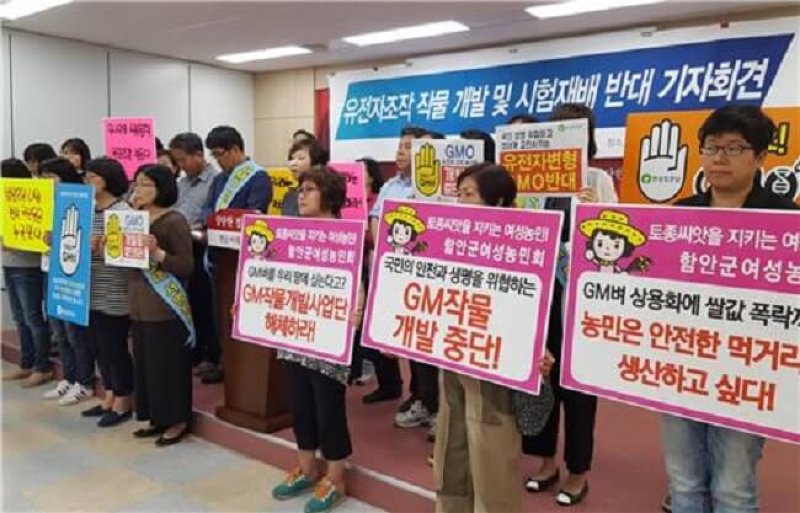
Representatives from regional civic groups are shown protesting GMOs near RDA headquarters

The Rural Development Agency (RDA) released a statement on September 1 declaring its decision to halt its efforts to foster a market for genetically modified crops (GMC).

The Agency came to the decision after carrying out a months-long exchange with regional civic groups that had opposed the RDA’s plans to eventually commercialize the GMC industry.

As part of its agreement with the groups, the Agency will also dissolve the National Center for GM Crops, an enterprise with an estimated 7 to 8 billion won in RDA investments.

Led by the anti-GMO collective GMO Free Jeonbuk, the civic groups record of opposition to the RDA’s aims began in 2015.

The groups have held press conferences and gatherings in front of the RDA offices as a show of protest.

Their remonstrations intensified in April, when they set up a tent under which a full-fledged sit-in protest eventually provided enough pressure that the RDA started to engage with the dissenters and listen to their demands.

A spokesperson for the RDA said regarding the agreement with the civic groups that it would continue to work closely with the local residents to foster a collaborative partnership.

The GLP aggregated and excerpted this article to reflect the diversity of news, opinion and analysis. Read full, original post: Rural Development Agency to Halt Commercialization of Genetically Modified Crops


{{ reviewsTotal }}{{ options.labels.singularReviewCountLabel }}
{{ reviewsTotal }}{{ options.labels.pluralReviewCountLabel }}
{{ options.labels.newReviewButton }}
{{ userData.canReview.message }}

Related Articles

Infographic: Global regulatory and health research agencies on whether glyphosate causes cancer

Infographic: Global regulatory and health research agencies on whether glyphosate causes cancer

Does glyphosate—the world's most heavily-used herbicide—pose serious harm to humans? Is it carcinogenic? Those issues are of both legal and ...

Most Popular

Screenshot 2026-05-26 at 10.15
Viewpoint: Double standard—Why does the wellness industry get a free pass while Big Healthcare is treated as morally suspect?
ChatGPT-Image-Jun-4-2026-01_27_58-PM
Viewpoint—N.A.D.+: Why Gwenyth Paltrow’s heralded anti-aging supplement doesn’t work
Screenshot 2025-07-30 at 10.48
Can gene editing eliminate Down syndrome? Scientists have done it in lab-grown cells
ChatGPT-Image-Mar-10-2026-01_39_01-PM
Viewpoint—“Miracle molecule” debunked: Why acemannan supplements don’t work
tick-DNA
GLP podcast: Spread meat allergy with gene-edited ticks? Bioethicists pose vile ‘thought experiment’
Screenshot-2026-06-03-at-1.24.46-PM
Challenging anti-GMO disinformation: Why genetically-tweaked crops offer bushels of benefits
ChatGPT-Image-Jun-4-2026-11_49_36-AM-2
‘You don’t understand Tolkien’: Skeptic Pope trolls tech giants about the exaggerated, risk-less benefits of AI
downsyndrome_compilation_MID_1
CRISPR breakthrough that can remove the chromosome responsible for Down syndrome raises ethical questions
Screenshot-2026-06-04-at-12.05.08-PM
Cases of brain inflammation surge as U.S. measles pandemic approaches 2000
ChatGPT-Image-May-26-2026-07_51_21-AM-2
Viewpoint: There are more than 1,000 chemicals in a cup of coffee—including many substances that can cause cancer. Why isn’t it banned?
ChatGPT Image May 26, 2026, 08_42_17 AM (1)
Viewpoint: Greenpeace and poison: How environmental advocacy groups rely on compliant (and often ignorant) journalists to spread disinformation and spark litigation

Sorry. No data so far.

glp menu logo outlined

Get news on human & agricultural genetics and biotechnology delivered to your inbox.